
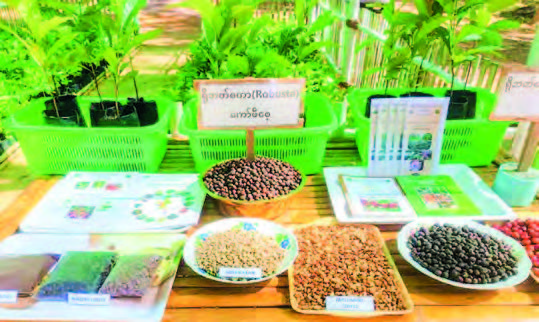
AFTER petroleum, which is the most widely traded commodity in the world, coffee beans rank second in global trade volume. Myanmar also cultivates coffee. According to the Yangon Region Department of Agriculture, more than 20,000 acres of Robusta coffee will be grown as an intercropping crop among perennial trees in Yangon, the country’s commercial capital, under a five-year project starting from the 2026–2027 period.
“Robusta coffee, which is a lowland variety, has been experimentally cultivated since last year as an intercropping crop among home gardens and perennial fruit and industrial crops such as mango, durian, pomelo and rubber, under the planning and implementation of the Yangon Region government. Farmers were provided with training and seedlings so that coffee could also be grown in forest plantation areas, enabling cultivation to begin in those locations.
In Yangon Region, out of more than 40,000 acres of perennial crops, over 20,000 acres have been designated for intercropped coffee under a five-year plan. As part of the 2026-2027 rainy season, coffee will initially be planted on 17 acres, and seedlings are already being raised. This is also a perennial crop that will bring tangible benefits to farmers,” said Daw Hla Kyi, Assistant Director of the Yangon Region Department of Agriculture.
In Yangon Region, more than 20,000 acres of Robusta coffee, a lowland crop, are being designated for cultivation under a five-year project from 2026-2027 to 2030-2031. Through this initiative, areas that have traditionally produced summer paddy, monsoon paddy, oil crops and various pulses each year are being transformed into coffee-producing zones, contributing to the development of Yangon as an economically important urban centre with a balanced integration of industry and agriculture.
Coffee culture is widely appreciated in Myanmar and around the world, and demand for coffee beans continues to grow annually. In Myanmar, coffee is cultivated as Arabica in upland areas and Robusta in lowland areas. Coffee beans produced in PyinOoLwin, Ywangan, Pinlaung, Hopong and Nawnghkio are particularly well known for their high quality. Although flavour and aroma vary according to soil, climate and seasonal conditions, Myanmar coffee has already gained recognition in the global coffee market. The State is therefore encouraging the expansion of coffee cultivation as a value-added crop.
In Myanmar, internationally traded Robusta and Arabica varieties are mainly grown. Of the more than 30,000 acres currently under coffee cultivation nationwide, over 10,000 acres are located in Pyin Oo Lwin, where production is well established and widely recognized in the market. As part of efforts to expand cultivation, lowland coffee varieties are now being grown in Yangon Region, Ayeyawady Region and Bago Region.
Coffee, which is consumed regardless of ethnicity or religion, is believed to have originated in Ethiopia around the ninth century and became widely known as “Arabian wine” in the sixteenth century. Today, coffee is consumed across the world, resulting in a strong demand for coffee beans. In Myanmar, more than 200,000 acres have been developed for coffee cultivation, producing over 9,000 tonnes of coffee beans annually. Production is concentrated mainly in Shan State and Mandalay Region, with smaller-scale cultivation in several other regions and states. In Yangon Region, following the success of pilot cultivation, a five-year project is now being implemented to expand coffee production as a commercial crop. — Nyein Thu (MNA)/MKKS