
June 06, 2020
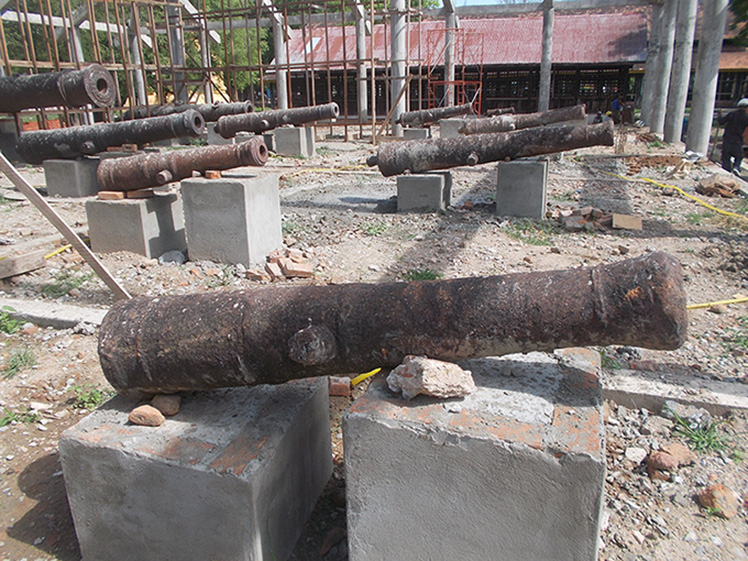
Standing in front of the Mya Nan San Kyaw Golden Palace, an invaluable historic heritage of ancient Myanmar, antique cannons of Yadanabon era have reflected the advanced idea of Myanmar people and the innovative armed power of the country.
Those iron cannons were bought from the ‘Woolwich’ (Royal Arsenal) armament factory in England to boost the defensive strength of the country.
Originally these cannons could move only forwards and backwards, but Myanmar people upgraded them to be able to swivel around 360 degree on a carriage.
When it is needed to fire, gunpowder and a cannon iron ball were pressed into the cannon and lit the fuse to be fired.
Now, a museum is under construction in front of the Mya Nan San Kyaw Golden Palace to display these iron cannons together with other ancient weapons. An archaeologist in Mandalay has collected some samples of iron cannon balls used in these big guns.
These historical evidences have shown that ancient Myanmar people in Yadanabon era tried to develop the country into an industrial nation, like the western countries. In this attempt, scholars were sent to western countries to establish a weapon industry and to turn the country into a modern armed power.
Myanmar successfully invented naval mines in those days.
On 16 May, 1865 in Yandanabon era, the King Mindon visited Kyauktawgyi pagoda at the foot of Mandalay hill in a royal process. During the visit, he put an artillery troop in front line, followed by six frontier troops or battalions, royal protection guards and auxiliary forces, according to an ancient Parabaik, a folding and illustrated
manuscript. Parabaik is a collection of coated thick papers used for writing and drawing in the past. These paper sheets are made from bamboo and palm leaves. Parabaiks were mainly used for writing message and information at that time.
Department of Indian Stone Inscription released the copies of parabaik in printed version, with the depicts of an artist explaining how the King visited the Kyauktawgyi pagoda in a royal process. Ancient kings used to go outside the palace to enjoy water-throwing festival, to observe the new royal building and to do meritorious deeds. During these visits, the king was protected by 12 guard forces—six in front line and six in back line. Forts of Yadanabon ear were well protected by huge cannons. Some of those can still be found at the northeastern side of Myanansankyaw Palace in Mandalay.—Nway Nady ( Myitnge) (Translated by GNLM)