
By U Win Sein
In the Triassic Period, 230 million years ago, continents formed Pangaea. Over the dinosaur era’s 165 million years, Pangaea broke apart via plate tectonics, resulting in today’s continent arrangement.
Dinosaurs are a group of reptiles that have lived on Earth for about 245 million years. In 1842 Richard Owen coined the term — Dinosauria, derived from the Greek — deinos, meaning “fearfully great” and saurian meaning “ lizard”. Dinosaur fossils have been found on all seven continents.
All non-avian dinosaurs went extinct about 66 million years ago. There were roughly 700 known species of extinct dinosaurs. Modern birds are a kind of dinosaurs. Because they share a common ancestor with the non-avian dinosaurs.
The extinct animals left behind those clues to what dinosaurs were like are found in fossils — the ancient remains of an organism such as teeth, bones, or shells or evidence of animal activity such as footprints and trackways.
For centuries people throughout the world have discovered amazing fossilized bones and footprint tales, and people imagined that those bones belonged to giants or huge monsters.
Some consider Varum Brown, who began his career at the American Museum of National History in 1897 to be one of the greatest dinosaur hunters of the late 19th and early 20th centuries. He began his career at the American Museum of National History in 1897. Many of his greatest discoveries including the first specimens of Tyrannosaurus Rex ever found are on display in the Museum’s dinosaurs hall.
At the beginning of the age of dinosaurs (during the Triassic Period, about 230 million years), the continents were arranged together as a single supercontinent called Panacea. During the 165 million years of dinosaur existence, this supercontinent slowly broke apart, its pieces then spread across the globe into a nearly modern arrangement by a process called plate tectonics.
Tectonics is a branch of Geology concerned with the structure of the crust of the planet Earth or the moon and especially with the formation of folds and faults in it.
Today in addition to patience and sharp observation skills, palaeontologists employ new technologies to solve unanswered questions about dinosaurs and other fossils, advanced imaging technologies, such as CT scans allow palaeontologists to see the three-dimensional structure of fossils often without having to remove the matrix. paleontologists incorporate the research of bio-mechanics applying the principles of both physics and engineering to reconstruct the biological movement of non-avian dinosaurs. The information gleaned from fossil bones along with observation of both the movement and musculature of living animal species help scientists to model how non-avian dinosaurs may have moved.
During the Mesozoic Era (a period of more than 180 million years that included the Triassic and Cretaceous periods), a species of avian dinosaurs evolved into species of avian dinosaurs, this avian dinosaur is the first bird and the forerunner of birds. Every non-avian went extinct 66 million years ago.
There are several theories as to what may have contributed to the mass extinction of non-avian dinosaurs and other species at the end of the Cretaceous Period, it is certain that massive asteroids or comets struck Earth during this time, causing a dramatic shift in Earth’s climate, Some scientists speculate that this impact had catastrophic consequences for life on Earth, but other factors including changing sea levels and large scale volcanic activity may also play a significant role in this mass extinction.
Dinosaur fossils and fossilization might have taken place like follows: -
Paleontologists use fossil evidence preserved in ancient rocks to discover how long-extinct animals lived and behaved
In most cases, a fossilized bone is actually a rock made out of minerals, with no trace of the original bone material
Their discovery of dinosaur eggs and nests provided evidence for the behaviour of some dinosaurs.
By comparing the skulls of Protoceratops of different ages. (In the image above) Palaeontologists can draw conclusions about how some dinosaurs grew
To discover how organisms lived in the past. Palaeontologists took for clues preserved in ancient rocks: the fossilized teeth, eggs, teeth marks, leaves and even dung of ancient organisms
Fossilized jaws, teeth and dung provide important clues about what non-avian dinosaurs are,
Series of fossilized footprints, and trackways, reveal some intriguing evidence about dinosaur behaviour and locomotion
Until recently it was believed that the feather was unique to birds, Recent discoveries, however, have unearthed evidence for feathered non-avian dinosaurs.
Palaeontologists looking for dinosaur fossils began their work by surveying areas to find sedimentary rock from the Mesozoic Era, Finding the right spot takes experience and a keen eye. Most theropod dinosaurs, such as Tyrannosaurus, had teeth that were pointed, slightly cured backward and serrated. The sharp points pierced the meat, and serrations helped slice it by catching and tearing. Muscle fibres. Meat eater didn’t chop or grind their food; they swallowed chunks whole.
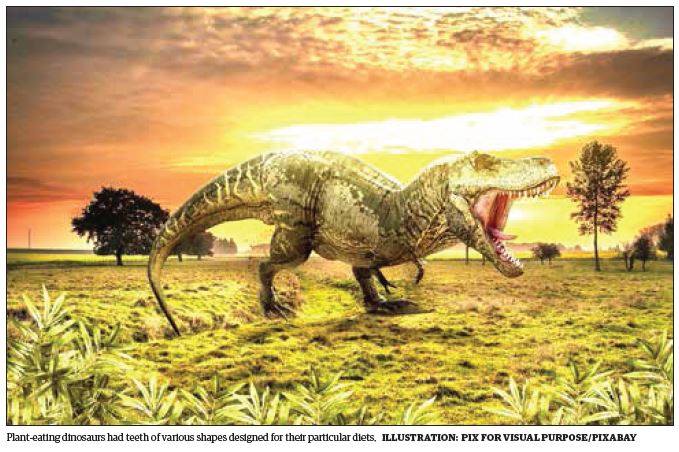
Plant-eating dinosaurs had teeth of various shapes designed for their particular diets. Triceratops for example had hundreds of teeth that formed a “wall” with sharp ridges The teeth were used to chop off vegetation. Other plant eaters such as Anatolian had wide flat teeth that they used to grind up tough vegetation. The long-necked dinosaurs, such as Diplodocus had long pencil-like teeth that they used to rake the leaves off branches, these dinosaurs swallowed the leaves whole, and they also ingested small stones, called gastroliths, most likely to grind up the food in the stomachs much the same way modern birds such as parakeets and chickens do today.
From an individual footprint, scientists can estimate the height of the dinosaur that made it. A rough estimate of leg length is obtained by multiplying the print length by four. A footprint can also provide clues about the kind of dinosaurs that made it. A three-toed sharp-clawed print means the footprint maker was likely a theropod, usually a carnivore, a three-toed print with rounded toes probably belonged to an ornithopod dinosaur, a herbivore, and pairs of unequal-sized prints were most likely the work of the four-legged, long-necked long-tailed dinosaurs called sauropods, another group of herbivore.
Modern birds or avian dinosaurs have skeletal features that are almost identical to some non-avian dinosaurs, feather evolved before flight and may have functioned as isolation to keep dinosaurs warm or for display as a way to attract mates.
It was in this environment that reptiles known as dinosaurs first evolved, reptiles tend to flourish in hot climates, because their skin is less porous, for example, mammal skin, so it loses less water in the heat, reptiles’ kidneys are also better at conserving water.
Palaeontology flourished fast nowadays, making the surveys of geological periods and fossils easier and more detailed in the collection than years ago. Palaeontologists may have visualized that if various kinds of dinosaurs had not become extinct 66 years ago and remained living in this world, the history of dinosaurs would have a different story to tell. With their tall and massive feature, consuming a large amount of green vegetation and roaming around this world with their gigantic body weight would be an awful scenario for us to guess.