The approved funds must be utilized effectively and effciently within the designated period so that public-benefit projects can produce tangible results.
SENIOR General Min Aung Hlaing stressed that projects that directly serve the public, such as education, healthcare, and transport, as well as initiatives requested by local communities, should be implemented as quickly as possible.
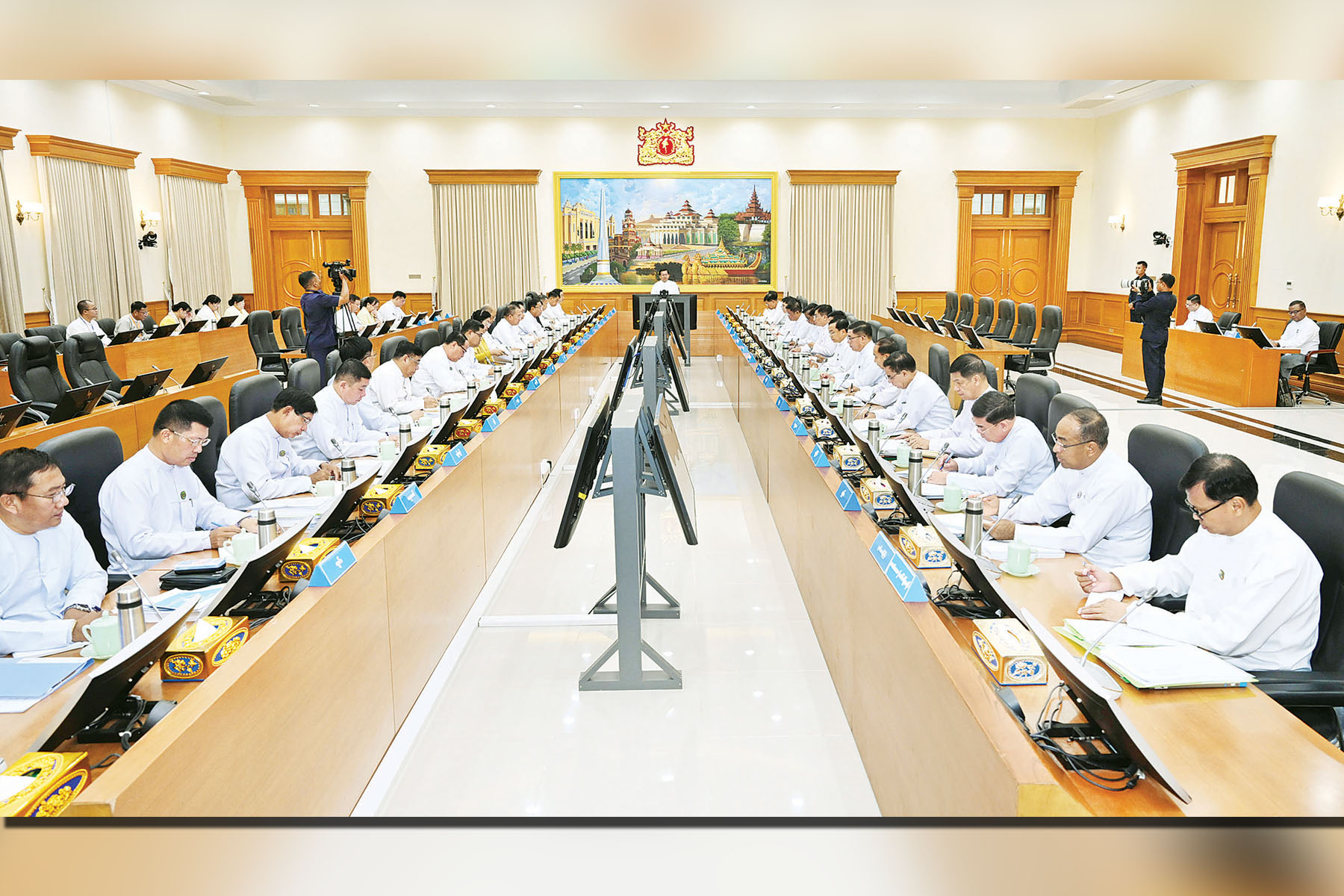
Chairman of the Finance Commission, Acting President of the Republic of the Union of Myanmar and State Security and Peace Commission Chairman Senior General Min Aung Hlaing delivered an address at the Financial Commission meeting in Nay Pyi Taw yesterday morning.
Also, present at the meeting were the Finance Commission Vice-Chairman, SSPC Member and Prime Minister U Nyo Saw, Union ministers, the Auditor-General of the Union, the Nay Pyi Taw Council Chairman, chief ministers of regions and states and officials.
In his speech, the Senior General said that the Financial Commission is to approve the supplementary budget proposals of the Union, Regions, and States for the 2025-2026 financial year. Once approved, the Union Government is to submit the Union Supplementary Appropriation Bill for the 2025-2026 financial year to the National Defence and Security Council for further approval and enactment.
The supplementary budget for the 2025-2026 financial year will primarily be allocated for expenses related to the repair and maintenance of offices, schools, hospitals, residential buildings, and other structures damaged or destroyed by the devastating Mandalay earthquake, as well as for rehabilitation efforts. In addition, it will cover expenditures for national development and public-benefit projects such as roads, bridges, schools, and hospitals, key components of basic infrastructure development.
He noted that in implementing the recovery efforts for losses in the Mandalay earthquake, it is necessary to consider the supplementary budget disbursement and the workloads.
The Senior General recounted that K2069.336 billion – funds returned to the General Reserve Fund (GRF) from the allocations of Union-level organizations and Union ministries for the 2025-2026 financial year – has been transferred to the National Disaster Management Fund to be used for the repair, maintenance, reconstruction, and rehabilitation of state-owned basic infrastructure damaged or destroyed by the recent major earthquake in Mandalay.
He pointed out that in efforts to accelerate the nation’s economic development, agriculture remains the primary livelihood for the majority of the country’s national races and serves as the lifeblood of the national economy. Therefore, it is necessary to promote and expand agriculture-based production industries as a foundation for sustainable economic growth.
He stressed that the State Government has allocated funds by respective sectors to implement national development projects and is providing support through various means.
As some departments and organizations were unable to fully implement their original plans due to unavoidable circumstances, they were instructed to promptly return any surplus funds without delay at the end of the financial year, instead of depositing them late.
He underlined that the Financial Commission is to discuss and approve matters related to the additional fund requests of Union ministries and organizations, supplementary funding to be provided by the Union to Regions and States, and the draft of the Additional Appropriation Law for the 2025- 2026 financial year.
Vice-Chairman of the Financial Commission, SSPC member and Prime Minister U Nyo Saw reported on scrutiny for demands of supplementary budget of the Union-level, organizations and regions and states in 2025-26 financial year, allowance for State service personnel and retired personnel, and the status of the Union’s approval and provision of supplementary funds, required funds, and tax allocations to Regions and States for the 2025-2026 financial year.
Secretary of the Financial Commission, Union Minister for Finance and Revenue Dr Kan Zaw, presented the matters to be financed from the Union’s general surplus funds for the 2025-2026 FY, including the list of supplementary appropriations, the original estimated budget, the revised estimated budget, and the draft law on the Union’s additional fund allocation and expenditure.
Union Minister for Legal Affairs and the Attorney-General of the Union, Dr Thida Oo, provided explanations regarding the draft Union financial expenditure law and the draft law on the Union’s additional fund allocation and expenditure for the 2025-2026 financial year. Similarly, Union Auditor-General Dr Khin Naing Oo presented findings from the audits of Union-level organizations, ministries, and the governments of Regions and States, and offered recommendations on actions to be taken in the future.
The Nay Pyi Taw Council Chairman, the region and state chief ministers also participated in the discussions.
In his speech, the Senior General delivered an additional speech, saying that additional funds should be used in areas that truly benefit the nation. Therefore, projects that directly serve the public, such as education, healthcare, and transport, as well as initiatives requested by local communities, should be implemented as quickly as possible.
Efforts should focus on carrying out projects that bring benefits to the public, local regions, and the nation as a whole. A failure to use the time and financial resources effectively causes harm to the country. Therefore, it is necessary to continue implementing initiatives that are beneficial to the nation, ensuring that time, funds, and authority are properly and efficiently utilized. Approved funds should be spent effectively within the designated time frame so that projects beneficial to the public can be realized.
In conclusion, the Senior General urged all to promote the development of MSMEs, small, micro, and medium-sized enterprises, which are based on agriculture and livestock industries, to enhance the social and economic lives of the people, strengthen the national economy, and reduce dependence on imported goods. At the same time, emphasis should be placed on advancing the national education and healthcare sectors to ensure the country’s continuous, sustainable, and robust development. — MNA/TTA