
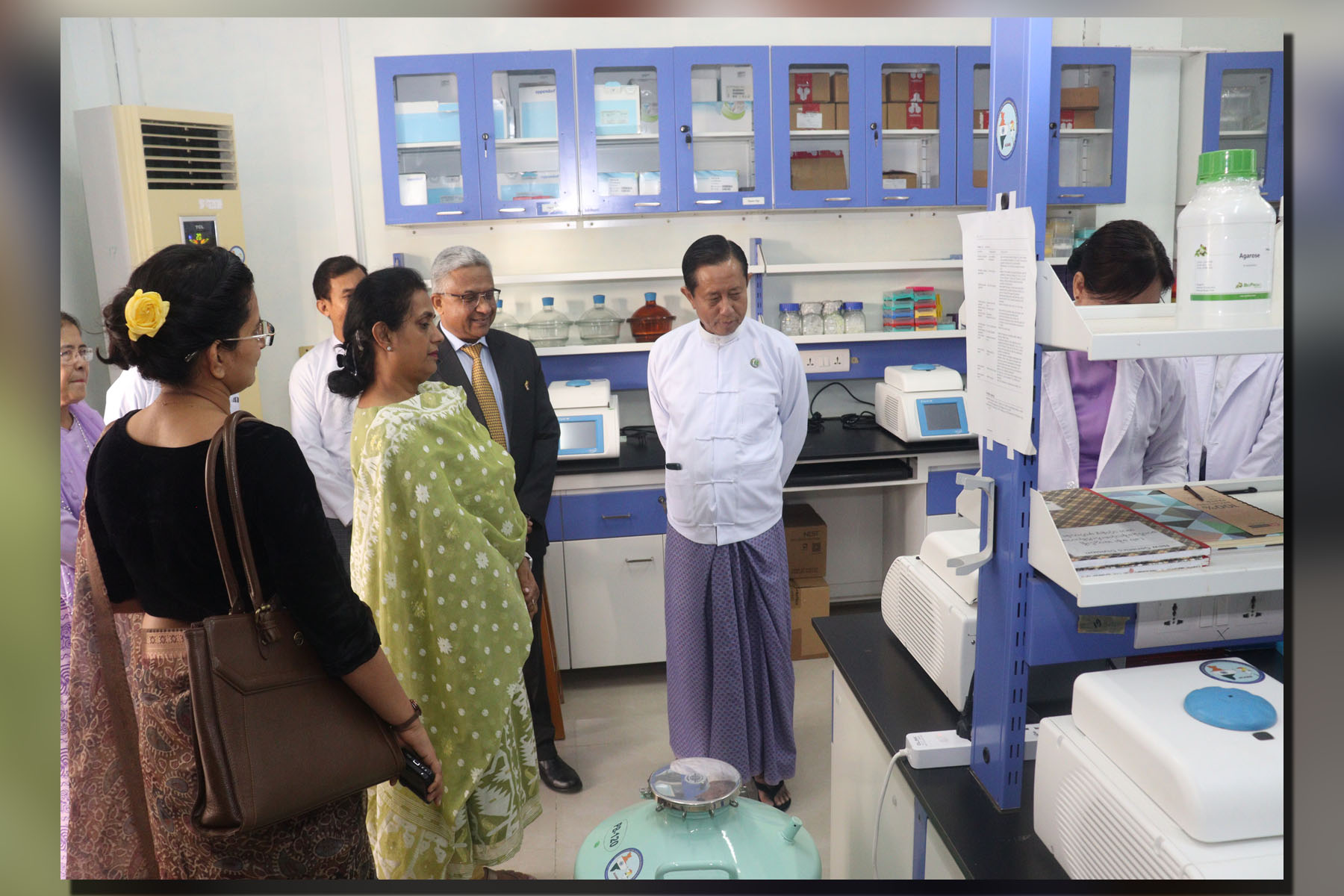
A commemorative ceremony marking the completion and commencement of two research and technology projects under the Mekong-Ganga Cooperation (MGC) framework, aimed at developing Myanmar’s agricultural sector, was held yesterday morning at the Centenary Hall of the University of Agriculture (Yezin). The projects include the “Drying Machine and Drying Facility Project” and the “ACARE Knowledge Repository Project”.
The ceremony was attended by Deputy Minister for Agriculture and Irrigation Dr Tin Htut, Mr Abhay Thakur, Ambassador of India to Myanmar, officials from the Ministry of Foreign Economic Relations and Investment, directors-general of relevant departments, invitees, the Rector and professors of the University of Agriculture, associate professors and researchers, and postgraduate students.
During the event, Deputy Minister Dr Tin Htut emphasised the importance of sustaining and further developing the completed projects. He urged the relevant departments to ensure the proper operation, maintenance, and systematic management of the drying machinery and facilities. He also highlighted the need to continuously update the ACARE Knowledge Repository with new information, strengthen communication and collaboration between research departments, extension programmes, and farmers, and implement successful pilot projects as models to be replicated and expanded to other regions.
Afterwards, the Indian ambassador highlighted that the essence of India-Myanmar relations is that of a friendly partnership based on good neighbourliness and mutual trust. He emphasised that the successful implementation of these two projects under the Mekong-Ganga Cooperation (MGC) framework represents a notable achievement in the sustainable economic and technological collaboration between the two countries. The ambassador further stated that the Government of India will continue to support Myanmar as a partner in the modern development of its agricultural sector, rural development, and human resource capacity building.
Subsequently, video clips documenting the implementation and completion of the projects were presented, and commemorative gifts were exchanged between the delegations of the two countries.
The deputy minister, together with officials from the Indian Embassy, then unveiled a commemorative plaque marking the completion of the Drying Machine and Drying Facility Project. They also visited the ACARE Knowledge Repository Project at the University of Agriculture’s Department of Advanced Agricultural Research and Education to observe its implementation.
These projects are designed to help farmers tackle challenges such as post-harvest losses, reduced crop quality, and diminished market value by providing drying technology and essential infrastructure. They aim to reduce losses, improve the quality and standards of exports, increase the value of agricultural products, and enhance market competitiveness. The ACARE Knowledge Repository serves as an important central hub, compiling agricultural research results, knowledge, and data, enabling researchers, policymakers, extension workers, students, and other stakeholders to access necessary information easily, make informed policy decisions, and support innovation. — MNA/MKKS