OUR bus started to leave Kaba Aye at 7:30 am. It wove its way through the streets and lanes in some residential quarters to evade the heavy traffic. Moreover, as it was a Sunday, the traffic was relatively lighter. So, in half an hour, our bus got to a river-crossing bridge leading to Thanlyin. It was the newly-built one, opened in 2025. To me, it looked like the Golden Gate Bridge in San Francisco in the US, which was world-famous for its excellent architectural design. I saw the old bridge a short way on the left. Cars of different models and sizes were streaming slowly along our bridge. My face was caressed tenderly by the breath of the cold breeze coming across the wide expanse of the river. My tiring mind was relaxed and refreshed. I espied a clump of tall buildings on a low-lying bank some distance on the right. My cousin, sitting by me, said that it was the Star City Housing Estate. The rippling river surface under the bridge was sparkling in the golden rays of the morning sun.
When we came to the side of Thanlyin, the scenes before us changed totally. The rain-drenched trees on the hills and mounds near the entrance to the town were still deep green and lush, as the monsoon retreated from Myanmar later this year. Our bus went on along the Kyaikkhauk Pagoda Road. As Thanlyin was a hybrid of an old town and a new one, we found some red-coloured brick buildings in the colonial style in wide compounds such as houses, churches, monasteries, mosques and Hindu temples. Some of them took on beautiful looks with big Sein-pan trees covered in red flowers in front. As it was in the Kathina season, the whole town was in a festive mood. We found some Padetha-bins (trees of plenty) erected at the corners of some streets with high-powered sound boxes playing songs noisily and with some young men and women collecting money from passers-by. We also noticed Padetha-bins with happy-looking young people in some open trucks going round the town. When our bus neared the Myoma market, it was held up by the heavy traffic for some minutes. I observed some high-standard tea shops, hotels, motels, restaurants and shopping malls on the sides of the Kyaikkhauk Pagoda Road.
At 8:29 am, the glittering Kyaikkhauk Pagoda crowning Utaringa hill came into view. I put my joined palms on my forehead out of veneration, turning my face towards the direction where the pagoda was. Just before reaching it, the bus diverted from the Kyaikkhauk Pagoda Road and followed a wide road which skirted around the foot of the pagoda hill. It was lined with green trees, behind which there were wide compounds fenced with brick and barbed wire walls, vast stretches of paddy fields and vegetable plantations, etc. It led to the International Thilawa Terminal. A few cars were running in a tearing rush. After a five-minute drive, our bus came to the arched gate of the Kyaikdeiwa Pagoda, which stands on a wooded low hill in a wide precinct on the eastern side of the road.
When the bus got inside the precincts, it took a path winding up the hill. I noticed a small Bodhi tree and a small gilded pagoda at its foot. Our bus ascended the gentle slope of the hill slowly and soon reached the top, where the gilded Kyaikdeiwa Pagoda, some monastic buildings, a rest-house, a prayer-hall, a Dhamma Beikman, a spirit-shrine room, etc., were clustered about. We parked the bus under a leafy, tall, old banyan tree with outstretched branches. The leaves were fluttering in the breath of cold wind coming uninterrupted from the direction of the Thilawa port. From there, we had a bird's eye view of some groves of green trees and a few fields covered with tall, wild grass lying around the foot of the hill. We could also enjoy the panoramic view of some distinguished landmarks outlined against the skyline, such as the Shwedagon Pagoda to the west, the Thilawa port to the south and the Padagyi Buddha image to the east. The sky above us was blue except for some thin layers of white clouds afloat. The morning sun was shedding its gold rays over the hill. We felt as if our worries had been removed due to the picturesque beauty.
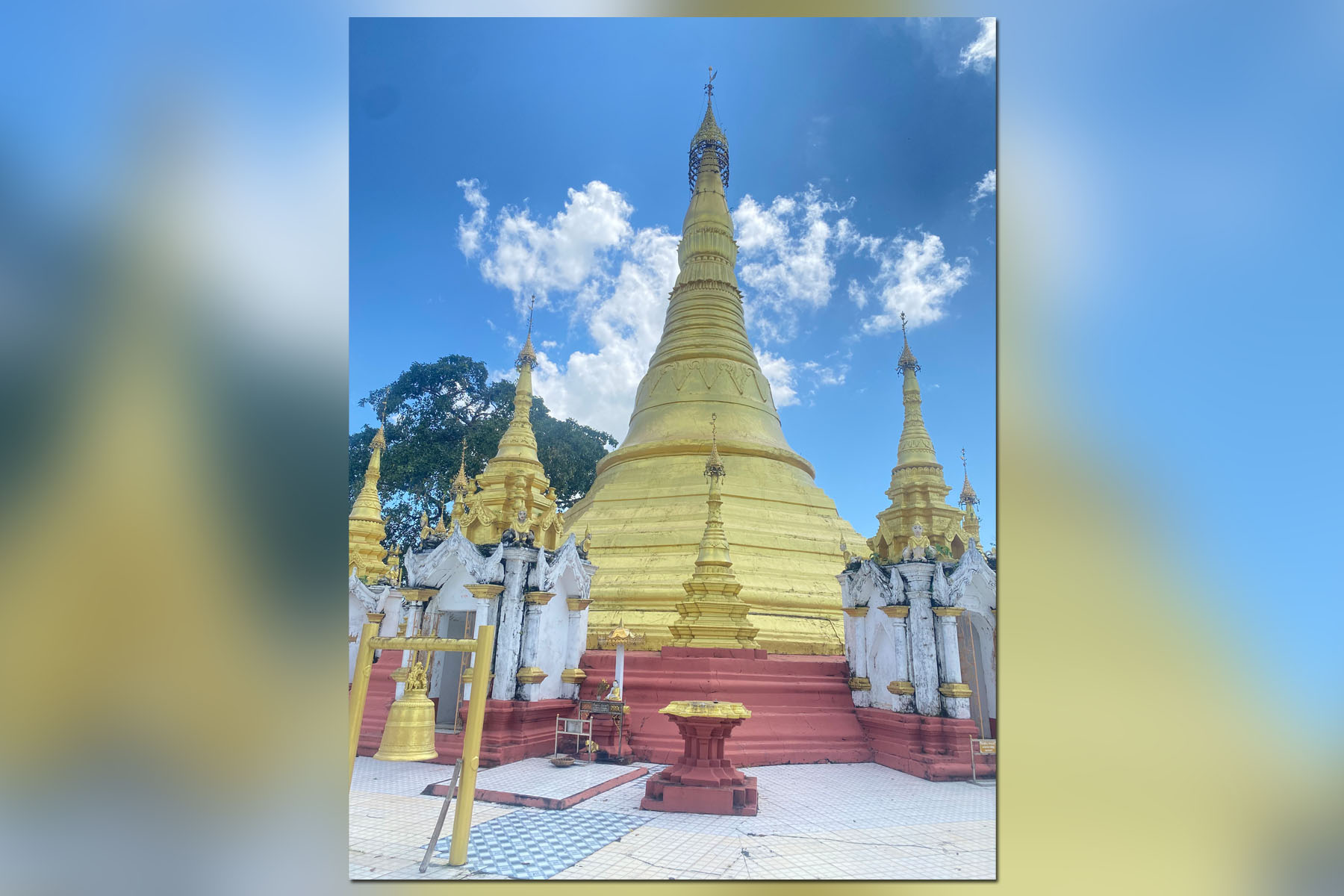
After enjoying the great beauty offered by nature for a few minutes, we scurried up to the Dhamma Beikman, where our Kathina-robe offering ceremony was to be held. On the way there, we had to cross the platform of the Kyaikdeiwa pagoda, which means' The pagoda built by gods ' in Mon. Its history was wrapped in uncertainty. It rises to the height of 70 feet with three receding terraces. When we reached the Dhamma Beikman, we found some members of our association who had cooked alms-meal throughout the previous night busy preparing for the Kathina robe offering ceremony. We joined hands with them. We set in place the robes and other prerequisites to be donated in front of the Dhamma throne, where Sayadaw Dr Bhaddanta Sobhita was to be seated to preach the Dhamma. We also placed 24 chairs for the other 24 monks behind the Dhamma throne. When everything was already made ready, 25 monks, headed by Presiding Monk Dr Bhaddanta Sobhita, came in a file into the hall. Saya U Khin Maung Htay, who served as the master of ceremonies, read out the agenda of the ceremony. Then, Sayadaw Dr Sobhita preached a short discourse on the meaning of the word' Kathina' and the benefits of the offering of the Kathina robes. It was learnt from the discourse that the Pali word ‘Kathina’ meant ‘indestructible’ or ‘lasting’ and that the donors of Kathina robes were free from dangers and food poisoning, could undertake their duties with ease, and their properties would not be destroyed by five types of enemies. At the end of the discourse, our members offered robes and pre-requisites to the monks. After receiving the Kathina robes from us, ten monks entered the ordination hall and sanctified themselves with the Kathina robes they had received. When they processed out of the ordination hall, we, in a queue, donated some offerings to them. We were very satisfied with ourselves, for we believed that we would get a lot of merits when we donated to the monks who came out of the ordination hall, just after being consecrated by the Kathina robes. Then we offered alms- meal to the monks and we also had lunch.
After lunch, I went out into the veranda of the Dhamma Beikman and looked around. As the Dhamma Beikman perched on the northern slope of the hill, I saw the gilded Kyaikkhauk Pagoda standing on Utaringa hill some distance to the north and the medley of the roofs of some monasteries and houses amongst the groves of green, shady trees at the foot of the hill.
Soon, we walked around the precincts of the Kyaikdeiwa Pagoda. First, we went up to the pagoda platform and paid homage to the pagoda. It is said that it was built in 1909. Despite its old age, its glitter did not diminish, for it seemed to be regilded at times. Then we went down from the pagoda platform by a short flight of stairs. In a large stretch of land, a short way down the platform, were found a devastated two-storeyed building, an old ordination hall and seven small brick buildings, in each of which only one person could meditate. Beyond them was a small monastery hanging above the steep slope of the hill. There was a long, roofed staircase leading down to the foot of the hill from the ordination hall. As this patch of land was sheltered by shady trees, we felt cool, relaxed and peaceful. We knew from the Sayadaw that the two-storeyed building was to be renovated. As it had turned about 116 years, it could be archaeologically regarded as an antique building. So, we wished it to be renovated in the original style. Then, we went back to the Dhamma Beikman, put away all the plates, pots and pans we had used during lunch and swept the floor clean. The Sayadaw and the monks retired to their rooms to take a mid-day nap. So, we left the pagoda at about 1 pm.
In conclusion, this Kathina ceremony coincides with the 50th donation of our charity association. Thus, it can be said to be the golden jubilee anniversary of our association, which was founded over four years ago. This being so, all the members put forth much more physical labour and financial resources in this ceremony than they did in other donations. The Kathina-robe offering ceremony was held successfully. The surroundings of the pagoda were very pleasant. So, all the members were filled with happiness, peace and satisfaction. Therefore, the sweet memories of this ceremony will remain branded in their minds for a long time.