
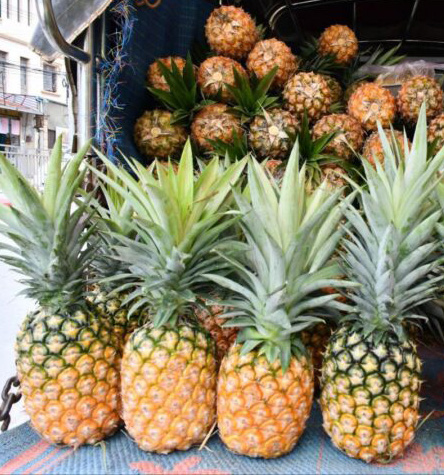
MYANMAR has exported 6.4 million tonnes of pineapple to Wang Ding, according to the Chinese Embassy to Myanmar.
Myanmar’s pineapple was given the green light to be exported to China on 11 November 2024. Yunnan Province brought in Myanmar’s pineapples for the first time.
After classifying pineapples by size in Wang Ding, they are delivered to Kunming, Chengdu and other big cities. Pineapples are in high demand in July and August. Consequently, 500 more tonnes are expected to be exported to China during that period, said a representative from a Shweli trading company.
According to the Sanitary and Phytosanitary (SPS) Protocol between Myanmar and China, inspection procedures are undertaken yearly to verify compliance with the standards.
The General Administration of Customs of the People’s Republic of China (GACC) announced on 11 November 2024 that Myanmar’s pineapple will be allowed to be imported to China, following the Phytosanitary regulation.
Myanmar’s pineapple is cultivated in northern and southern Shan State. The harvest season is in June-September. Earlier, Myanmar’s pineapple export to China was conducted via a green channel under a cross-border trade plan. Yet, China halted this trade route on 16 June 2019, affecting Myanmar’s pineapple industry adversely.
Myanmar’s exporters explored new markets in Thailand, Singapore and other countries. However, the market share is quite low. A series of negotiations between Myanmar and China in the past years reaped a fruitful result, and Myanmar’s pineapple is now allowed to be exported to China via sea trade.
According to GACC’s notification, the Ministry of Agriculture, Livestock and Irrigation needs to forward the list of pineapple farms and processing factories to the Chinese side to seek approval from the GACC. The approved list will be disclosed on its website.
Myanmar’s growers are required to strictly adhere to good agricultural practices and implement quality management, a tracking system for food security and integrated pest management measures.
Packing fresh fruits includes washing fresh fruits with high-pressure spray and checking and removing debris to be free from insects, snails, invasive grass seeds, soil, crop residue, weeds and dirt.
Infestation of the spiralling whitefly (Aleurodicus dispersus), grey pineapple mealybug (Dysmicoccus neobrevipes), Passionvine mealybug (Planococcus minor), Jack Beardsley mealybug (Pseudococcus jackbeardsleyi) and the fungal plant pathogen Fusarium sacchari are considered devastating pests.
Therefore, Myanmar’s relevant authorities are asked to check samples of not less than two per cent of export volume within the first two years of pineapple trade. Inspection of food samples will be reduced to one per cent if pests cannot be detected in two years. — NN/KK