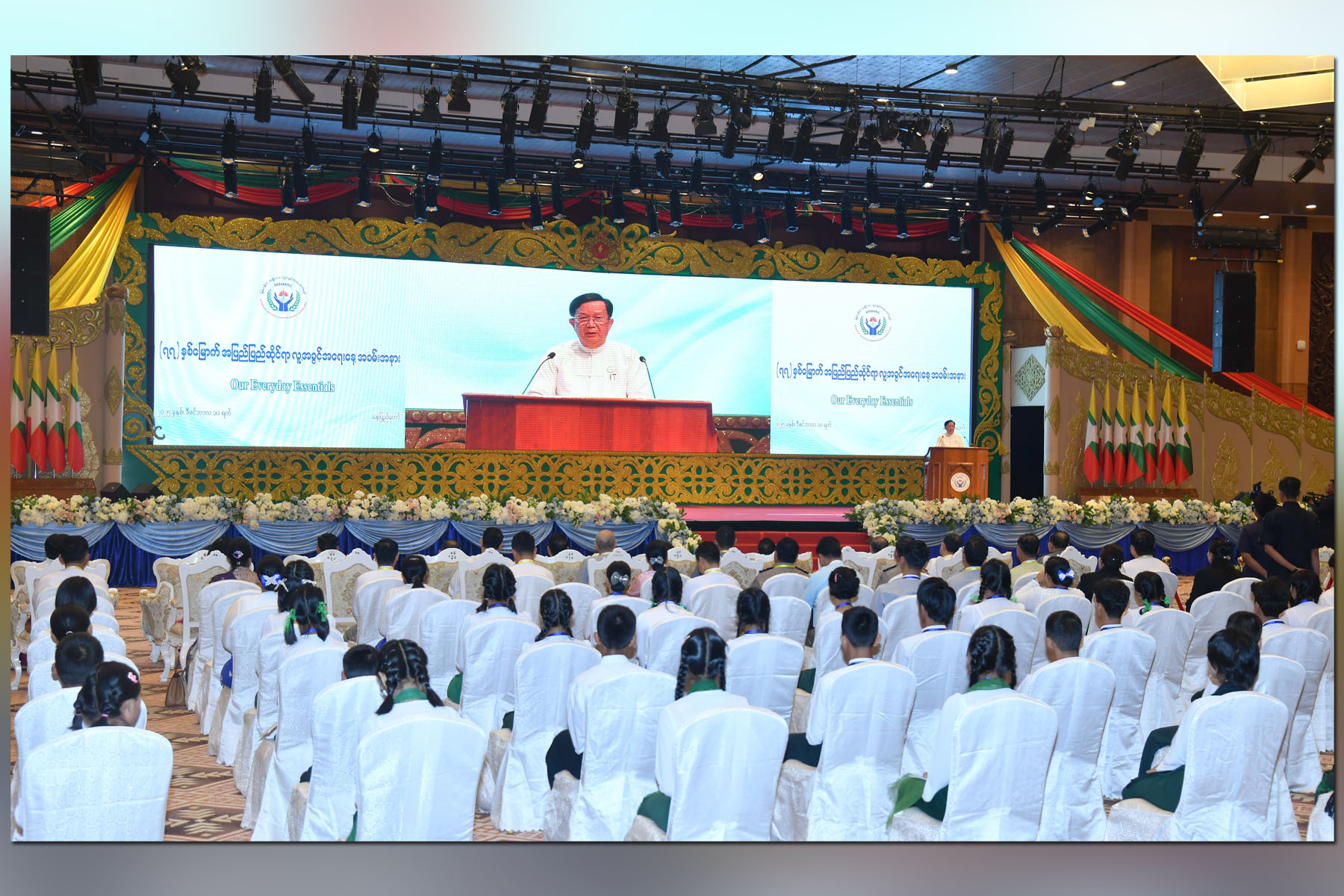
THE 77th International Human Rights Day ceremony was held yesterday morning at the Myanmar International Convention Centre I in Nay Pyi Taw, where U Aung Lin Dwe, Executive Chief of the Office of the National Defence and Security Council, delivered a speech.
The ceremony was attended by SSPC member and Union Minister Lt-Gen Tun Tun Naung, Union-level dignitaries, Union Ministers, the Chairman of the Union Civil Service Board (UCSB), the Chairman of the Nay Pyi Taw Council, the Governor of the Central Bank of Myanmar, the Chairman of the Anti-Corruption Commission, the Chairman of the Myanmar National Human Rights Commission, deputy ministers and departmental officials, officials from the Myanmar National Human Rights Commission, representatives of associations, UN agencies, and foreign embassies in Myanmar; as well as students and guests.
First, U Aung Lin Dwe, Executive Chief of the Office of the National Defence and Security Council, delivered a speech stating that 10 December 2025 marks the 77th anniversary of the adoption of the Universal Declaration of Human Rights by the United Nations General Assembly and is observed as International Human Rights Day, adding that, as the day is celebrated in many countries around the world, Myanmar is also commemorating the occasion out of respect for human rights.
The Universal Declaration of Human Rights consists of 30 articles and sets out the fundamental rights of all human beings, including civil and political rights, as well as economic, social, and cultural rights and responsibilities. The Declaration is the first historical document to recognize the inherent rights of all human beings. When the UN General Assembly voted to adopt the UDHR on 10 December 1948, Myanmar was among the 48 countries that supported the Declaration. The UN General Assembly later designated 10 December – the day the Declaration was adopted – as International Human Rights Day.
Since the adoption of the Universal Declaration of Human Rights, various international human rights treaties have been developed to implement the rights set out in the declaration in a legally binding manner.
U Aung Lin Dwe highlighted that, for Myanmar to respect human rights and cooperate with the international community, successive governments have signed various international human rights treaties as a signatory state, including the Convention on the Rights of the Child, the Convention on the Elimination of All Forms of Discrimination against Women, the Convention on the Rights of Persons with Disabilities, and the International Covenant on Economic, Social and Cultural Rights, and have also acceded to several additional protocols related to these treaties.
The State has enacted and implemented domestic laws to fulfil the obligations contained in the relevant treaties, established national-level committees, and regularly submitted country reports to the respective treaty bodies.
In order to ensure that ethnic peoples living in the country enjoy their fundamental rights, the Constitution of the Republic of the Union of Myanmar (2008) sets out the fundamental rights and duties of citizens. Therefore, citizens must not only enjoy the fundamental human rights guaranteed by the constitution but also comply with the duties it prescribes. Furthermore, the Myanmar National Human Rights Commission was established in 2011 to further promote and protect the fundamental rights of citizens.
The Myanmar National Human Rights Commission Law, enacted in 2014, outlines the Commission’s duties, including investigating complaints of human rights violations, providing human rights education, and issuing recommendations on human rights matters. Since its establishment in 2011, the commission has been in existence for over 14 years, during which its efforts to promote and protect the human rights of citizens have made significant progress.
The establishment of the Myanmar National Human Rights Commission to promote and protect the human rights of citizens living in the country is also evidence of the State’s commitment to human rights.
Respecting and practising human rights within a society greatly contributes to its stability and peace. Only when there is stability and peace can the rule of law prevail; only then can all citizens live and work in safety and happiness, and socio-economic development be enhanced.
The Executive Chief also stated that the Government is committed to the rule of law and stability in the country to promote socio-economic development, enable all citizens to live and work in peace, reduce the gap between poverty and wealth, and ensure the successful holding of orderly, free, and fair multi-party democratic general elections to create a Union based on a disciplined democratic system, which is the true desire of the people.
In a democratic system, general elections are vital, so the government is working hard to ensure they are conducted in accordance with the law, all ethnic groups must work together to make the elections fair, successful, and firmly on the path to multiparty democracy, and, recognizing that the people are the greatest force in nation-building, citizens need to participate actively, respect one another, and take responsibility for creating a peaceful society and holding fair elections.
He said that deciding whether to vote or not is a citizen’s right, but voting is also a civic duty, and that citizens must fully exercise their rights, fulfill their responsibilities, and express their opinions in the best interests of the country, urging all eligible voters to participate in the upcoming multi-party democratic general election and fulfill their civic duty, while emphasizing that human rights and civic duties are two fundamental concepts that must be interconnected and balanced to build a democratic system of governance and a just society.
The National Defence and Security Council, which is currently responsible for exercising the three branches of State authority in accordance with the constitution, is also making arrangements to ensure that all eligible voters in the general election can cast their votes freely and fairly, demonstrating that the national government is taking citizens’ rights seriously.
The UN’s theme for this year’s International Human Rights Day is “Our Everyday Essentials”, which emphasizes that human rights are essential and indispensable in everyday life. By upholding the three universal principles of justice, freedom, and equality – the fundamental principles of human rights – in all aspects of our daily lives, a peaceful and prosperous society can emerge, as the State prioritizes domestic peace, stability, and national prosperity and strictly enforces the law to promote and protect the fundamental rights of citizens.
A citizen has both rights and responsibilities as a member of society, including protecting the rights of others and contributing to the public good to ensure that society functions peacefully, respecting the law as the most fundamental duty for maintaining peace and order, engaging in public affairs through fair and responsible voting and participation in social activities, ensuring that one’s freedoms do not infringe upon the rights and freedoms of others, and fulfilling one’s responsibilities as an investment in respecting the rights of others and ensuring the long-term sustainability of one’s own rights.
He stated that the rule of law and good governance guarantee citizens’ rights and urged citizens to support good governance by fulfilling their civic respon-sibilities.
Then, U Paw Lwin Sein, Chairman of the Myanmar National Human Rights Commission, explained the implementation of the commission’s work, while Dr Myint Thu Myaing, a member of the commission, read the message sent by the UN Secretary-General on the occasion of International Human Rights Day and presented a video clip commemorating the event.
Afterwards, the Chairman of the Myanmar National Human Rights Commission presented a commemorative gift to U Aung Lin Dwe, Executive Chief of the Office of the National Defence and Security Council. Next, artistes from the Fine Arts Department of the Ministry of Religious Affairs and Culture danced to the song “Human Rights for All”.
Executive Chief U Aung Lin Dwe, along with other attendees, also toured the exhibits on international human rights treaties signed by Myanmar, the Universal Declaration of Human Rights in ethnic languages, the Myanmar National Human Rights Commission’s illustrated books in Russian and English, photographs of the commission’s work, and human rights books that are being printed and distributed. — MNA/TH