THE information was released on 11 January regarding the combined team comprising security forces that conducted operations to expose and seize the materials believed to be used for the production of heroin, Methamphetamine, narcotic drugs and psychotropic substances that threaten the survival of the entire mankind, and also the sites and equipment involved in online fraud and gambling.
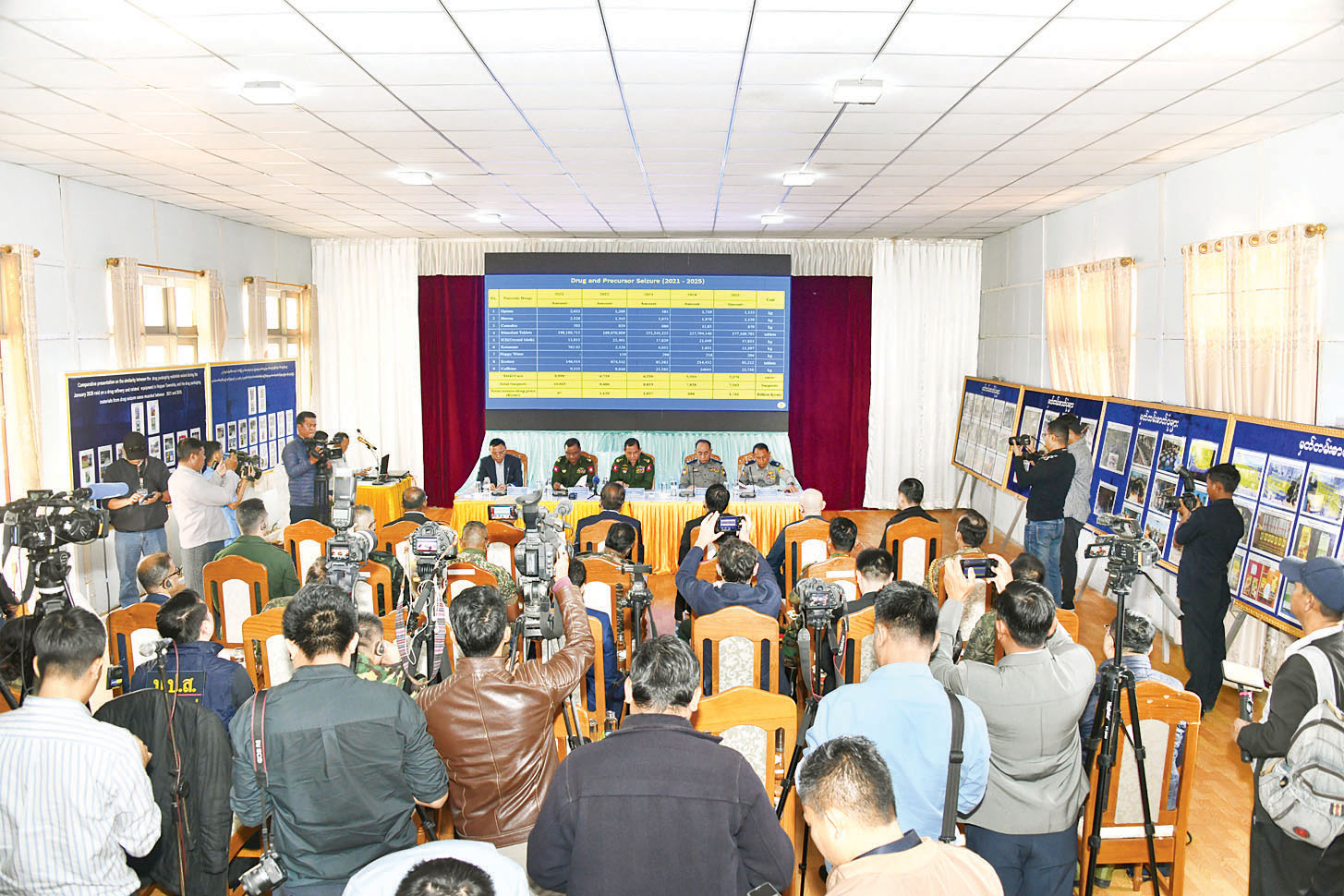
Regarding the largest-ever seizures of narcotic drugs and equipment used in drug production, as well as equipment used for online fraud and gambling, a press briefing by the Government of the Republic of the Union of Myanmar was held yesterday morning at Anisakhan Airport in PyinOoLwin, Mandalay Region. The briefing was led by Commission Member and Union Minister for Home Affairs Lt-Gen Tun Tun Naung, and Leader of the Information Team of the National Defence and Security Council and Deputy Minister for Information Maj-Gen Zaw Min Tun.
The press conference was attended by ambassadors, diplomats, and military attachés from Nepal, Laos, Pakistan, Brunei, and Bangladesh, officials from National Narcotics Control Commission (NNCC) of China, Office of the Narcotics Control Board (ONCB) of Thailand, and the United Nations Office on Drugs and Crime (UNODC) and journalists from domestic media outlets, daily newspapers, domestic television channels, and foreign media organizations based in Myanmar.
First, Commission Member and Union Minister for Home Affairs Lt-Gen Tun Tun Naung explained that Myanmar has designated drug suppression as a national duty and is prioritizing it as a key task. The drug problem does not affect only Myanmar and its people, but poses serious harm to people in all countries. Meanwhile, certain groups and countries handle this global humanitarian problem with ethnic, religious, or political bias. He reaffirmed Myanmar’s unwavering commitment to serving its obligations on drug control.
He then mentioned Myanmar’s drug suppression efforts from 2021 to 2025, the destruction of poppy fields, seizure and incineration of narcotic drugs and chemical substances, special anti-drug operations, and the exposure of drug manufacturing sites.
He added that while operations uncovered only small-scale production sites, the currently seized drug manufacturing bases were identified as the largest ever discovered. Analysis of the seized chemicals and equipment confirmed that massive quantities of drugs had been produced at these sites.
Myanmar continues to cooperate closely with the international community in combatting drug cases in line with its commitments. The successful exposure and destruction of a major drug production hub have significantly disrupted drug manufacturing activities. He pledged that Myanmar will continue its drug eradication efforts by using all available resources in the country as per the commitments made to international countries.
NDSC Information Team Leader Deputy Minister for Information Maj-Gen Zaw Min Tun explained that the Myanmar government regards narcotic drugs as a national threat and conducts drug eradication as a national duty. He highlighted the destructive activities of insurgents and terrorists under the name of EAOs to occur instability in the country to engage in drug production and trafficking as a major of their income, drug trafficking that support money laundering, arms smuggling and terrorism and poses threats to stability of the country, condition of Myanmar as it does not produce the chemicals and related materials used for drug production whereas insurgent groups import these materials into the country through various means from other countries, taking advantage of instability and weakened law enforcement of the country including COVID-19 pandemic by the insurgents to expand their drug-related activities.
He continued that the government has been actively cooperating with neighbouring countries, including China, and regional partners to crack down on drug production and online gambling, aiming for complete eradication as a national task. He provided background information on the areas between Hsipaw and Mongyai in northern Shan State, and southwest of Mongyai, where large amounts of drugs and online gambling materials are seized at present.
He added that in 2013, the members of the SSPP/SSA Wamhai group entered areas south of the region, including the Haipa and Pachi road junctions, resulting in clashes with Tatmadaw. Tatmadaw conducted military operations advancing as far as the Wamhai headquarters area of the group. However, in 2015, in line with discussions and efforts toward signing the Nationwide Ceasefire Agreement (NCA), military operations were suspended. Then, the information related to narcotic drugs around these areas was received, and Tatmadaw carried out clearance activities and issued warnings to the SSPP/ SSA Wamhai group.
In these areas, Tatmadaw had previously controlled, and the region was designated as a "white area." The Tatmadaw controlled areas near the road linking Hsipaw and Mongyai, including the vicinity of Sin Kyaut, Saung Kye, Hoya, and to the south, Namlan. However, following the emergence of the so-called Operation 1027 in 2023, Tatmadaw retreated temporarily from those areas, including Lashio.
In accordance with bilateral ceasefire agreements, while the Tatmadaw was required to halt operations without advancing or retreating, individuals familiar with drug production and driven by greed took advantage of the situation by cooperating with EAOs to establish drug processing bases, produce drugs and commit online fraud. These activities are like the saying… the cat jumps with joy when the forest is on fire.
During 2025, as Tatmadaw gradually reestablished its presence in the area, law enforcement operations were progressively intensified in cooperation with the Myanmar Police Force. As a result of these efforts, arrests were made involving foreign nationals engaged in online gambling and fraud, along with the seizure of related equipment in Mongha of Mongyai township of Shan State (north) in February 2025, Mongnaung, Kyaythee Township, Shan State (South), in November, and Taung Hteik village in Kyaukme Township, Shan State (North), in December.
In January 2026, the local ethnic residents, who did not cherish the online fraud operations which were being conducted in areas between Hsipaw and Mongyai Townships in northern Shan State and the acts committed by insurgents such as unlawful detention and torture, forced recruitment, confiscation of valuable property owned by locals, and destruction of buildings and roads, which severely damaged the socio-economic lives of the people, were unable to safely provide information to Tatmadaw. But, Tatmadaw columns successively recaptured and regained control of areas temporarily dominated by terrorist insurgents, public trust and support for the Tatmadaw grew, and the people eagerly reported to Tatmadaw columns. Therefore, Tatmadaw conducted aerial surveillance and ground intelligence many times, and found the involvement not only in online fraud but also in drug-related activities. Therefore, the government and Tatmadaw decided to conduct special operations. Tatmadaw deployed three battalions, while the Myanmar Police Force deployed three police commando units, operating at full strength. This operation became the most extensive narcotics suppression operation in history, in terms of scale of clearance, destruction, and seizures.
The government and Tatmadaw have expressed recognition, pride, and appreciation for the security personnel who carried out their duties with dedication and perseverance under challenging conditions to ensure the success of the operation. Moreover, the government, led by the Acting President and Commander-in-Chief of Defence Services, issued instructions to personally present cash awards to security personnel stationed in the operational areas.
While seizing the narcotic drugs, materials used in drug manufacturing, and equipment used in online fraud and gambling activities in Hsipaw and Mongyai townships of Shan State (North), the site used for online fraud and gambling was discovered about nine kilometres northwest of Narlin village, whereas a drug manufacturing base about 800 metres east of that site, first drug production site near Manphyet Village about 26 kilometres southeast of Mongyai, a second drug production site about 20 kilometres southwest of Mongyai and a third main drug manufacturing site about19 kilometres southwest of the second site.
In the course of these discoveries, temporary shelters used for online fraud and gambling activities, computers, Starlink devices, and other related equipment were seized from the respective locations. Also confiscated were chemical liquids and related chemical materials used in drug production, tablet-press machines, packing machines used for narcotics packaging, heavy machinery and associated equipment, and buildings used in the operations. Moreover, SSPP/ SSA uniforms, rank insignia, shoulder patches, and individuals connected to the organization were seized and arrested, along with those involved in narcotics manufacturing and those participating in online fraud and gambling activities.
He continued that when the seized drug-manufacturing equipment and materials were subjected to preliminary examinations by joint teams including technical experts, it was initially discovered that heroin and methamphetamine were being produced. Based on estimations derived from the chemical substances seized at the second location mentioned above, it was assessed that approximately 27 tonnes of ICE, valued at about K540 billion, could be produced. If converted into tablet form, it would be possible to produce about 810 million methamphetamine tablets. If these tablets enter the market, narcotic drugs worth an estimated K1,620 billion would have been circulated. The analysis of the seized drug-manufacturing equipment and materials from the site revealed that the facilities were capable of routinely producing quantities exceeding 27 tonnes of ICE or more than about 810 million methamphetamine tablets.
It was also observed that the packaging styles of narcotic drugs previously seized within Myanmar matched exactly the packaging styles produced using the machinery discovered at these sites. Based on examinations of the seized drug packaging bearing the label “Guan Yin Wang” and other packages labelling with Chinese characters, the volume produced and distributed from the two seized locations accounted for about 33.44 per cent of the total amount of ICE seized nationwide during 2025. The terrorist groups mainly rely on the production and transport of narcotic drugs as a major source of income. The maritime exit routes are being utilized by the AA group, routes into Thailand by the KNU, KNLA, and PDF groups, and routes into India by the PDF and CNF groups, respectively.
He also talked about the close cooperation with neighbouring countries, ASEAN members, Mekong regions, BIMSTEC members, international drug control organizations including the UN, comprehensive cooperation as a national task by every country to ensure the eradication, and proper international participation in anti-drug activities of Myanmar to achieve success as quickly as possible.
He continued that the Myanmar government is combatting drug production and trafficking, online fraud and gambling as a national duty, and will take effective action against any organization involved in these cases.
He further explained that drug production, trafficking, and online fraud and gambling activities are not only harmful to the citizens of Myanmar but also pose serious threats to neighbouring countries. Therefore, the entire people are urged to collectively oppose such activities and to promptly provide any information they obtain to the relevant authorities.
After the ceremony, attendees observed around the related equipment used in producing narcotic drugs, the seized items, and photos.
The Commission Member Union Minister for Home Affairs Lt-Gen Tun Tun Naung and Leader of NDSC Information Team and Deputy Minister for Information, and relevant officials, together with diplomats, domestic and foreign media outlets travelled by helicopter to a drug-manufacturing site near Man Phat Village, located about 26 kilometre southeast of Mongyai in northern Shan State. At the site, temporary structures, chemical substances, and related equipment used in drug production were explained area by area. The officials and members of the security forces who participated in the exposure and seizure operations provided clarifications and answered questions raised.
The Commission Member and party then proceeded to another major drug-manufacturing site located about 19 kilometres southwest of that area. The relevant officials provided clarification and answered questions regarding the chemical substances and equipment used in drug production.
Union Minister Lt-Gen Tun Tun Naung and Leader of NDSC Information Team Maj-Gen Zaw Min Tun presented K100million provided by Acting President and Chairman of State Security and Peace Commission for Tatmadaw members and Myanmar Police Force members participating in anti-drug operations on behalf of the Acing President to North-East Command Commander Brig-Gen Aye Min Oo and Deputy Chief of Police of the Myanmar Police Force Police Maj-Gen Win Bo.
Then, the temporary shelters, chemical substances, and related equipment used in drug manufacturing were explained area by area, and responsible officials and security force members involved in the exposure and seizure operations provided further clarifications and answered questions.
The Union Minister and party observed the drug manufacturing site about 20 kilometres northwest of Mongyai by helicopter and returned.
Today, security forces who participated in the operation to uncover and seize drug production sites answered questions from the media as follows: -
A police member
We arrived at Mongphyat on 8 January. On 9 January, police, Tatmadaw, and commando units all gathered carefully and then marched together from Mongphyat. It had taken us two days to come this far. We also had to cross creeks. One of the creeks was about 20 feet wide and eight feet deep, and we crossed it carefully to avoid any danger. During this operation, we arrested suspects. In addition, there were uniforms that were recovered as well. These buildings were also secured intact, without any damage. We carried out the operation according to the procedures of the Myanmar Police Force, following the directives of the Union Minister for Home Affairs, instructions from the Chief of Police, and under the close supervision of responsible officers. The Myanmar Police Force will continue to collaborate with Tatmadaw in eradicating illegal drugs.
A Tatmadaw member
Starting on 9 January, we marched from Mongphyat. The main reason for this operation was that we had received orders from higher authorities to eradicate narcotic drugs, so we studied the terrain and set out. The fighting occurred in a short time. At the beginning of our march, we captured one person – a 37-year-old man. Later, after reaching the area and completing the security operations, six more men were arrested, bringing the total to seven. When we arrived, we went up a difficult mountainous area, not the location the targets had expected. The creek nearby was quite deep, with a strong current. Crossing it together with both Tatmadaw column and the police commando units was risky and could have taken a long time. Therefore, I advised the police Major to separate the forces into two groups to cross the creek more efficiently. By 7 am, we had fully raided the area. At that time, those from the drug-related area fled in disarray. — MNA/KTZH