
WRITING in Real Clear Defence, a Washington, DC-based news publication with close ties to Republicans, Joe Buccino, a retired US Army Colonel and former US Central Command communications director, wrote an opinion editorial contending that Myanmar’s upcoming elections present a strategic opening for President Trum to reset its long-stagnant policy towards Myanmar and the Southeast Asia region.
Ahead of Myanmar’s elections, Col Buccino examined the regional momentum, strategic considerations, and recent confidence-building measures between the US and Myanmar.
Col Buccino highlighted that recent US actions, such as the Trump administration’s termination of Temporary Protected Status (TPS) for Burmese nationals, may reflect a shift in US policy connected to progress in Myanmar’s governance and stability.
In November, US Secretary of Homeland Security Kristi Noem announced the termination of Myanmar’s TPS designation, noting the country’s “…progress in governance and stability, including the end of its state of emergency, plans for free and fair elections, successful ceasefire agreements, and improved local governance contributing to enhanced public service delivery and national reconciliation.”
Col Buccino wrote, “The Trump administration’s recent termination of Temporary Protected Status for
Burmese nationals, citing Myanmar’s progress in governance and stability, signals a potential shift in US-Myanmar relations…With Myanmar’s first national elections scheduled for later this month, Washington has an opportunity to recalibrate a relationship that has stagnated for decades – with implications for US strategic positioning across Southeast Asia.”
Col Buccino states that Washington’s recent shift in policy, combined with various confidence-building measures between the two countries, is generating momentum for the US to reassess and revitalize its engagement with Myanmar after decades of poor policies, especially those from the Biden administration. A policy reset could also reshape Washington’s broader strategic posture in Southeast Asia, Buccino noted.
“Two decades of American isolation policy have created a vacuum that competing powers have filled. Without a significant US presence, Myanmar has increasingly looked elsewhere for economic partnerships, military equipment, and development financing. Reconnecting with Myanmar could help rebalance these influences while securing US access to critical resources needed for defence and technology industries. Recent diplomatic signals suggest openness to such engagement. At October’s ASEAN Summit, the administration notably refrained from public criticism of Myanmar’s government – a marked departure from previous approaches. This measured response may indicate willingness to prioritize strategic engagement over political conditionality.”
Read more here: Myanmar Elections: US Policy Reset in Southeast Asia? (RealClear Defence, by Joe Buccino, 22 December 2025)
— Editor
*****
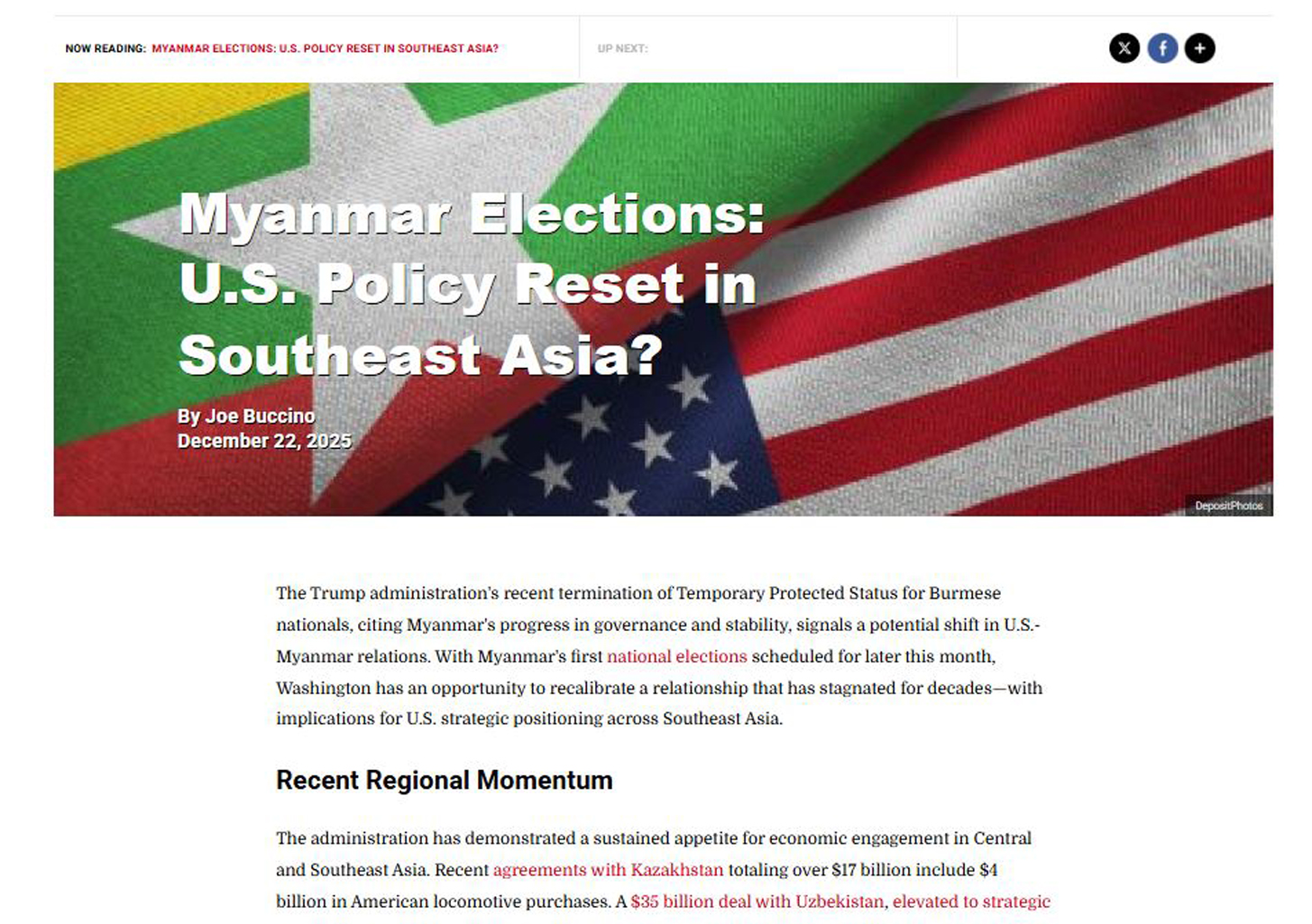
Myanmar Elections:
U.S. Policy Reset in Southeast Asia?
By Joe Buccino
Retired U.S. Army Colonel and former
U.S. Central Command communications director
THE Trump administration’s recent termination of Temporary Protected Status for Burmese nationals, citing Myanmar’s progress in governance and stability, signals a potential shift in U.S.-Myanmar relations. With Myanmar’s first national elections scheduled for later this month, Washington has an opportunity to recalibrate a relationship that has stagnated for decades, with implications for US strategic positioning across Southeast Asia.
Recent Regional Momentum
The administration has demonstrated a sustained appetite for economic engagement in Central and Southeast Asia. Recent agreements with Kazakhstan totalling over $17 billion include $4 billion in American locomotive purchases. A $35 billion deal with Uzbekistan, elevated to strategic partnership status, includes more than $8 billion for American aircraft.
Closer to Myanmar, trade agreements with Thailand, Malaysia, Cambodia, and Vietnam have enhanced US access to critical minerals essential for defence manufacturing. These agreements have also strengthened cooperation between US and regional law enforcement to dismantle transnational cybercrime networks. Together, these initiatives establish a template that could apply to Myanmar engagement, given the country’s mineral wealth and challenges with criminal networks operating within its borders.
The Strategic Case for Myanmar
Myanmar’s geography alone warrants strategic attention. As the only ASEAN member state with direct access to both the Bay of Bengal and the Andaman Sea, Myanmar occupies a critical position linking South and Southeast Asia. Control of Myanmar’s coastline provides potential naval access to critical sea lanes, while its land borders with China, India, Bangladesh, Thailand, and Laos make it a natural nexus for regional trade and military logistics. The country’s natural resources, including rare earth elements essential for defence manufacturing and emerging technologies, add another dimension to its strategic value.
Two decades of American isolation policy have created a vacuum that competing powers have filled. Without a significant US presence, Myanmar has increasingly looked elsewhere for economic partnerships, military equipment, and development financing. Reconnecting with Myanmar could help rebalance these influences while securing US access to critical resources needed for defence and technology industries.
Recent diplomatic signals suggest openness to such engagement. At October’s ASEAN Summit, the administration notably refrained from public criticism of Myanmar’s government—a marked departure from previous approaches. This measured response may indicate willingness to prioritize strategic engagement over political conditionality.
Potential Confidence-Building Measures
Several concrete policy adjustments could signal US openness to renewed engagement while establishing conditions for reciprocal actions. These measures would need careful sequencing to build momentum toward normalized relations.
On Myanmar’s upcoming elections, Secretary of State Rubio stated earlier this year that the administration would “avoid opining on the fairness or integrity of an electoral process, its legitimacy, or the democratic values of the country in question.” Applying this principle to Myanmar’s elections would be consistent with stated policy and could open diplomatic channels that have remained closed. While this stance will draw criticism from democracy advocates, it reflects a judgment that engagement may serve US interests better than continued isolation, particularly given that isolation has not produced desired political changes within Myanmar.
On the economic front, establishing support for commercial opportunities that benefit American companies, including aircraft components, mining equipment for resource extraction, materials for oil and gas infrastructure, and medical equipment. Such an arrangement would demonstrate the US’s willingness to move beyond punitive measures.
The 2023 Burma Sanctions Regulations effectively excluded American energy companies from Myanmar’s oil and gas sector. Reassessing these restrictions could allow US firms to compete with state-owned enterprises from other nations currently dominating Myanmar’s energy development. American energy companies bring not only capital and technology but also higher environmental and safety standards that could benefit Myanmar’s long-term development. This would provide both economic returns and strategic influence over a sector that shapes Myanmar’s economic trajectory and international alignments.
Regional Context and Precedent
Myanmar’s leadership has expressed support for closer relations with Washington, particularly around countering cybercrime operations targeting American citizens. Myanmar has taken steps to crack down on fraud centres, demonstrating a willingness to cooperate on issues of mutual concern. The administration’s “Third Neighbour” trade framework – successfully applied to Mongolia and Kazakhstan – offers a proven model for engaging states seeking to diversify their international partnerships. This framework allows countries to balance relationships with major neighbours while developing independent economic ties with the United States.
Strategic Considerations
US policy for two decades prioritized isolation over engagement. This has simply ceded strategic space to competitors. The policy question is whether continued isolation serves American interests better than conditional engagement.
The upcoming elections provide a diplomatic opening that may not persist. Engagement could be structured around concrete benchmarks related to governance improvements, economic reform, humanitarian access, and regional security cooperation. Such an approach would maintain leverage while creating incentives for incremental progress rather than demanding comprehensive transformation as a precondition.
Southeast Asia’s political and economic landscape is being actively shaped by competing powers. Whether the United States will contest for influence in Myanmar or continue to observe while competitors establish facts on the ground represents a fundamental strategic choice with lasting implications for the Indo-Pacific balance. The administration’s recent track record in Central Asia and mainland Southeast Asia demonstrates a willingness to pursue engagement where strategic benefits align with American interests. Myanmar’s geography, resources, and position within ASEAN make it a logical next focus for this approach.