
August 22
A recent research on 57 persons with moderate COVID-19 determines how long people are infectious and when they may safely be released from isolation. The research, which is led by Imperial College London and published in The Lancet Respiratory Medicine journal, is the first to unveil how long infectiousness lasts for after natural COVID-19 infection in the community.
Detailed daily tests
The study team conducted detailed daily tests from when people were exposed to SARSCoV-2 to look at how much infectious virus they were shedding throughout their infection. The findings suggest that in people who develop symptoms, the majority are not infectious before symptoms develop, but two-thirds of cases are still infectious five days after their symptoms begin.
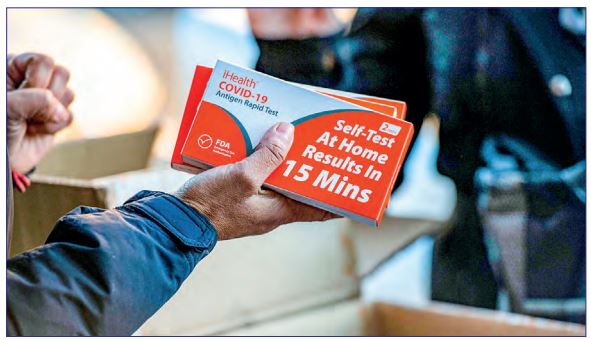
They also suggest that while lateral flow tests do not detect the start of infectiousness well, they more accurately identify when someone is no longer infectious and can safely leave isolation. Study author, Professor Ajit Lalvani, Director of the NIHR Health Protection Research Unit in Respiratory Infections at Imperial, said: “We closely monitored people in their homes from when they were first exposed to the virus, capturing the moment when they developed infection through until they ceased being infectious.
Before this study we were missing half of the picture about infectiousness, because it’s hard to know when people are first exposed to SARS-CoV-2 and when they first become infectious.
By using special daily tests to measure infectious virus (not just PCR) and daily symptom records we were able to define the window in which people are infectious.
This is fundamental to controlling any pandemic and has not been previously defined for any respiratory infection in the community.”
Dynamics of Omicron infections
“Combining our results with what we know about the dynamics of Omicron infections, we believe that the duration of infectiousness we’ve observed is broadly generalisable to current SARS-CoV-2 variants, though their infectious window may be a bit shorter.
Our evidence can be used to inform infection control policies and self-isolation guidance to help reduce the transmission of SARSCoV-2.”
Co-author, Dr Seran Hakki also from Imperial’s National Heart and Lung Institute, said: “There is no longer a legal requirement to self-isolate if you test positive for COVID-19, but most people still want to isolate until they are not infectious. Despite this, there is lack of clarity around how to come out of self-isolation safely.
Our study is the first to assess how long infectiousness lasts for, using real life evidence from naturally acquired infection.
Our findings can thus inform guidance as to how to safely end self-isolation.” She adds: “If you test positive for COVID-19 or have symptoms after being in contact with someone with confirmed COVID-19, you should try to stay at home and minimise contact with other people.” Most complete picture of the course of infectiousness to date.
How long someone is infectious
Previous studies estimating how long someone is infectious for have been a laboratory-based human challenge study or have used mathematical modelling. The new study followed people who were exposed to someone with PCR-confirmed COVID-19 in their home between September 2020 and March 2021 (pre-Alpha SARS-CoV-2 virus and Alpha variant waves) and May-October 2021 (Delta variant wave), including some who were vaccinated and others who were not. Participants completed daily questionnaires about their symptoms and did daily nasal and throat swabs that were sent to a laboratory for PCR-testing.
PCR-positive samples were then tested to determine if they contained infectious virus and how infectious the virus was. The researchers also completed 652 lateral flow tests on the samples to determine how accurate lateral flow tests were at identifying actual infectiousness as opposed to PCR-positivity.
Samples from a total of 57 people were used, but not all were included in some analyses because of some participants not sharing information about their symptoms, some people not shedding culturable virus, and some people shedding infectious virus before or beyond the sampling period. As a result, the duration of infectiousness was measured in 42 people. There were 38 people with a confirmed date of when their symptoms started and three were asymptomatic.
Real-world timeline of infectiousness
The study found that the overall median amount of time that people were infectious was five days. Though 24 out of 38 people tested positive on a PCR test before they developed symptoms of COVID-19 this does not indicate infectiousness and most people only became infectious after they developed symptoms. Only one in five participants were infectious before symptom onset (7 out of 35 cases). Although levels of infectiousness reduced during the course of infection, 22 of 34 cases continued to shed infectious virus five days after symptoms began, and eight of these people continued to shed infectious virus at seven days. Current NHS guidance suggests that people should try to stay at home and avoid contact with others for just five days.
Safely self-isolating To help understand when people may be able to safely leave isolation, the researchers compared levels of infectiousness with lateral flow test results. SOURCE: ANI