
By April Son
THE day on 28 March 2025 was an unforgettable day for all citizens of Myanmar. Ten minutes to 1 pm on that day, a devastating earthquake jolted Mandalay Region, Sagaing Region, Shan State, Nay Pyi Taw Council Area and Bago Region, resulting in several casualties.
The Mandalay earthquake measured 7.7 on the Richter scale. Among the earthquakes that have occurred since the 1900s, this is the second most powerful. Out of the 18 significant quakes we’ve experienced, the one in 1912 was the strongest, at 8.0 on the Richter scale. This recent earthquake was extremely powerful and caused significant loss and damage. Over 3,700 people have died, and more than 5,000 were injured. About 70 people are still missing. Around 67,000 homes have been destroyed. Approximately 6,400 schools and around 350 hospitals and clinics were damaged. Many roads and bridges have also been destroyed. This article aims to commemorate the powerful Mandalay earthquake that struck on 28 March 2025 and to draw as many lessons as possible from the event.
Indeed, everybody can see that all-powerful earthquakes can destroy small and large infrastructures. It will be a dreadful occurrence which can leave deaths and injuries to people from the quake-affected areas. Whenever natural disasters hit any area of all countries worldwide, they will perform search and rescue operations to save survivors from the scenes as much as possible. As one more step, international rescue teams will rush to the scenes on the humanitarian ground to save the people in rescue operations, applying their experiences. So, the Myanmar people acknowledged gratitude to foreign rescue squads and medical teams which helped quake-affected people in the recent earthquake.
It is undeniable that the devastating Mandalay earthquake has brought about immense losses for Myanmar. Alongside the tragic loss of thousands of lives, countless others were injured — an event that will never be forgotten in the nation’s history. In addition to the loss of life, homes, buildings, and infrastructure were reduced to rubble, resulting in financial losses amounting to K3,629.288 billion.
As Myanmar citizens, we suffered significant losses due to the major Mandalay earthquake. That tragedy has served as a warning light, reminding us to construct our homes and buildings according to proper standards and regulations. The earthquake has shown us the importance of systematic and standardized construction so that if a similar powerful quake strikes in the future, we will not face such severe destruction again. This earthquake has served as a wake-up call, urging us to be more cautious and build properly. In this sense, the devastating earthquake has also provided an opportunity — a critical lesson — to help prevent further loss of lives within Myanmar society.
Due to the major earthquake, both ancient and modern buildings were extensively damaged and collapsed across the affected areas. The debris from the collapsed structures must be cleared to ensure the safety of residents. Among the collapsed buildings are cultural heritage sites, religious structures, and infrastructure such as roads and bridges used by the public.
If some of these heritage structures — which have stood for many years — have collapsed but are located in areas that do not pose a significant risk to surrounding communities, they can be preserved in their damaged state. These ruins, created by the powerful earthquake of 2025, could be maintained as historical remnants. In doing so, they could become memorable landmarks that attract both domestic and international tourists as a form of remembrance of the earthquake. This can be considered one of the positive outcomes resulting from the major earthquake.
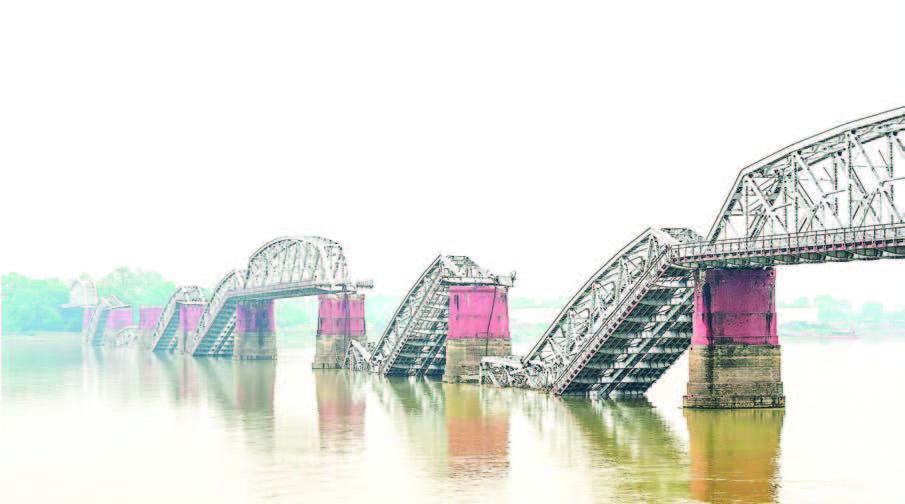
We must possess the ability to transform a major earthquake into a blessing for the nation. For example, the historic Sagaing (Inwa) Bridge, whose arches have collapsed into the Ayeyawady River, once served as a vital crossing for citizens, easing transportation across the river. This bridge, which withstood the impacts of world wars, stood for many years as a valuable and essential piece of infrastructure for Myanmar.
However, the earthquake did not choose what was important or not — it brought down even this priceless bridge. Due to the collapse of the bridge’s arches into the Ayeyawady River, it has become necessary to locate and remove the fallen bridge spans in areas where water navigation cannot be blocked, ensuring the safety of boats and ships passing through. Since the river route must not be obstructed, removing the debris is the right course of action. Only when the waterway is clear can passengers and goods travel safely and without risk.
This is merely a proposal aimed at the development of the tourism industry. The intention is that if there are prominent structures like this large bridge that the Mandalay earthquake has damaged, they should be repaired. At the same time, certain parts can be left in their damaged state as a memorial to the major earthquake, so that future generations can learn from it. This approach would benefit both historical preservation and the tourism industry. During an inspection of the damage caused by the Mandalay earthquake, the Head of State instructed that the Sagaing Bridge (Inwa) be repaired to restore smooth and efficient transportation for the public. Therefore, repairing the Sagaing Bridge (Inwa) is necessary.
A similar site is the historic Mandalay University, which has existed for over a hundred years. The 2025 Mandalay earthquake did not spare the university, which is home to many centuries-old buildings. The quake caused damage to the university’s dormitories. To ensure that students can continue their studies without difficulty, authorities are making strong efforts to repair and rebuild. Debris is being cleared away. Tatmadaw members, members of the Myanmar police force, firefighters, departmental staff, members of social organizations, and residents are all participating in the restoration efforts to prepare the buildings of the university for the opening of the 2025-26 academic year.
While the restoration and clearing efforts are underway, it would be highly appropriate to preserve one or two earthquake-damaged buildings – without repairing or altering their original damaged state – as memorials of the powerful earthquake that struck the area. These preserved structures should be located in places where they pose no danger to the students moving around the campus. If designated as part of the university and earthquake history, they would serve as meaningful reminders for future generations. These ruins would visually convey how Mandalay University experienced the great Mandalay earthquake, and in comparison to newly constructed buildings, they would demonstrate the resilience and struggle of construction during that time as a piece of living history.
Even now, the century-old Mandalay University continues to attract tourists, and with its earthquake-damaged buildings, it is likely to draw even more visitors. As there are many travellers around the world who wish to explore Myanmar’s cultural heritage and its unique and remarkable sites, this historic university will significantly contribute to the development of Myanmar’s tourism industry.
No one wishes to experience the devastating effects of natural disasters. Everyone tries their best to prevent and avoid them. People fear natural disasters and take all possible precautions to protect their lives and property from damage or loss. Natural disasters are often more powerful than humans, so we must rely not only on our physical strength but also on our intelligence and knowledge to overcome nature’s challenges. Even when complete victory is not possible, we strive to minimize damage and loss, carefully planning and making efforts to overcome the challenges as effectively as we can.
Moreover, it is only human beings who can extract the maximum benefit from the natural forces that pose dangers to us and work to advance the well-being of humanity. After a natural disaster occurs, it is humans alone who are capable of analyzing how to prevent and overcome similar future events, and of devising protective measures. Truly experiencing a natural disaster is not something to be wished for. Natural disasters tend to occur unexpectedly, at unforeseen times and places, so constant vigilance and preparedness are necessary.
Even with such vigilance, human lives, homes, and possessions are often lost. Parents, siblings, and relatives may perish in natural disasters. Parts of the human body may be lost or damaged. Therefore, it is the responsibility of human beings to transform these highly dangerous, unwelcome natural disasters into events from which society can gain some form of benefit or lesson.