Nawnghkio Township, located 2,759 feet above sea level, is in Kyaukme district of Shan State (North), and surrounded by Thabeikkyin and Mogok townships to the north, while Kyaukme to the east, Yaksawk to the south and PyinOoLwin to the west. It also possesses good transport connections to Mandalay, PyinOoLwin, Kyaukme, Hsipaw and Lashio with the Mandalay-Lashio Road and railways, while Taunggyi with No 43 Pyidaungsu Road.
Moreover, the major route for China-Myanmar border economic affairs, Mandalay-Muse road (No 14 Asia Road) passes Nawnghkio from west to east, and all the townships across the nation through PyinOoLwin and Mandalay and other townships in Shan State (North) through Kyaukme Township.
Shan, Dhanu and Myanmar people live there peacefully. Agriculture is the main business in Nawnghkio, and the locals operate livestock breeding, minerals, manufacturing, services, tourism, transport and trading. Nawnghkio also boasts waterfalls, caves, landscapes, different ethnic groups and historic places. The tourism industry develops its proper transport and high arrivals of travellers, and the socioeconomic status of residents also develops.
TNLA and PDF terrorists launched attacks against the units and headquarters in Nawnghkio with excess forces starting from 25 June 2025. They torched the houses of locals, forcibly took the public properties, aiming to affect the governance mechanism. Therefore, locals, including students, children and elderly people, moved to their relatives’ houses and temporary refugee camps from their native towns.
Due to their sudden ambush, Tatmadaw officers, other ranks and convoys defended to lose their outposts and headquarters, sacrificing their lives. However, the dead and injured became high, and also due to the high numbers of terrorists, Tatmadaw members retreated to intermediate positions and cooperated with the bases of Taungkham and PyinOoLwin. Then, they established a temporary defence at the site of Taungkham and PyinOoLwin-Nawnghkio, and attacked the terrorist groups.
TNLA, MDY-PDF and Danu PDF terrorists who temporarily controlled Nawnghkio and accelerated their attacks, entering the villages, schools and monasteries near the vicinity areas of Taungkham station starting from 10 August 2024, and they used the villagers as human shields to attack Tatmadaw convoys and bases. However, Tatmadaw was ready with defence lines in strategic fronts, and they could not easily break through the defence. They used drones and heavy weapons and initiated ambushes. They temporarily blocked the Naunglin-Maepoke-Zaygon road, the Narsho-Zaygon junction, and entered the Yarpyin-Innpho-Taungshay road and blocked Taungkham village. They attacked Tatmadaw stations via the Naunglin-Maepoke-Zaygone road. At the same time, they expanded their attack in Kyaukkyan, Ommakha, Yaymaungthan, Bangway along the PyinOoLwin-Nawnghkio road and Hokho, Thanbo and Kyaukmelay along the PyinOoLwin and Mogok road.
Tatmadaw deployed commandos, additional troops and administrative orders in Taungkham, and explored the ground situation with the air and heavy weapon support. Starting from 25 August 2024, Tatmadaw launched the Counter-Terrorism Operation in certain areas controlled by the terrorists. On 28 February 2025, Tatmadaw recontrolled the routes that connect Makyiyay to Taungkham and also Kyaukmelay to Thanbo village and the Gangaw-Ohmmathi route.
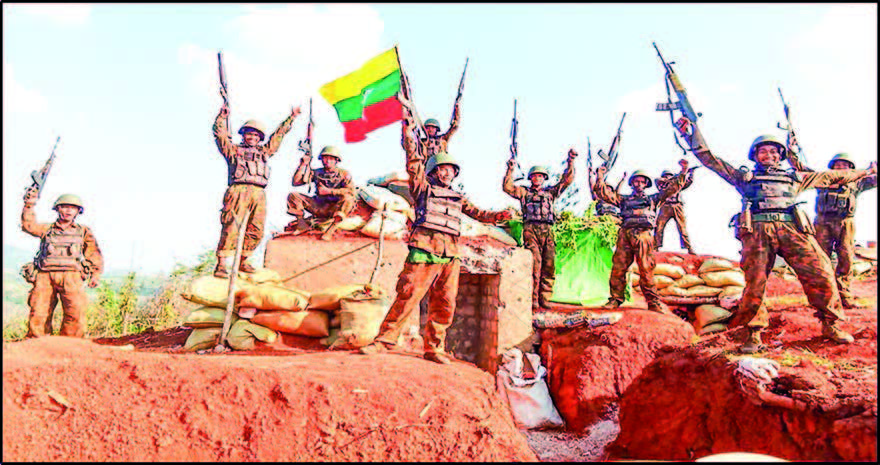
Tatmadaw has been able to significantly break the morale of the TNLA and PDF terrorist groups and has gained the full support and encouragement of the local population. As a result, military officers and soldiers participating in combat operations have been demonstrating high morale, strong determination, and a heightened spirit to fight. By combining strategic ground and air military tactics, Tatmadaw has systematically attacked and occupied locations where the terrorist insurgents had temporarily established camps. These operations have led to the successful reoccupation of Nawnghkio. On 8 July 2025, Tatmadaw had full control over the vicinity of Namhsaunghu along the Taungkham-Kangyi-Nawnghkio route, while Gokteik along the Taungkham-Shwethoon-Gokteik-Nawnghkio route on 12 July, from Ohmmathi-Ohmmakhar village along the PyinOoLwin-Nawnghkio Pyidaungsu road on 15 July.
Tatmadaw convoys dug tranches step by step to reoccupy Nawnghkio and its vicinity areas, sacrificing their lives, and there were 20 clashes and 566 armed engagements within 11 operational months. The famous clashes were Ngonmin Zedi, Point 1130, Zetawun Phayagon, Magyiyay Monastery, Htonephosu village, Kanbawza Monastery, Narsho village, Shwesanphaw Monastery, Saltaungpyae Pagoda, Mahmaw village, Taungshay village, Kyaukkan village, Namhsaunghu, Myatchinnu, Shwepyinyunt, Shwethoon, Konesan, Gokteik and Point 1118. Tatmadaw seized 171 dead bodies of terrorists, 116 magazines and other materials. Terrorists were not able to defend against the counterattacks of Tatmadaw, and they retreated.
On 16 July, Tatmadaw occupied the whole Nawnghkio area and fulfilled the desire of local ethnic people who wanted to return to their houses peacefully and operate their business safely without any threats from terrorists.
Although some of the civilians and the locals who fled from their towns did not support Tatmadaw due to different political stances before the clashes, they came to understand that they would lose their human rights and other chances in the economy, social, health and education sectors if they were under the control of TNLA and PDF terrorists. They also supported Tatmadaw eagerly, and reported to Tatmadaw regarding the ground information and cooperated with Tatmadaw.
When TNLA and PDF terrorists temporarily controlled Nawnghkio, they constructed bunkers at the religious buildings, schools, departmental buildings, hospitals and houses, and they attacked Tatmadaw convoys using locals as human shields. Moreover, they burgled the houses and shops of locals and took valuable materials, food and other commodities. They also destroyed the roads, the Goatwin bridge, by planting mines.
Tatmadaw convoys are working to ensure that residents who had temporarily fled from Nawnghkio can safely return and live in their homes. Efforts are being made to quickly restore the government administrative mechanisms and to clear landmines planted by the terrorist insurgents, in line with the Geneva Conventions. Tatmadaw, in cooperation with local people, will begin repairing and rebuilding schools, hospitals and clinics, government offices, religious buildings, and houses that were destroyed by the insurgents. Security operations in the area are also being strengthened.
All members of the Myawady TV respect and honour Tatmadaw officials and other ranks who participated in the counterattacks for the safety of the socioeconomic status of people and Nawnghkio, and also families of Tatmadaw and supporters of Tatmadaw who fully provided the necessary assistance, including mental support to Tatmadaw officials and other ranks. — MNA/KTZH