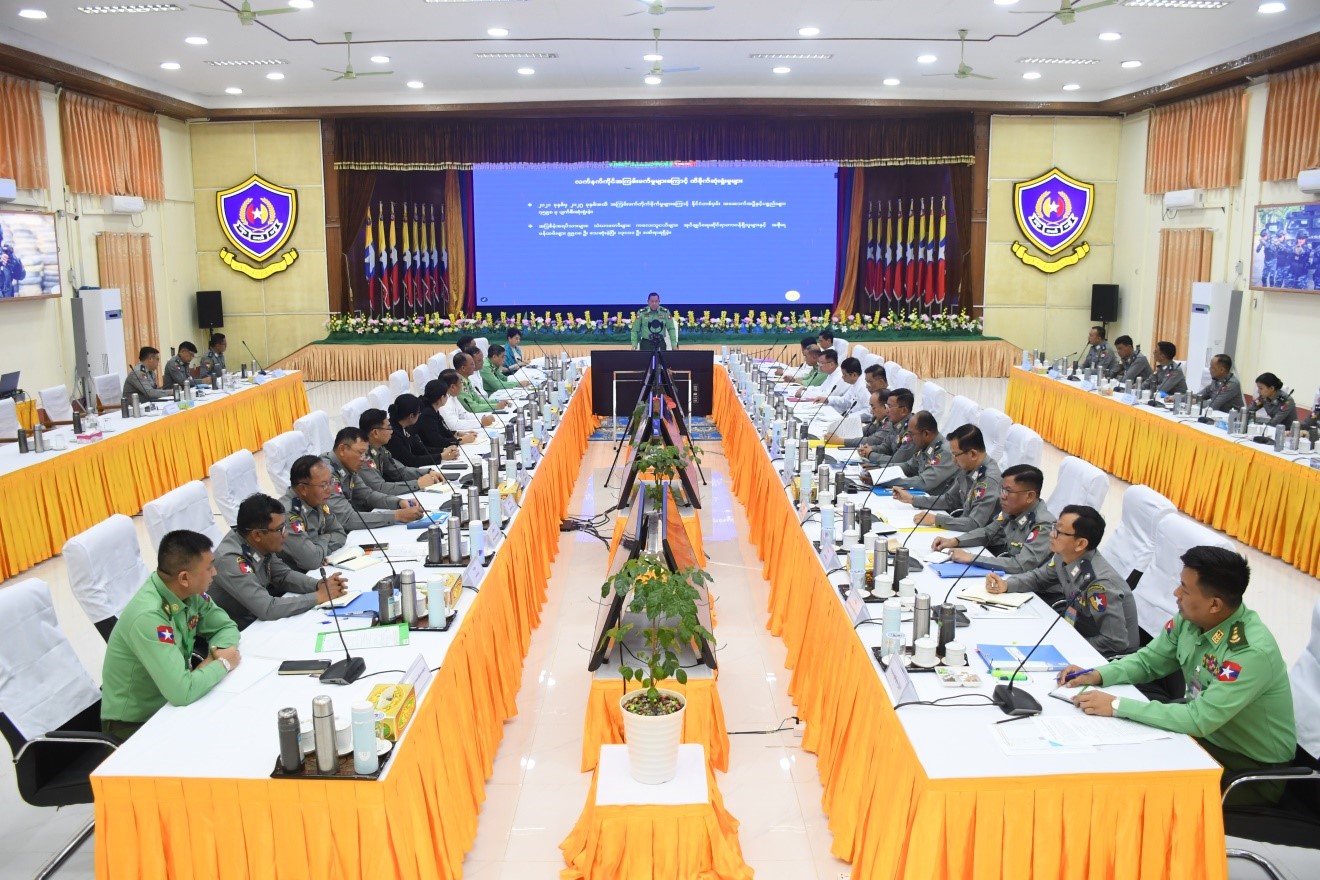
THE Central Committee on Counter-Terrorism Meeting 2025 was held yesterday at the Areindama Hall, Myanmar Police Force Headquarters in Nay Pyi Taw.
During the meeting, Chairman of the Central Counter-Terrorism Committee, Union Minister for Home Affairs Lt-Gen Tun Tun Naung, said terrorism has been changing in various forms along with political, social, and technological developments. According to the Global Terrorism Index (GTI), the nature of terrorism is shifting from conventional methods to more technologically advanced hybrid forms. Non-state actors around the world are increasingly using drones. In Myanmar, terrorist groups are using drone technology to attack civilian targets and destroy infrastructure, while also increasingly using the cyber domain for propaganda and fundraising.
The government drafted the Counter-Terrorism Law with five objectives and enacted it on 4 June 2014. Then, the central committee was formed to implement 19 tasks, and also five working committees and five working groups were formed to carry out the plans effectively.
The Union minister then mentioned the brutal actions of terrorists against the civilians, resulting in thousands of deaths, damage to 7,598 buildings and property, 9,908 deaths including civilians, monks, children, administrative officials, and government staff, whereas 13,011 were injured due to the terrorist attacks between 1 February 2021 and 26 December 2025.
He added that the terrorist groups worldwide raise funds through illegal channels such as drug trafficking and human trafficking. For the country to be removed from the Financial Action Task Force (FATF) monitoring list, it is necessary to prevent and combat the financing of terrorism. Efforts must be carried out in accordance with domestic laws and international stipulations, including United Nations Security Council resolutions 1373 and 2462.
He stated that the drug trafficking activities of the AA terrorist group have expanded significantly, involving the smuggling of chemical precursors for drug production, drug manufacturing, transportation and storage, domestic distribution, and coordination for export in connection with international drug smugglers. From 2016 to 23 December 2025, there were 24 drug seizure cases involving AA members, including nine cases in which AA leadership figures were directly involved.
He continued that according to confessions, those arrested were not engaged in drug trafficking as private business activities but were acting under assignments given by the AA group. About 70 per cent of the profits obtained from drugs were used to purchase weapons and ammunition. The group was also found to be engaged in transnational crimes such as money laundering, human trafficking, and exchanging drugs for weapons through connections with international arms smuggling networks.
Terrorism, arms smuggling, drug trafficking, money laundering, and human trafficking are interconnected, and according to 2025 international and regional cases, the terrorist groups mainly receive their funds for military expenses and procurement of weapons from drug trafficking. Money earned from drugs and human trafficking is laundered through various means, including cryptocurrencies, to conceal traces and then reused for terrorist activities. As these crimes are connected transnationally, regional cooperation is essential. The key to preventing and suppressing terrorism and other transnational crimes lies in information exchange and mutual legal assistance. Myanmar has enacted the Mutual Assistance in Criminal Matters Law and has formed a central committee in accordance with the law. Therefore, existing central committees formed under relevant laws must work together through mutual coordination and cooperation.
He then mentioned the role of international cooperation in combating terrorism, active participation of the country in activities of INTERPOL and ASEANAPOL, drafting of national policy guidance for combatting terrorism (CT) and violent extremism (VE/CVE) based on UN Charter, the Universal Declaration of Human Rights, the UN Global Counter-Terrorism Strategy, ASEAN Convention on Counter-Terrorism and the BIMSTEC Convention.
The committee members, working committee chairmen, working group heads, secretaries, and members then presented their explanations and suggestions.
The Union minister gave proper instructions and concluded the meeting. — MNA/KTZH