
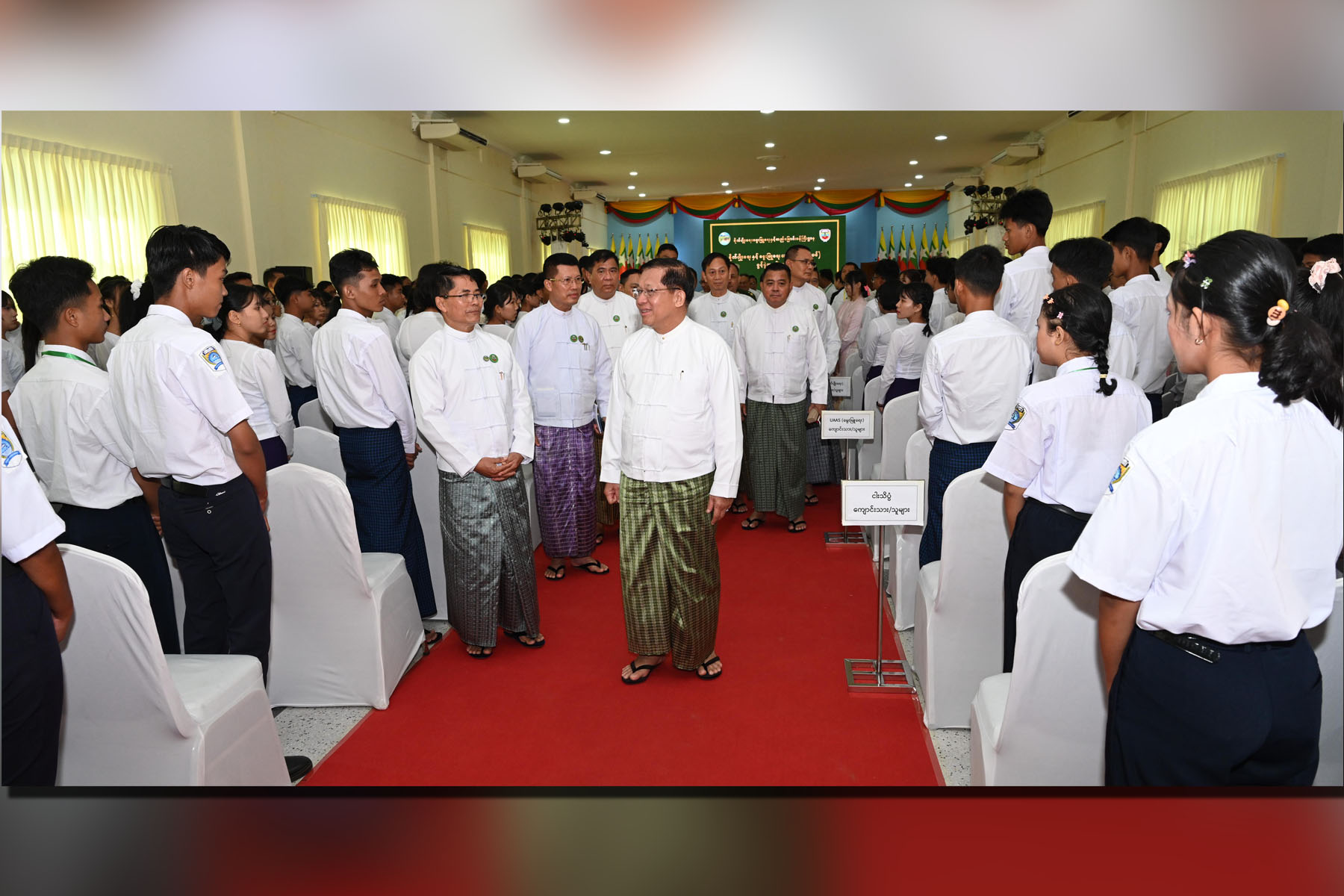
Senior General Min Aung Hlaing unveiled that the newly-inaugurated University of Agriculture and Livestock Breeding (Maubin) has planned to produce 300 agricultural and livestock professionals each per year.
Acting President of the Republic of the Union of Myanmar, Chairman of the State Security and Peace Commission, Senior General Min Aung Hlaing inaugurated the University of Agriculture and Livestock Breeding (Maubin) under the Ministry of Agriculture, Livestock and Irrigation yesterday morning.
Commission Secretary and Joint Executive Chief General Ye Win Oo, Commission member and Union Minister for Border Affairs Lt-Gen Yar Pyae, Union Minister for Agriculture, Livestock and Irrigation U Min Naung, Union Minister for Science and Technology Dr Myo Thein Kyaw and Ayeyawady Region Chief Minister U Tin Maung Win cut the ribbon to inaugurate the ceremony.
The Senior General unveiled the signboard of the main building of the university and sprinkled scented water on the plaque of the main building.
Speaking on the occasion, the Senior General underscored that opening the University of Agriculture and Livestock Breeding (Maubin) starting from the 2025-2026 academic year will significantly contribute to the development of the human resources needed in the country’s agriculture and livestock sectors and support efforts to enhance the national economy.
In addition, he revealed that the university’s aim is not only to provide academic teaching and learning but also to upgrade the institution into a research-oriented university, so that it can produce agricultural and livestock science professionals who can meet international standards.
He explained that the agricultural sector contributes up to 23.7 per cent of the country’s gross domestic product (GDP), and approximately 46 per cent of the nation’s population is rural residents earning their livelihood through agricultural, livestock, and related activities.
The Senior General noted that only when the agricultural and livestock sector develops and the incomes of rural residents increase can rural development contribute to the overall economic growth of the country.
In the past, he recounted that the Yezin University of Agriculture was only one agricultural university. Likewise, the University of Veterinary Science is a sole university of its kind in the country. At present, the Yezin University of Agriculture is producing some 300 agricultural graduates per year and the University of Veterinary Science, some 200 per year.
In its tenure, he highlighted that the current government established 19 industrial, agricultural and livestock high schools and upgraded nine agriculture and livestock institutes out of 15 agricultural institutes. Moreover, the Fisheries Institute (Twantay) and one Veterinary Instititute have been established. So, these institutions could turned out 8,352 human resources rather than the past.
The Senior General underlined that the newly-inaugurated University of Agriculture and Livestock Breeding (Maubin) will produce 300 agricultural and livestock professionals each per year. Moreover, preparations are being made to establish a similar university in the upper Myanmar while opening agriculture and livestock breeding college in each region and state as the future plans.
He noted that the University of Agriculture and Livestock Breeding (Maubin) is formed 13 major departments related to agricultural sciences, 12 major departments related to livestock sciences, and three departments of arts and science, assigned with qualified faculty members.
He emphasized that the University of Agriculture and Livestock Breeding (Maubin) is also planned to offer degrees in livestock science. This will enable graduates and rural residents not only to engage in crop farming but also to earn income from livestock activities during the off-season, thereby increasing household income and reducing poverty.
Union Minister for Agriculture, Livestock and Irrigation U Min Naung reported on establishment of the university and its functions and presented a commemorative gift to the Senior General.
Also, present at the ceremony were senior Tatmadaw officers from the Office of the Commander-in-Chief, departmental officials, rectors, pro-rectors, teachers and students.
At the meeting hall of the university, the Union Minister reported to the Senior General on construction of the University of Agriculture and Livestock Breeding (Maubin), appointment of teachers, formation of academic departments, attending of students from regions and states at the university in 2025-26 academic year, plans to provide stipends, plans to construct more buildings of the university, number of students at the Border Region National Race Youth Development School (Maubin) and support for the students and the Union Minister for Science and Technology on facts about the Government Technical High School (Maubin), appointment of staff and conducting the training courses.
In response, the Senior General revealed that plans are underway to provide stipends to students of the Agriculture and Livestock Breeding Universities. As country’s economy is primarily based on agriculture and livestock, adopting modern, the systematic agricultural and livestock practices rather than traditional subsistence methods would generate significant benefits. Therefore, efforts are being made to produce agricultural and livestock professionals who can support such initiatives and implement agro-based industries. Construction of universities needs to adopt the master plans for the future prospects.
The Senior General signed the guests’ book of the university. He then visited the University of Agriculture and Livestock Breeding (Maubin), the Border Region National Race Youth Development Training School (Maubin), GTHS (Maubin), and Polytechnic University (Maubin) and gave necessary guidance to officials.
The University of Agriculture and Livestock Breeding (Maubin) aims to develop the human resources needed for the country’s agricultural, livestock, and rural development; to increase the production of qualified graduates in agricultural science and livestock science; to enable students to study and acquire modern technologies and applied skills required for agricultural and livestock sectors and related basic economic enterprises; and to strengthen practical, applied research activities. — MNA/TTA