
By Ms Monn
THERE is a Myanmar saying, “May The Physical Body Be Carried Along Wherever The Mind Goes”, which evokes a profound philosophical idea rooted in Myanmar’s rich literary and cultural heritage. It suggests that the mind, nourished by knowledge and imagination, can transcend physical limitations, carrying the body towards enlightenment, progress, and fulfilment. In traditional Myanmar’s thought, influenced by Buddhist teachings, the mind is the gateway to wisdom, and books serve as the vessels that expand its horizons. Yet, in contemporary Myanmar, these ideal faces significant challenges. As our society grapples with rapid modernization, economic hardships, and the digital revolution, the once-vibrant culture of reading is fading, leaving many minds scattered and unanchored. Here, let me explore the decline of book-hiring shops, the struggles of libraries, the critical importance of reading for our youth, and the broader implications for Myanmar’s cultural and national identity, drawing on relevant facts from our country’s context.
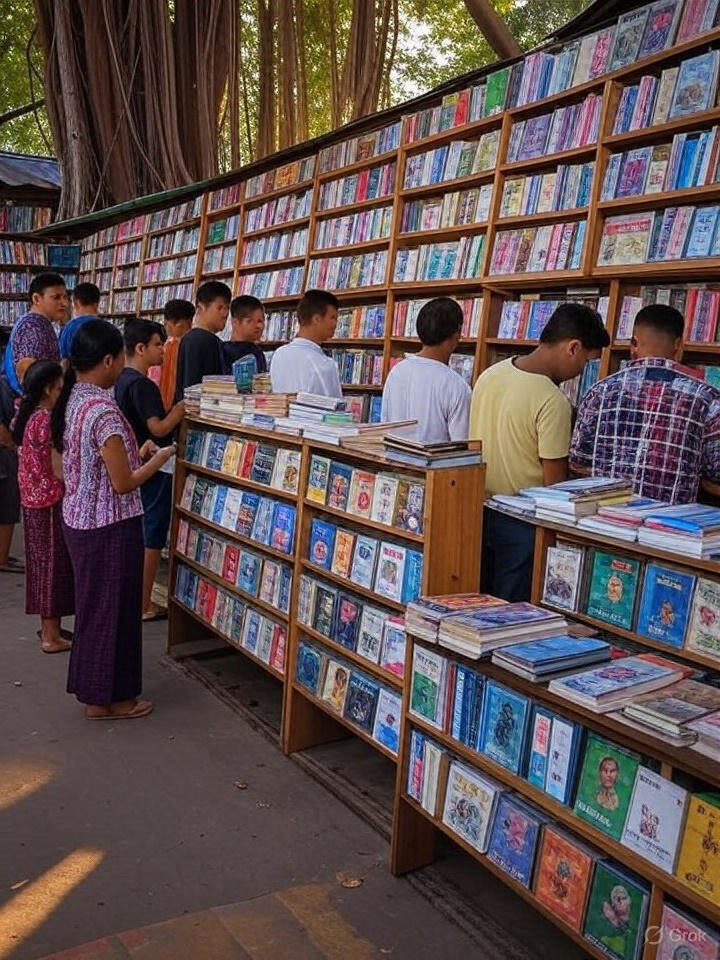
When I was young, Myanmar’s society pulsed with a flourishing culture centred around book-hiring shops, often called “rental libraries” or “book stalls”. These were not grand institutions but humble, community-driven enterprises that dotted urban streets and rural wards. In cities like Yangon and Mandalay, and many other small towns, late afternoons saw crowds of youths and adults flocking to these shops, eagerly selecting novels, magazines, and knowledge-packed volumes. They were metaphors for “doors of the heart”, opened by passionate book enthusiasts who curated diverse collections without the rigid systems of formal libraries. Regular customers formed bonds with shop owners, discovering gems in literature, history, science, and aesthetics. I recall the simple joy of sitting in a nearby teashop, sipping lahpet yay (Burmese tea) while immersing myself in a freshly issued magazine. That tactile comfort – turning pages under the shade of a banyan tree – far surpassed today’s digital scrolling on smartphones under free Wi-Fi networks in the same teashops.
Historically, these book-hiring shops emerged in the late 20th century, during Myanmar’s post-independence era, when literacy rates began to rise under initiatives like the mass education campaigns of the 1950s. By the 1970s and 1980s, they thrived as affordable alternatives to buying books, especially in a country, where poverty limited access to personal libraries. Streetside bookstores in Yangon, such as those along Pansodan Street, became cultural hubs, offering everything from local folklore to translated international works. Comics, novels, and weekly journals were staples, rented for a few kyats, fostering a reading habit among the masses.
However, over the past few decades, these book-hiring shops have vanished like dinosaurs in a mass extinction. Their disappearance can be attributed to multiple factors deeply intertwined with Myanmar’s socioeconomic shifts. The most prominent is the explosive rise of the internet. In 2015, internet penetration in Myanmar was near zero, but by 2020, it had surged to over 40 per cent, and as of 2025, it exceeds 50 per cent. This digital leapfrog, fueled by affordable smartphones and data plans, has shifted reading habits toward social media platforms like Facebook and TikTok. Young people now consume bite-sized content, often laced with misinformation due to low digital literacy rates – estimated at around 30 per cent among youth. Economic pressures have compounded this: post-COVID-19, book publishing in Myanmar declined by 30-50 per cent, with only about 11,000 new books published annually in recent years, down from 14,000 in 2015. Rising costs of paper, printing, and distribution have forced many shops to close, replaced by internet cafes and online entertainment.
Who has investigated this cultural loss? Few, it seems, as attention focuses on immediate survival amid Myanmar’s challenges. Today, while a handful of book-hiring shops linger in places like Yangon’s streetside markets, they pale against the backdrop of underfunded libraries. Myanmar boasts 55,755 registered public libraries, but only about 4,868 are active, with many lacking basic resources. The government, through the Information and Public Relations Department, operates around 440 of these, but the founders of community libraries face insurmountable hurdles: funding shortages, site acquisition, building maintenance, skyrocketing book prices, and staff salaries. Initiatives like the National Library Development Plan 2040 aim to modernize libraries, including e-libraries for higher education, and campaigns such as “Developing Libraries and Raising Reading Habits” in states donate books and cash. I praise the resilient mindset of library founders, like those in monastic and private setups, who persist despite odds, echoing the spirit of projects like Beyond Access Myanmar, which equips libraries with digital tools to bridge the urban-rural divide.
In this context, our nationals, particularly the youth, are drifting away from books. Myanmar’s literacy rate stands at approximately 89 per cent as of 2025, a commendable rise from 75 per cent in 2016, but this masks disparities: rural areas lag at 80 per cent, and female literacy is 86 per cent compared to 92 per cent for males. Besides, other difficulties have further eroded education, with only four per cent of children having books at home. People who shun reading resemble those with disordered, scattered minds, unable to appreciate masterpieces by even the most brilliant writers. John Ruskin, the English critic, warned: “If a race who are looking down on literature, science, art, life, loving-kindness, and sympathy but is desirous and chasing cash, that race cannot last long in society.” In Myanmar, still grappling with poverty – where over 40 per cent live below the poverty line – chasing economic survival often overshadows cultural pursuits. Yet, as Ruskin implies, neglecting the mind’s nourishment invites societal decay. Man requires nutrition for the body, but books feed the soul, fostering empathy, critical thinking, and innovation essential for national progress.
Moreover, the words of Ludu U Hla, a revered Burmese journalist and chronicler, resonate deeply: “Opening of a door of a library can make a door of a prison close.” This wisdom, inspired by global thinkers like Victor Hugo, highlights libraries’ role in preventing crime through education. In Myanmar, the lack of a thriving library culture raises alarms. How many prison doors have opened due to closed library doors? Best-selling books globally rack up sales in the millions (seven digits or more), but in Myanmar, even hits rarely surpass 10,000 copies. This stark contrast underscores our literary standard: while countries like Thailand boast 2,116 public libraries and robust reading programmes, Myanmar’s per capita book access remains low. Literature is the yardstick of a nation’s culture, as most assume, and ours risks falling short.
All in all, animals do not read books; it is literature that elevates humanity from savagery, enabling escape from hostility and fostering civilized living. Myanmar’s literary tradition has long been a beacon. Yet, as a member of my township’s library foundation, I feel a pang of shame. We must revive reading through government-backed initiatives, community drives, and balanced digital integration — perhaps hybrid models like the 2018 launch of Myanmar’s first national eBook store. By nurturing minds with books, we ensure the physical body follows wherever enlightened thoughts lead, securing a brighter future for our nation.