By Maung Maung Aye
OUR car was scudding along the Yangon-Bago highway. Tall trees lining the road were swirling behind. I often espied vast stubble fields dotted with shabby huts or clusters of green trees. I looked over the fields as the villages were sheltered by leafy trees. The air was fresh from the cold of the night. As it was just about 8 am, the sun was at the toddy's palm height, shedding its orange-coloured rays over the world. Soon, we came to Hlegu. It was a prosperous town with tea shops, restaurants, offices, monasteries, meditation centres, schools, the Hlegu Education Degree College, etc. Its economy was bolstered by husbandry, agriculture and good transportation. At the toll-gate, I observed a long queue of trucks fully loaded with various commodities produced from different parts of the country, which were heading for Yangon. As the traffic was heavy, our car had to hug the road. Then we passed through Inntakaw. It was also a busy town with monasteries, the Inntakaw Buddhist College, meditation centres, tea-shops, restaurants and factories. When we were out of Inntakaw, we saw the Manle Tawya Monastery ensconced amongst shady big trees and the Shwepyi Resort on the left of the road and some meditation centres and large stretches of forests on the right. We now and then found pagoda-crowned hills standing well back from the road. At about 9:30 am, our car got to the Tenth-mile Hill at the entrance to Bago.
I noticed that many monasteries, pagodas, meditation centres and other Buddhist institutes clustered around the Tenth-mile Hill. These Buddhist buildings, old and new, were tucked away amongst flowering shrub-berries, groves of bamboo plants and shady trees in the wide precincts. My mind was filled with serenity and peace by this quiet neighbourhood, and I was put under the spell of the beautiful landscape shining in the glow of the rising sun.
At the same time, I was reminded of the Buddha's brief stop at this place on the way to Thaton (Sudhammavati) in the year 111 Maha Era mentioned in the Mon chronicles. The chronicles say that when the Buddha reached there, he saw a female Hamsa (Brahminy duck) with a male Hamsa on her back standing on a small island and that the Buddha prophesied his teachings (Sasana) would flourish at the city which would emerge after his demise at the place where the couple of Hamsas perched. I think Bago was, therefore, the earliest place the Buddha had visited in Myanmar and named 'Hamsavati (City of Brahminy Ducks)' after this traditional narrative.
To my knowledge, apart from Hamsavati, Bago bears two other names: Ussa and Pegu. U Mya, a former Director of the Archaeological Department, assumed that the word' Ussa' was corrupted from ' Orissa', a region in the north-eastern part of India. During the Colonial Period, Bago was called 'Pegu' by the British. Only after 1988, the name' Pegu' was changed to 'Bago'. Historically, the First Hamsavati was founded by Prince Samala and Prince Vimala in about the 6th century AD and the Second Hamsavati by King Banya U in the 14th century AD. During the Toungoo Period, it was a thriving seaport town, a commercial hub busy with local and European merchants. During the Colonial Period, it was a district-level town, the seat of a Deputy Commissioner.
A few minutes after passing the Tenth-mile Hill, we came to the entrance to Bago. I saw Bago University hidden among green, leafy trees on a vast estate on the right side of the road. It is known that it was upgraded from a degree college to a university in 2011 and that its campus covers over 700 acres. A few minutes afterwards, I, on the left, found the archway to the Kyaikpwon Buddha image, one of the oldest Buddha images in Bago. It is said that this four-faced, seated Buddha image goes back to the 7th century AD and was built by King Migadippa and repaired by King Dhammazedi in the 15th century AD, that it is 90 feet in height and that the images of the Kakusanda Buddha, the Konagamana Buddha, the Kassapa Buddha and the Gotama Buddha are erected back-to-back with their faces towards the four cardinal points.
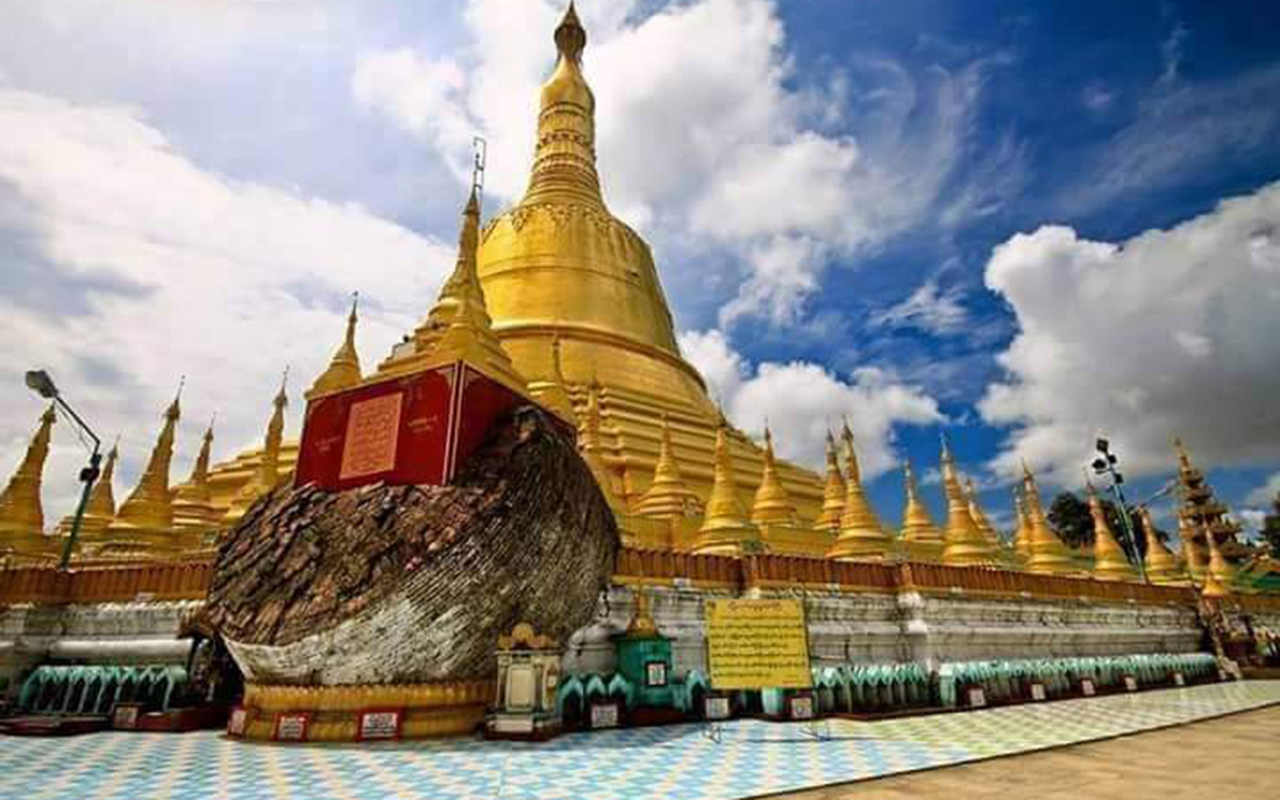
Our bus proceeded along the road. At 10 am, we arrived at the foot of the Shwemawdaw Pagoda Hill. We ascended the hill by the flight of stairs leading to the pagoda platform. The Shwemawdaw Pagoda, the highest of all the pagodas in Myanmar, was glittering in the sun. We walked clockwise around the pagoda. The pagoda platform was packed with many pilgrims, some paying homage to the pagoda, some offering flowers and lighted candles to Buddha images and some telling rosary beads. At a certain place on the plinth of the pagoda, a model of the broken spire of the pagoda was found. It is said that it was made to commemorate the toppling down of the spire of the Shwemawdaw Pagoda due to a great earthquake, which occurred in 1970. The pagoda platform was surrounded by rest-houses, monastic buildings, spirit-shrines and pavilions. Legend has it that Shwemawdaw Pagoda was built with the enshrinement of the two hair relics of the Buddha brought from Majjhimadesa by the two merchant brothers named' Mahasavaka' and ' Culasavaka’, who were the natives of Zaungtu town.
At 10:30 am, we left the pagoda for the Shwethalyaung Reclining Buddha Image. After a 15-minute drive, we got to the Shwethalyaung Reclining Buddha Image. It was situated in a wide precinct on the Shwethalyaung Pagoda Road in Mazin Ward. It was housed in a large pavilion surmounted by a tiered roof. Behind the pavilion were rows of stalls selling foods, fruits, flowers, local products, Myanmar traditional handicrafts, etc. There were full of pilgrims not only in the pavilion housing the reclining Buddha image but also in the stalls. We bought some flowers and donated them to the reclining Buddha image and paid homage to it. This image measures 180 feet in length and 52 feet in height. It is said that it was built by King Migadippange in the 10th century AD and was renovated by King Tissa, King Banyar U, King Rajadhirit, Queen Shin Saw Bu and King Bayintnaung. As we became hungry, we ate lunch greedily at a stall behind the shrine hall.
At about noon, we departed from the Shwethalyaung Reclining Buddha Image. We called in on the Kalyani Ordination Hall located in vast precincts sheltered by large perennial trees on the same road. Some feet to the east of the ordination hall was found a shed which housed the Kalyani Stone Inscriptions, which were very important in the history of Buddhism of Myanmar. We found ten stone slabs on which the religious contributions of King Dhammazedi were engraved in Pali and Mon. It is learnt that when King Dhammazedi succeeded to the throne of Hamsavati in 1472, he was aware that Buddhism was declining in Lower Myanmar, that he, therefore, dispatched some Mon monks to Sri Lanka and had them reordained on the Kalyani river there, that when they arrived back in Myanmar, King Dhammazedi endeavoured to purify and promote the declining teachings of the Buddha with the assistance of the monks who had been reordained in Sri Lanka. Then, King Dhammazedi had all his religious activities recorded on ten stone slabs in 1476, which were later known as the Kalyani Stone Inscriptions. To my relief, these valuable epigraphic documents were kept in good custody by the Department of Archaeology and National Museum. But I think responsible personnel should try to bring more public attention to this priceless cultural heritage.
Although we wanted to visit some more historical buildings and sites like the Kambojasadi Palace built by King Bayintnaung in 1553, the Hamsa Hill Pagoda, which was built to mark the perching of Hamsas (Brahminy ducks), the Mahazedi, a merit of King Bayintnaung, etc., we felt so tired due to the intense heat of the mid-day summery sun. So, we gave up our cherished desire of ransacking this ancient town for more ancient sites and buildings connected with legends and history and left Bago at 2 pm. But, to me, it was a worthwhile trip, for I got some knowledge on the history and Buddhism of Bago and was relaxed by the enchanting beauty on the way.