By Dr Aung Tun
TOBACCO is one of the world’s biggest health threats, causing over seven million deaths every year and many long-term illnesses. Tobacco products means any material prepared for the purpose of smoking or consumption of the whole or part of the tobacco plant, leaf or stalk of the same processed. Tobacco contains at least 2,550 chemicals, and tobacco smoke contains tar, carbon monoxide, nicotine and thousands of other chemicals, many of which are toxic, addictive, carcinogenic and damaging to the coronary arteries that supply the heart. All tobacco products are harmful, and there is no safe level of use. Cigarettes are the most common, but other forms include waterpipes, cigars, heated tobacco, roll-your-own products, smokeless tobacco and e-cigarettes. Most users live in poorer countries, where tobacco worsens poverty by taking money away from food, housing, and other needs. About 80 per cent of the world’s 1.3 billion tobacco users live in low- and middle-income countries.
Second-hand smoke fills indoor spaces like homes, offices, and restaurants. Even small amounts are dangerous. It causes heart disease, lung cancer, and other serious illnesses, leading to about 1.6 million premature deaths each year.
The costs of tobacco are huge – not only in healthcare but also in lost lives and productivity.
Current Situation of Tobacco Use in Myanmar
In Myanmar, tobacco use is widespread. According to the World Health Organization (WHO) STEPwise Approach to Non-communicable Disease (NCD) Risk Factor Surveillance (STEPS) survey report (2014), more than half of adults (54.4 per cent) use some form of tobacco. About one in four adults (26.1 per cent) smoke, while 43.2 per cent use smokeless tobacco. Smoking is far more common among men than women, and men also smoke more heavily – averaging 5.6 sticks per day compared to 3.2 sticks for women.
Tobacco use among young people is also a concern. According to the WHO Global Youth Tobacco Survey (GYTS) 2016 report, among youths, 30 per cent of boys use some form of tobacco, with rates of cigarette smoking showing a strong increase over the past decade; only 8.5 per cent of boys were reported to smoke cigarettes in 2007, compared to 17 per cent in 2016. Many youths begin smoking early, especially in rural areas, where cultural traditions, such as fathers encouraging their sons to help light a cigarette, play a role in early initiation. Tobacco is more commonly used among poorer communities. The poorest 20 per cent of the population are more likely to smoke (18 per cent) compared to the middle-income group (15 per cent). Education also makes a difference: people with no schooling are more likely to smoke (23 per cent) than those with at least primary education (about 15 per cent). Cheroots are the most common form of smoked tobacco in Myanmar. About 64 per cent of smokers use cheroots, followed by manufactured cigarettes (33 per cent), hand-rolled cigarettes (20 per cent), and other tobacco products.
The Rise of Pictorial Health Warnings Worldwide and in Myanmar
Globally, pictorial health warnings (PHWs) have become one of the most powerful and cost-effective measures to inform the public about the dangers of tobacco use. Countries such as Nepal (90 per cent), Thailand (85 per cent), and India (85 per cent) mandate that large portions of cigarette packs be covered with graphic warnings showing the harms of smoking. Australia pioneered plain packaging with PHWs in 2012, setting a benchmark for the world.
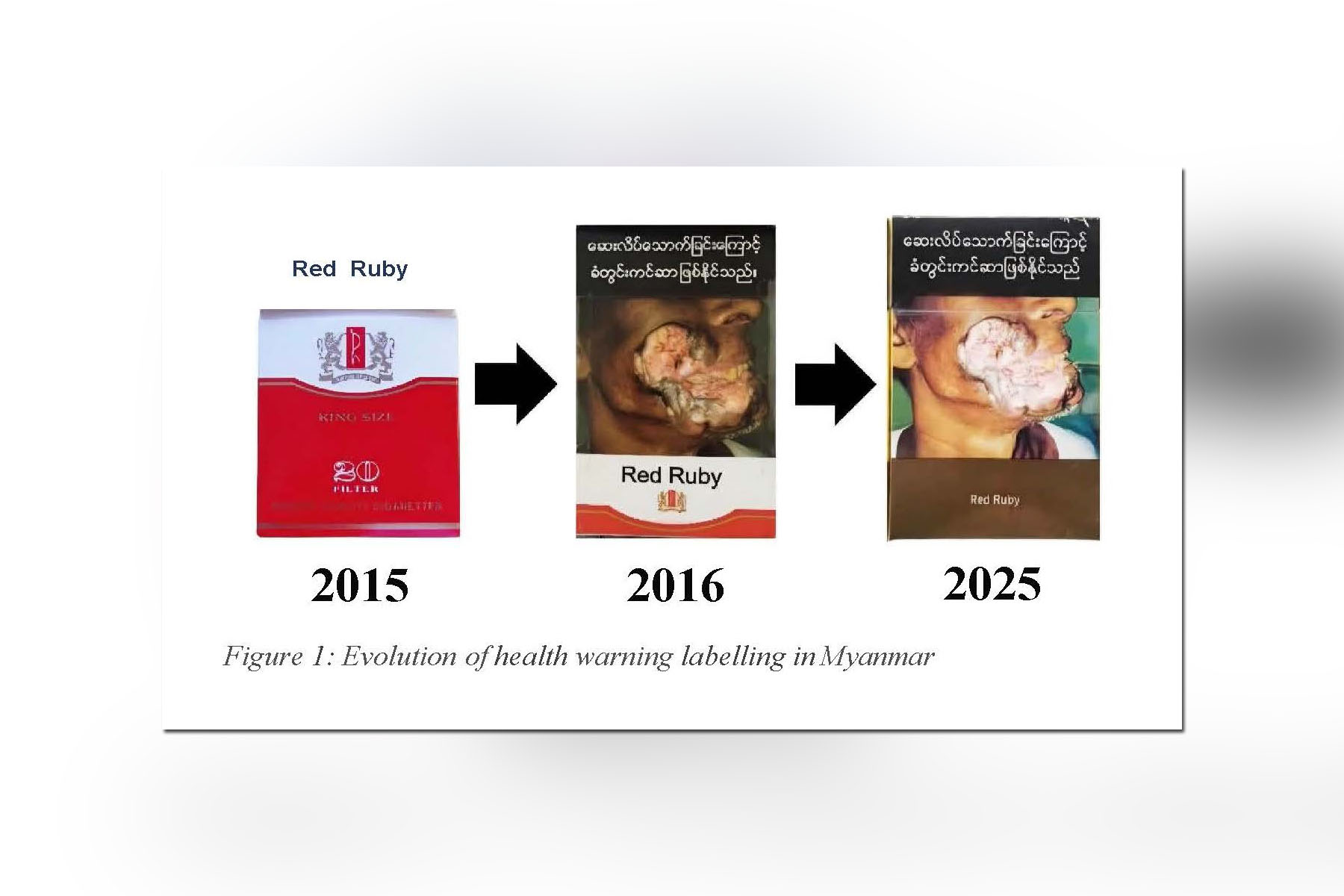
Myanmar joined this global trend on 26 February 2016, when the Ministry of Health announced the adoption of pictorial health warnings covering 75 per cent of the front and back of tobacco packages. By September 2016, this regulation came into force. A national survey conducted in 2014 had already shown that pictorial warnings were far more effective than text warnings, with nearly 80 per cent of smokers reporting that they were motivated to quit after seeing the images.
The Journey of Plain Packaging: Global and Myanmar Experience
Plain packaging, also known as standardized packaging, removes all logos, brand images, colours, and promotional elements from tobacco packs. Only the brand name in a standard font and size is allowed, while packs must feature dull colours and large rotating pictorial health warnings.
Australia was the first country in the world to introduce plain packaging in 2012, followed by several countries, including the UK, France, and Ireland. In Asia, Thailand and Singapore implemented plain packaging in 2019 and 2020, respectively.
Myanmar, after several delays, finally implemented plain packaging in September 2025, making it the third Asian country to do so. This move requires all tobacco products to be sold in a standardised drab brown pack with pictorial health warnings covering 75 per cent of the surface.
Myanmar’s Efforts in Tobacco Control
Myanmar has demonstrated a consistent commitment to tobacco control, even in the face of strong industry opposition. After signing and ratifying the WHO Framework Convention on Tobacco Control (FCTC) in the early 2000s, the government introduced the Control of Smoking and Consumption of Tobacco Product Law in 2006.
Subsequently, the Ministry of Health advanced measures step by step, first mandating large PHWs in 2016, then pushing forward plain packaging despite repeated delays between 2022 and 2025 due to lobbying pressures. By 2025, with support from organizations, such as the WHO and, South East Asian Tobacco Control Alliance (SEATCA). The Union/Vital Strategies and People’s Health Foundation (PHF) Myanmar reached a historic milestone in public health.
Effectiveness of Plain Packaging and Expected Impact in Myanmar
Evidence from other countries demonstrates that plain packaging is effective in:
- Reducing the attractiveness of tobacco products.
- Eliminating the advertising effects of packaging.
- Increasing the visibility and salience of health warnings.
- Encouraging smokers to quit and discouraging youth from starting.
In Australia, smoking prevalence dropped significantly after plain packaging was introduced, while Quitline calls increased by nearly 80 per cent during the implementation phase. In Thailand and Singapore, studies confirmed that standardized packs made cigarettes less appealing and health warnings more powerful.
For Myanmar, these effects are expected to translate into fewer young people starting to smoke, more existing smokers attempting to quit, and a long-term decline in tobacco-related diseases and deaths.
A new chapter in the country’s fight against tobacco
The successful implementation of standardized tobacco packaging in Myanmar stands as a testament to the country’s strong commitment to public health. It is not only a milestone in tobacco control but also a clear demonstration of Myanmar’s dedication to upholding its WHO FCTC obligations and protecting the health rights of its citizens.
With the full implementation of plain packaging in 2025, Myanmar has joined the ranks of global leaders in tobacco control. This bold step, combined with strong pictorial health warnings, marks a new chapter in the country’s fight against tobacco. Continued monitoring, enforcement, and public awareness are essential to sustain this achievement.
References:
- WHO report on the global tobacco epidemic, 2025: warning about the dangers of tobacco, WHO, ( 23 June 2025)
- Pictorial Health Warning in Myanmar, MOH, Myanmar (26 Feb 2016)
- Tara Singh Bam. (15 September 2025). The journey to #endtobacco and #savelives in Myanmar. Retrieved from Facebook.
- SEATCA. (18 September 2025). Myanmar is the third Asian country to enforce standardized tobacco packaging. Retrieved from SEATCA Facebook.