
By Yin Nwe Ko
IT was already precisely 4:45 am before dawn on 11 July when I finished reading (U) Khin Maung Myint’s short essay in The Global New Light of Myanmar newspaper. Something in my mind compelled me irresistibly to write another text which reveals my emotion about the issue of his, so I happened to write the following words.
Khin Maung Myint’s poignant essay, “The Lingering Echoes of Pain,” strikes a chord that resonates far beyond its immediate context, yet finds a terrifyingly urgent application in Myanmar today. His central thesis — that unhealed early trauma becomes an invisible architect of a lifetime, shaping thoughts, emotions, and actions long after the events themselves fade — is not merely psychological theory. It is the lived, unspoken reality for an entire generation of Myanmar’s youth, a generation sculpted not by the nurturing environment of peace, but by the relentless chisel of “the trauma of an unnecessary war.” To support their future, and thus the nation’s, demands more than physical reconstruction; it demands a fundamental commitment to healing these profound psychological wounds.
He masterfully articulates the universal mechanism: childhood trauma forces the developing psyche into survival mode. When the environment is defined by fear, neglect, violence, and the shattering of fundamental safety, a child’s emotional system learns to endure, not to flourish. These adaptive strategies — hypervigilance, dissociation, profound mistrust, explosive anger, or crushing despair — are brilliant solutions for immediate danger. However, when the immediate threat recedes but the underlying fear remains unaddressed, these survival habits “harden into lifelong patterns.” They become the subconscious scripts running beneath the surface, “quietly steering relationships, choices, and self-worth.” The past, as he starkly warns, becomes an “invisible puppeteer,” pulling strings in ways the individual often doesn’t comprehend, leading to reactions that feel alien yet are rooted in “long-forgotten wounds.”
Nowhere is this dynamic more catastrophic than in contemporary Myanmar. Decades of conflict, political upheaval, and the ensuing widespread violence have created a pervasive atmosphere of trauma for young people. Their foundational experiences are not of security and hope, but of “lost safety, broken trust, and interrupted futures.” They have witnessed or experienced violence, displacement, the arbitrary destruction of lives and dreams, and the erosion of any semblance of societal stability. These are not abstract concepts; they are visceral realities that etch themselves onto the developing brain and psyche. As he observes, “These wounds may not bleed, but they fester silently.” The danger is profound: unprocessed collective trauma doesn’t vanish; it metastasises. It manifests in cycles of violence, in crippling apathy, in fractured communities unable to build trust, in a population struggling with pervasive anxiety and depression, and in a deep-seated disillusionment that undermines any vision of a shared future. This “poison” threatens not just individual potential but the very fabric of the nation.
He offers a powerful and devastating metaphor: “To rebuild a country while ignoring the emotional damage to its people is like planting new crops in scorched earth.” We can pour resources into visible reconstruction – roads, bridges, schools, hospitals. These are necessary, tangible signs of progress. But if the “soil” — the collective psyche of the people, especially the youth who must carry the nation forward — remains “wounded, dry, brittle, and unable to nourish real growth,” then any progress will be superficial and ultimately unsustainable. The green shoots of economic activity or political restructuring will wither when they hit the bedrock of unhealed pain, mistrust, and despair. “Roads and buildings can be repaired,” he concedes, but rightly asserts that “Minds and hearts take longer, but matter more.” A nation rebuilt with impressive infrastructure but built upon a foundation of “broken hearts and buried pain” is, as he chillingly concludes, “a nation standing on a fault line”. The inevitable seismic shifts of future challenges will find it perilously vulnerable.
The tragedy is stark: “The young, who should be dreaming, learning, and building, are instead carrying the weight of a war they never chose.” Their inner resources are consumed by the energy required to manage unresolved trauma, leaving less capacity for creativity, innovation, deep learning, and the resilient optimism needed to build a better society. If their “inner world is left in ruins,” no matter how sturdy the “outer structure” — the institutions, the economy — it “will not stand for long.” Trauma erodes the social cohesion and individual resilience upon which stable societies depend.
Therefore, his call is not for sympathy, but for a radical reorientation of priorities: “We must stop pretending that survival is enough.” Merely existing through the chaos is not a foundation for a nation. The young people of Myanmar “deserve more than endurance — they deserve healing, dignity, and a voice.” This is not a luxury; it is the absolute prerequisite for a viable future. True national healing must be holistic. It requires integrating psychological and psychosocial support into the very core of any rebuilding strategy for Myanmar. This means:
Recognizing Trauma as a Core Issue: Acknowledging the widespread psychological impact of conflict and political violence as a fundamental barrier to development and peace, not an afterthought.
Investing in Mental Health & Psychosocial Support: Scaling up culturally sensitive, accessible, and sustainable MHPS services, training community workers, integrating basic psychosocial support into education and community programs, and destigmatizing mental health struggles.
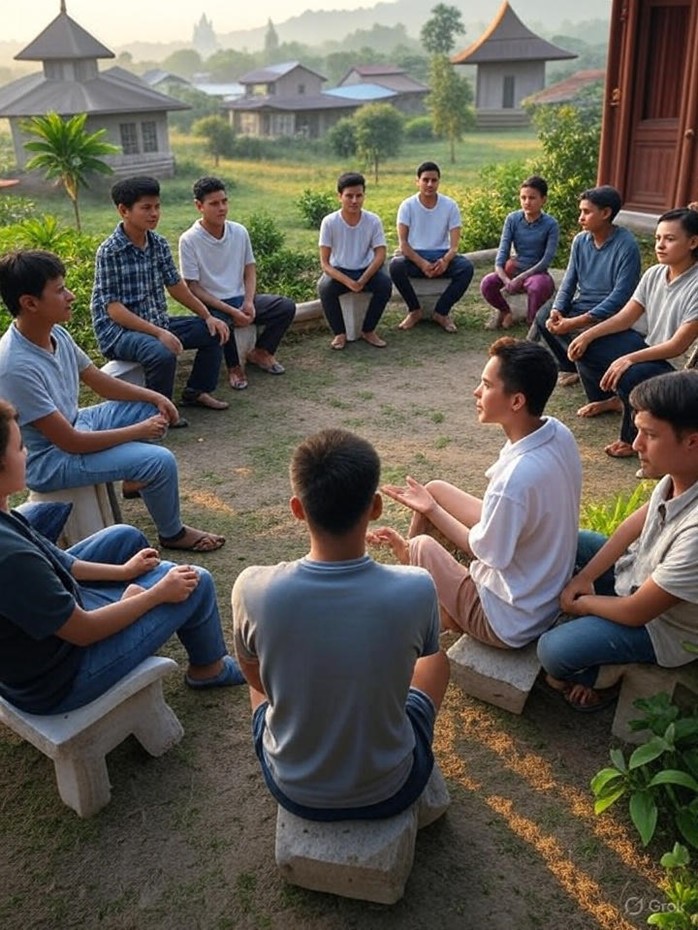
Creating Safe Spaces for Expression: Facilitating platforms where youth can safely share their experiences, process their emotions, and find solidarity without fear, fostering that essential “voice.”
Fostering Environments of Safety and Trust: Rebuilding community networks, promoting nonviolent conflict resolution, and working towards genuine justice and accountability — essential elements for psychological safety.
Prioritizing Education that Heals: Reimagining education not just for skills, but as a space for social-emotional learning, critical thinking, peacebuilding, and restoring a sense of agency and hope.
“Anything less is betrayal dressed as progress.” Building gleaming structures while the minds and hearts of the future generation remain fractured by unaddressed pain is the deepest betrayal of their potential and the nation’s promise. Khin Maung Myint’s essay is a profound wake-up call. If Myanmar is to have a future that is truly “free and lasting,” it must “begin not just with laws or roads, but with the quiet, patient work of restoring the human spirit.” The unseen wounds of the youth are the most critical foundation to mend. Their healing is not separate from national rebuilding; it is the bedrock upon which any lasting future must stand. Ignoring this is to build on sand, perilously close to the fault line of recurring crisis. The time to tend to the scorched earth of the soul is now. Therefore, I am strongly attached to the words that the pain that clings from childhood, impossible to cast off, shapes a lifetime.