
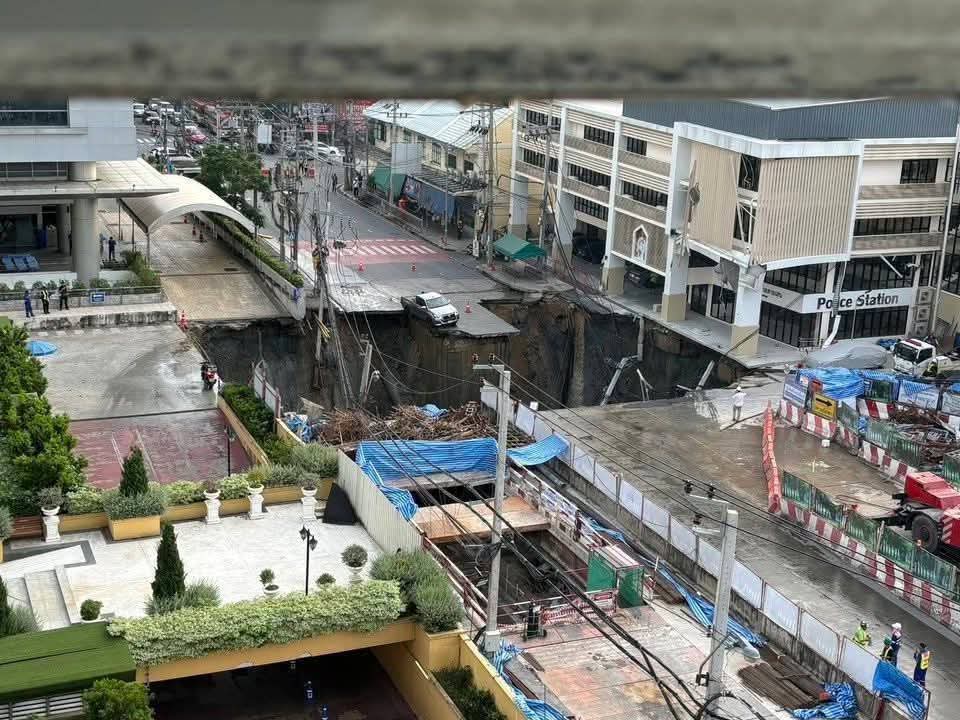
CITING the landslide in front of Bangkok’s Wachira Phayaban Hospital, author Mee Eain Shin Dr Nightingale suggested on social media that Myanmar should reduce the use of underground water to avoid such cases.
Heavy rains caused the landslide at 7:13 am on 24 September, resulting in a sinkhole about 150 feet (50 metres) deep. No one was injured, but the road has been closed, and 3,500 patients in the hospital have been moved to safer facilities.
According to landslide surveys, Yangon is one of the 48 cities in the world with subsidence.
“Yangon is one among 48 cities with subsidence. About two-thirds of the Yangon Region are facing it, and it is the worst in South Dagon Myothit, according to Singapore’s Nanyang Technological University,” she said.
Some areas of Yangon were sinking between 0.01 and 7.5 cm per year from 2014 to 2020, and the worst, South Dagon, suffered 7.5cm subsidence per year, possibly due to overusing underground water, said the study.
With an eight-million population, Yangon had to depend more on artesian wells for freshwater, while internationally funded water supply projects seemed to be stopped. Ground sinking was prominent in South Dagon Myothit and Hlinethaya, she said, quoting the study.
A 2014 paper titled “Yangon Seismic Analysis” published by researchers from Thailand’s Chulalongkorn University and the Myanmar Earthquake Commission, based on satellite technology, suggests that the land between the Dagon University and the East Dagon Industrial Zone is sinking at a rate of more than two inches per year, possibly due to the extraction of excess groundwater, advising this factor to be considered in future Yangon urban development. — Htun Htun/ZN