
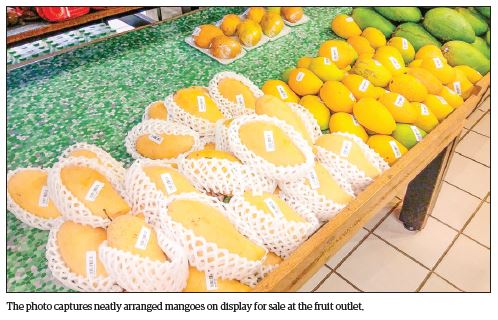
Fruit traders are facing a series of challenges while exporting mangoes to China this year, like watermelon export.
At present, Myanmar’s watermelons and muskmelons are exported to China through the Bhamo-Mongla road channel. The traders are bracing for transport hurdles, such as rough roads and extreme weather conditions, affecting the quality of the fruits. Therefore, there seems to be no other option than Muse Road during the coming mango season, the Khwanyo Fruit Depot stated.
As a result of this, exporters face big challenges depending on the export channel and fruit quality, according to the Khwanyo Fruit Depot.
“Myanmar’s mango export to China has risen since 1990. The negative consequences of the COVID-19 pandemic shut down some borders, and fruit exporters were forced to explore new road access, which have long distances and bumpy roads. As they barely make a profit, watermelon exporters are contemplating market conditions amid market hurdles, said an official of the Khwanyo Fruit Depot.
He continued that some growers try their luck against risks. There do not seem to be any other road channels for a smooth flow of trade except for Muse. If there is transport facilitation, there is market potential for Seintalone, Shwehintha and other mango varieties in the competitive market of China despite some unexpected challenges. He wished the best for the stakeholders in the supply chain, including mango growers, freight forwarders, brokers and exporters.
The price of Seintalone mango hit 120-180 yuan per 16 kg in early April 2023. They fetched approximately K50,000 per 16-kilogramme basket in the domestic market.
The high cost of cultivation input batters growers. Last year, low use of cultivation input affected quality, causing postharvest diseases such as stem end rot and black spots in fruit.
Some traders did not even cover the cultivation cost due to the inferior quality of Seintalone mango.
Of about 200 mango varieties that originated in Myanmar, Seintalone, Shwehintha, Padamya Ngamauk, Yinkwe, and Machitsu varieties are primarily grown. The foreign market prefers Seintalone varieties.
Ayeyawady Region possesses the most extensive mango plantation acres, having about 46,000 acres. Bago Region is the second largest producer, with 43,000 acres, and Mandalay has 29,000 acres of mango. There are over 24,000 acres in Kayin State, over 20,400 acres in Shan State and over 20,000 acres in Sagaing Region, according to the association. — NN/EM