
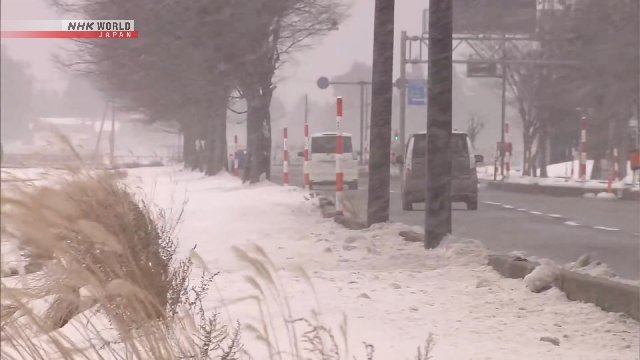
Blizzards are affecting parts of northern to western Japan, mainly on the Sea of Japan side. Weather officials are warning that the severe conditions will peak through Monday morning.
The Japan Meteorological Agency says a strong winter pressure pattern and a cold air mass are bringing the heavy snow and winds.
A maximum instantaneous wind speed of 115.2 kilometers per hour was recorded on Miyake-jima, one of the Izu Islands, during the three hours through 6 p.m. on Sunday. Tottori Airport saw a wind speed of 98.28 kilometers in that period, while Kanazawa City recorded 88.92 kilometers.
Snowfall is intensifying mainly in the Tohoku to Hokuriku regions, parts of which were experiencing blizzards. Some areas received 10 to 20 centimeters of snowfall during the same period.
Accumulation had reached 1.29 meters in Uonuma City, Niigata Prefecture as of 6 p.m. Tadami Town in Fukushima Prefecture recorded 95 centimeters, Hokkaido's Otaru City saw 56 centimeters, while Yonezawa City in Yamagata Prefecture got 33 centimeters.
Snowfall in the 24-hour period through Monday evening in mountainous areas is expected to reach 80 centimeters in the Tohoku region, 70 centimeters in Niigata and Gifu prefectures, 60 centimeters in northern Kanto and the Hokuriku region, 50 centimeters in Hokkaido, the Kinki region and Nagano Prefecture, and 30 centimeters in the Chugoku region.
Strong winds are expected to continue. A maximum wind speed is predicted to reach 90 kilometers per hour on the Izu Islands, 82.8 kilometers in Hokkaido and Hokuriku, Kanto, Kinki and Chugoku regions, and 72 kilometers in the Tohoku region and Niigata Prefecture.
The meteorological agency also forecasts a maximum instantaneous wind speed of between 108 and 126 kilometers per hour. High waves and rough seas are expected to continue.
Weather officials are warning of heavy snow, blizzards, snowdrifts and their impact on transportation systems, and also gusty winds and high waves.
They also urge people to be cautious about snow falling from roofs, snow-caused power outages and avalanches. In addition, they say lightning strikes and gusty winds, including tornadoes, are possible because atmospheric conditions are very unstable.
nhk