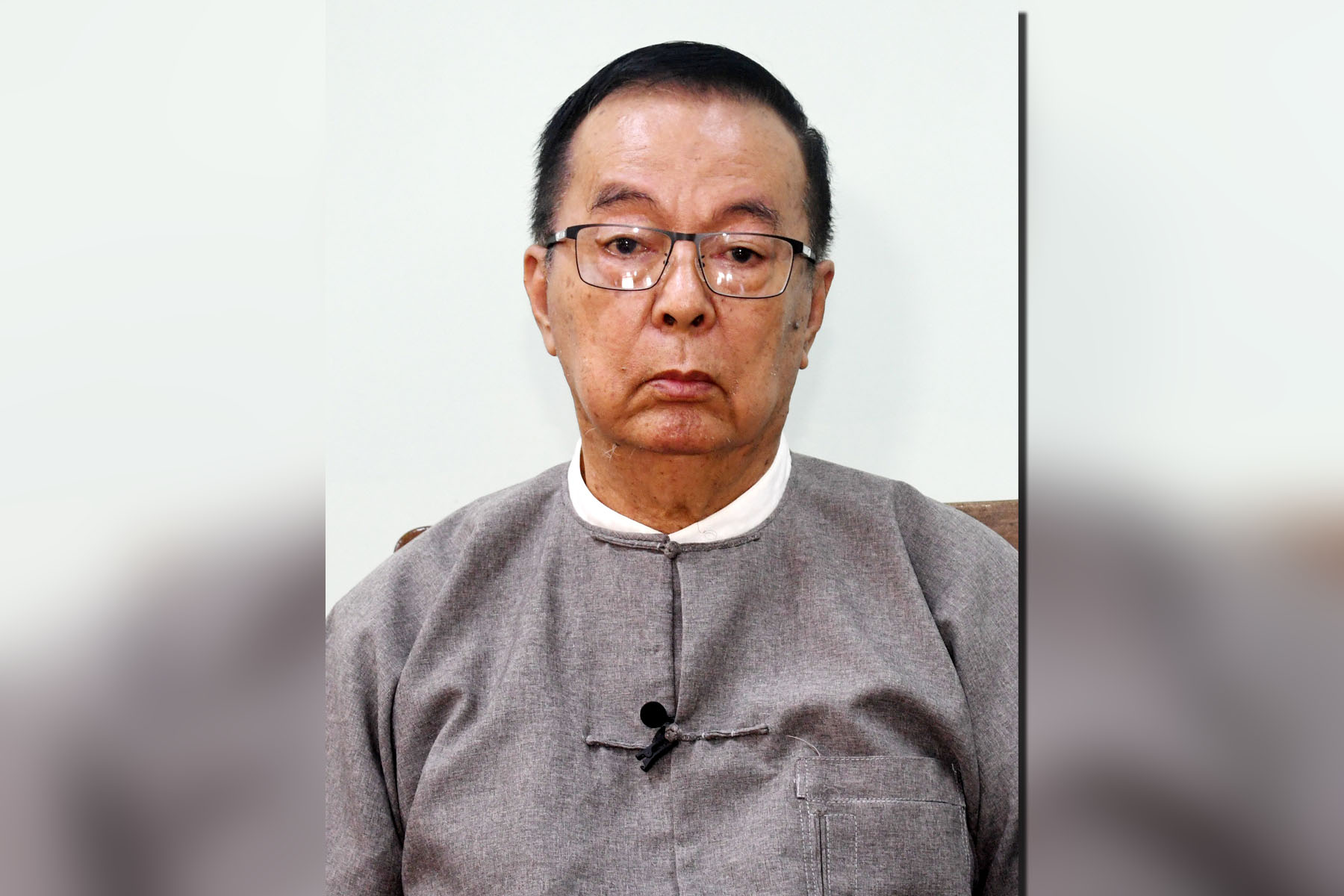
U Win Lwin
Retired Ambassador
When Operation Nagamin began, I was in charge of the relevant department at the Ministry of Foreign Affairs. As there was an increase in people entering the country illegally, we conducted a census. I believe the first pilot project took place in Mingala Taungnyunt. From there, we moved on to Sittway in Rakhine State. During this process, people who had entered Rakhine State for various reasons and lacked official registration documents fled.
When they fled, the Ministry of Foreign Affairs received a report that there were about 800 people; over time, this number gradually grew into a large and widespread community. The number on the other side also grew to hundreds of thousands, and complaints were raised between the two sides. The government conducted an investigation, after which the two sides met for discussions on two or three occasions. The other side also formed a delegation led by its Foreign Minister, and we did the same. We discussed the issue extensively, and the Myanmar side stated that our country shares land and water borders with Bangladesh and that, as it was a newly independent country, we would do everything possible in accordance with our policy toward neighbouring countries. The elders decided to accept this approach: if a person residing here was found to have a legitimate claim, we would accept them. On that basis, we proceeded with negotiations.
When we say they will be accepted back, it appears that, among those who fled — numbering over 100,000, as I mentioned earlier — only a little over 3,000 people actually possess genuine Myanmar registration cards. The rest offer explanations such as having fled, having their tents burned, disappearing, being left behind, or losing their registration cards. In any case, if they are truly people who have lived in Rakhine State, Myanmar, they will be accepted, and so on.
Of the registration certificates, about 3,000 were genuine. Among the rest, some had fake registration certificates, while others had fake household cards. In any case, if a person truly had lived in Rakhine State, Myanmar, I accepted them. In total, I accepted and recognized about 130,000 — perhaps 140,000; I do not remember the exact number. In this regard, Myanmar was the first — indeed, the seventh — country in the world to recognize this. The meaning of this was to uphold a good-neighbor policy. I accepted them in a spirit of friendship.
They also insisted on taking everyone back, saying nothing and simply accepting them. This side agreed, and when it did, the process was carried out in stages. If they had lived in Rakhine State, we would accept them regardless, and we did so without further verification. Because the two countries are neighbours, the acceptance was based on friendship — in that sense.
Now, finally, this is the third time. There was a second time, and that process has ended. For the third time, Myanmar, as a neighbouring country, stated — as it had before — that if a person was genuinely from Rakhine State, they would be accepted. However, this time the other side acted differently. Their leadership was no longer the same as before, and although they had previously sent back those who were accepted here, this time they did not do so. Instead, they internationalized the issue, turning it into a global matter rather than a simple issue between two countries.
When this issue became internationalized, the entire world immediately became aware of it. Information technology was used, and Myanmar was affected. The situation was leveraged to turn it into a global problem. We do not know who was responsible—whether it was the relevant country or organizations sharing the same religion as that country. In reality, the matter was minor, and this side had accepted it honestly, as before. However, sending people back was delayed, and the case was brought before the World Court. When the case was filed, it carried severe charges.
In fact, police officers were killed in the incident. Compared with the killings and bombings taking place in the Middle East, this incident was minor and largely unrelated. For political gain, people from their own country are being targeted — undermining the ruling government and harming the nation itself. This has damaged the relationship between two countries that must coexist, whether they like it or not. The real issue is not merely the lawsuit; it is that Myanmar has been taken to the World Court by a country with which we have never had a conflict and of which we had little prior knowledge. Consider whether this is right or wrong — whether this is truly just.
The relevant country is not simply making an accusation; the claim comes from a distant country that intervenes deliberately, conspires, and creates this problem. This has nothing to do with any individual or policy—it is, simply put, a matter of plain fact. Ideally, if someone is affected, they have the right to respond. In this case, however, the person responsible did not commit the act; it was carried out by someone far from the area and completely unrelated. So what is the difference between then and now? When two countries are neighbors and share a land border, they should cooperate for a lifetime, whether they like it or not. At a time when the world is facing such challenges, a global organization has not encouraged collaboration but has instead driven the two countries further apart. I see this as a simple matter, not caused by any individual. There are many problems in the world, and neighbors have many issues they need to handle together. I see this as a situation in which they simply do not want to face each other.
Dr Myint Thein
Member of Myanmar Historical Commission
The Rohingya people do not actually exist in our country. There is no mention of this group in the history of Rakhine, nor in the history of Myanmar. In the early period of Myanmar’s history, about six documents were written concerning one hundred and one people, and none of these documents mention the Rohingya. So how did this issue arise? Previously, they were referred to as Rakhine Muslims, Bengalis, Chattogram Thar, or sometimes Khao Taw. The name Khao Taw was still in use during the Myanma Socialist Programme Party era, up until the 1980s.
This term did not exist at that time. English records show that this name does not appear in either colonial or contemporary documents. In 1872, the British first entered Burma and began taking a census in the Rakhine State and Lower Myanmar. The census was conducted in 1881, and then again in subsequent years. Thereafter, censuses were conducted every ten years — 1891, 1901, 1911, 1921, 1931, and 1941. These censuses included information on ethnicity, population, gender, and age. In the Rakhine State censuses, the terms used were “Bengalis” and “Chattogram Thar” and sometimes “Hindustan”. Although the British did not always conduct the census with complete accuracy regarding how many people entered or left the region, this particular term did not appear until the Second World War.
This name appears relatively late. A scholar who studied this thoroughly noted that he had previously served as a British ambassador to Thailand, Vietnam, and Laos. When he studied this group, he searched for all available evidence from the British colonial period in India. He examined reports, censuses, official records, and court rulings. What he concluded from this research was that, during the 122 years that the British occupied and administered Rakhine, there was no mention of the word “Rohingya” in any of the evidence. Who is this scholar? His name is Derek Tonkin. He also confirmed that he found no occurrence of the word “Rohingya” in the historical records. Similarly, a prominent researcher on Rakhine, Jacques Leider, wrote in the Oxford Encyclopedia of Asia that this term became popular around 1950. From this, we can infer that this group is a relatively recent, newly defined community.
Another point is: when did this name emerge? The name only came into being after World War II. However, the fundamental reason for the emergence of this name after World War II was that, in 1947, Muslims in India sought to separate. When they attempted to form Pakistan, the Muslims in Buthidaung and Maungtaw stated that if they wanted to separate from India, they should be included in that new country. They approached the leader of the Pakistan secession movement, Ali Jinnah, from India and requested to be incorporated into Pakistan.
But Ali Jinnah refused. In 1947, General Aung San went to London to sign the Aung San-Attlee Agreement. Afterwards, when he traveled to India, he met with Ali Jinnah and the Muslim separatist leader. During the meeting, the General said, “Relax on this matter; we have no desire to merge with any other country, and we are against all those who try to secede from it.” He also reassured them, saying, “There is no need to worry about it.” The Muslim groups in Buthidaung and Maungtaw, who had attempted to merge, eventually considered how they could establish and claim a separate state within Myanmar after the Second World War.
The problem was that, when Myanmar gained independence in 1948, the Rakhine ethnic leaders in Rakhine began demanding a separate state and an autonomous region. The Bengalis feared that granting Rakhine such independence would lead to increased oppression against them. As a result, they began considering demands for self-administration of their own and started planning how to achieve it.
One of them was that around 1948, the Mujahid leaders began making demands on behalf of their people. At that time, the Muslim liberation leader at the Muslim Conference requested a state for them as Rakhine Muslims. Then, in 1951, during the Muslim Conference held in Ale Than Kyaw village in Maungtaw, they also requested a separate state for the Bengalis. When they made this request, the term “Rohingya” was not used. They only asked for a separate state for themselves and to be recognized as Rakhine Muslims so that they could operate independently.
The Rakhine people do not like the term “Rakhine Muslim” because there are no Muslims among the Rakhine, so they do not accept it. At that time, they were referred to as Chattogram Thar, Bengali, Rakhine Muslims, or the people of Kho Taw. Among these names, the one we preferred was “Rakhine Muslim”, but since the Rakhine people did not accept it, a new name had to be created.
When I think about it, this name began to become widespread around 1950. The word “Rowentgya” was first used around 1948 to refer to refugees who had been displaced from elsewhere. Later, a person named Abdul Ghaffar, who was elected to parliament, mentioned it in parliament around 1950. The term “Rohingya” then began to be used to refer to their people. At the same time, Abdul Ghaffar wrote a comprehensive historical article about the Rohingya in the Guardian newspaper. The article, which focused on the Sudetan Muslims, was published in 1951. Then, in May 1960, another person named MA Tahi Ba Tha wrote about it as well. Similarly, when we refer to the Rowanghnya, we are not necessarily referring to them as Rohingya. He also explained in the Guardian how the Rowanghnya people came into being.
In other words, this name was clearly created around 1950. It is evident that this is not an indigenous ethnic group and that it was deliberately constructed later. When the census was conducted in Sittway in 1953, the people of Buthidaung and Maungtaw included all those who had come from Chattogram. They were compelled to register and were forcibly counted in the census. Among those recorded, some were listed as Rakhine Muslims, while others were listed as Rohingyas.
Therefore, we can conclude that the term they use is a fabricated ethnic name that emerged around 1950, as noted by Western researchers. It can be assumed that it was deliberately created and adopted for political purposes. — The Information Team