
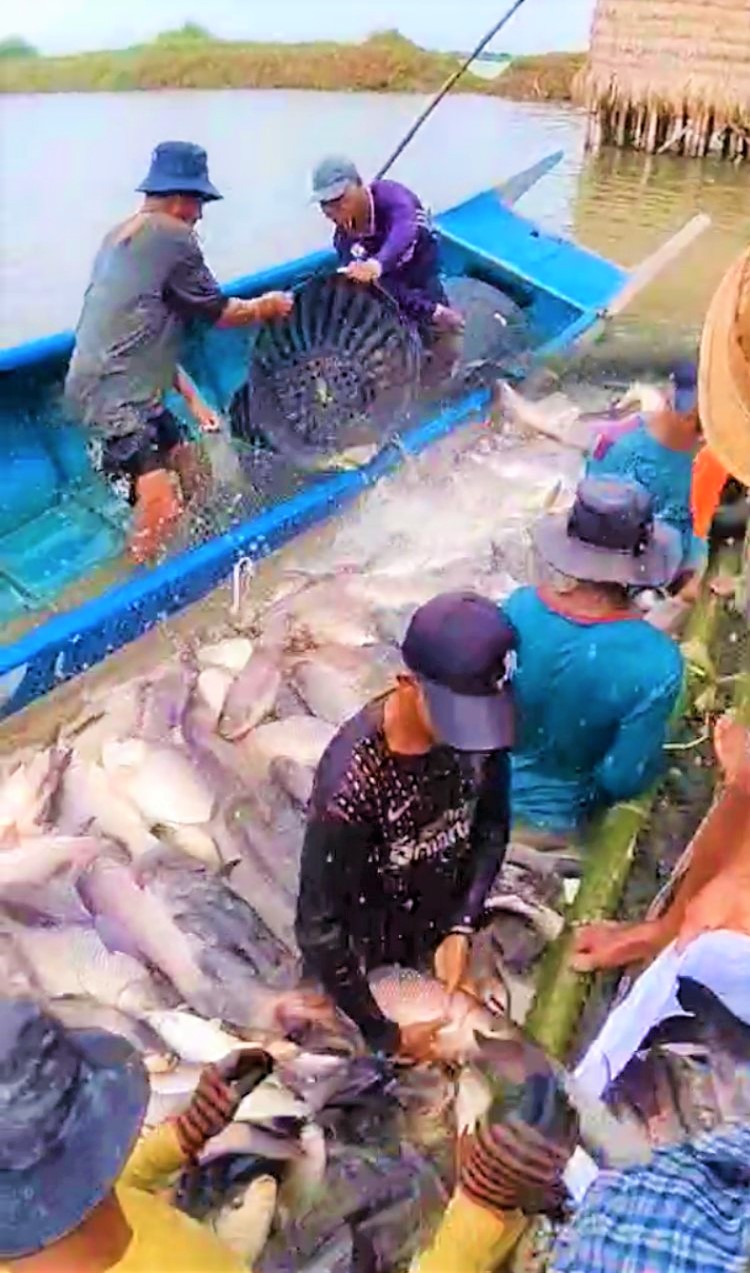
THE fish farming industry in Bago Region, which produces aquatic products sufficient for local consumption and exports the surplus abroad, has been steadily increasing its production year by year, according to the Bago Region Fisheries Federation.
The region produces marine products from farming, reserved fishery and open fishery, and it produced 65,321.64 visses in the 2021-2022 financial year, 65,026 visses in 2022-2023, 67,204.208 visses in 2023-2024, 67,970.748 visses in 2024-2025, and 68,410.94 visses in 2025-2026, showing annual growth.
The reserved fishery also increased annually, reaching 89,504.65 visses in 2021-2022, 90,827 visses in 2022-2023, 91,917.618 visses in 2023-2024, 92,503.243 visses in 2024-2025, and 92,965.38 visses in 2025-2026.
The open fishery showed annual increases, producing 133,964.03 visses in 2021-2022, 134,972 visses in 2022-2023, 137,040.008 visses in 2023- 2024, 138,265.62 visses in 2024-2025, and 138,957 visses in 2025-2026. Altogether, the three fisheries sectors produced a total of 1,474,850.531 visses of aquatic products between February 2021 and March 2026.
“Bago Region has sufficient aquatic products, and the surplus is being supplied to Nay Pyi Taw and Yangon. It is encouraging to see freshwater production increasing every year. At present, the region has dried fish processing, fish paste production, powdered fish paste production, ready-to-eat fish paste processing, pounded fish paste production, and dried snakehead fish processing. As there is no value-added fish processing factory yet, we are working, with the support of the regional government, to establish cold storage facilities and develop value-added fish products,” said U Tun Tun Naing, Chairman of the Bago Region Fisheries Federation.
In Bago Region, a variety of fish are harvested from natural water from September through the end of March each year. The fish, together with farmed fish, are supplied to Shwe Padauk Fish Market and Kyimyindine Sanpya Fish Market in Kyimyindine Township, Yangon, and to markets in Nay Pyi Taw. The eel fillets are also exported to China.
The region possesses over 30,000 acres of fish farming ponds, and makes efforts to increase the marine products production year by year to generate huge foreign incomes. — Thitsa (MNA)/KTZH