
By Junior Thin
Great changes in the world are not always created by very big actions. Sometimes they begin with small and simple good deeds done in our daily lives. If people help one another with kindness, sympathy, and responsibility, society will gradually become better and more peaceful.
When individuals try to do their duties honestly and help others whenever possible, these small actions can influence many people around them. As a result, the community becomes stronger and more united.
Therefore, instead of waiting for big opportunities to change the world, every person should start with small, good actions in their daily life. These simple efforts can finally lead to meaningful and positive changes in society.
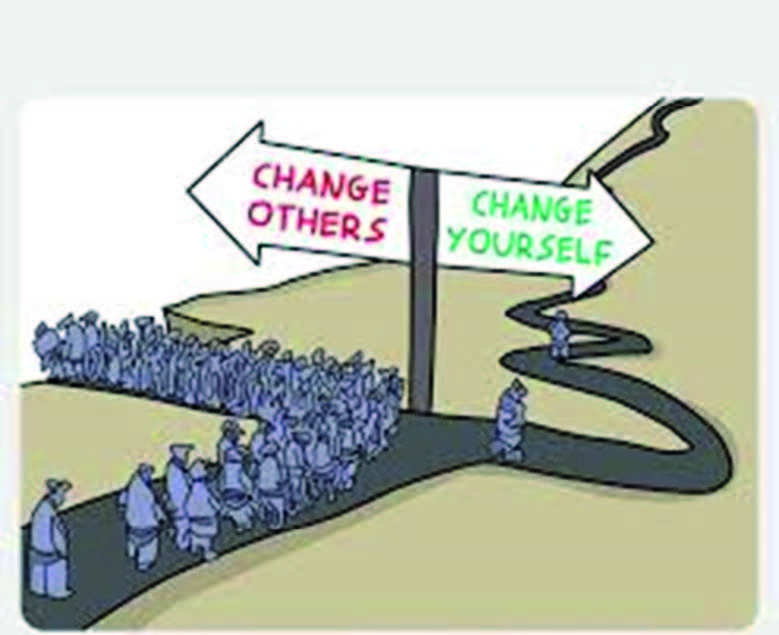
Changing oneself is the way to change the world. Human daily lives cannot be separated from the surrounding environment. In society, people often face many difficulties and inconveniences related to politics, economics, social affairs, and workplace conditions.
If we truly want to create genuine progress and change in these problems, instead of blaming and criticizing others, we should begin by changing ourselves. By building ourselves as disciplined individuals with good character, honesty, responsibility, and awareness of our duties, we can become useful persons not only for ourselves but also for others. This is the single most important key to benefiting both oneself and society.
Avoiding Blame and the Foundation of Change
By nature, people tend to hide their own weaknesses and shift their mistakes onto others. In workplaces, when we see problems such as a lack of unity, irresponsibility, or other undesirable situations, people often blame others by saying, “It is because of them” or “It is because of the system.” Such blaming only gives temporary psychological relief.
Criticism and blame do not produce constructive solutions. Instead, they make the environment more tense and toxic. According to psychologists, blaming others is often an attempt to make oneself appear superior by pointing out others’ weaknesses. Such behaviour does not create positive results and may even harm the surrounding environment.
One of the greatest social movements in the world was inspired by the famous guidance of Mahatma Gandhi, who said, “Be the change that you wish to see in the world.”
This statement changed the way people think. Gandhi emphasized that change should not begin outside but within ourselves. Instead of blaming the environment, we should begin by becoming the kind of person we want to see in the world. By developing empathy, discipline, and responsibility within ourselves, we begin the process of changing the world around us. Only through this method can we demonstrate true responsibility, awareness, and leadership.
Self-Development and Taking Responsibility with Sacrifice
To become a person who benefits oneself and society, we must begin by building ourselves with moral values and discipline. Most problems in the world begin in the hearts of individuals. Greed, anger, and ignorance arise from individuals and gradually combine to create major social problems.
People often try to hide their own faults while exaggerating the faults of others. As a result, problems become worse while time is wasted on criticism. Therefore, the first task of someone who wants to change the world is to change their own heart and mind. Self-reflection and self-examination are the first steps towards real change.
Discipline and Good Character
Discipline is as fundamental as breathing. It can begin with simple daily habits such as being punctual, keeping promises, and maintaining personal integrity. Discipline means controlling oneself to act according to one's goals and values. It is the foundation of all success. With discipline, a person can fulfil responsibilities properly in both professional and family life.
Good character means remaining honest, fair, and morally upright even when no one is watching. Psychologists say that good character is an essential component of leadership. When a person is disciplined and morally upright, their words and actions become consistent, and people around them naturally develop trust in them.
Loyalty and Sacrifice
Loyalty means faithfully standing by one’s commitments, relationships, and organization. In the workplace, an employee’s loyalty greatly contributes to the stability of the organization. Even when difficulties and temptations arise, remaining faithful to one’s responsibilities and principles is a highly respected quality.
Sacrifice means giving up personal benefits, time, or energy for the benefit of others. Instead of merely criticizing the lack of compassion in society, personally helping others in their difficulties is a true expression of empathy. Sacrifice is one of the most fundamental attitudes in working for the welfare of others.
Responsibility and Consideration
Fulfilling responsibilities means carrying out one’s duties towards work, family, and society with dedication and effort. In a time when irresponsibility is commonly seen, those who work hard and take responsibility can become role models for others.
Consideration and emotional intelligence are also very important social virtues. Emotional intelligence is the ability to understand others’ feelings and manage one’s own emotions. Consideration means expressing the truth at the right time and in the right way without hurting others’ dignity. This helps reduce unnecessary conflicts in workplaces and communities.
The Ripple Effect of Change and Serving the Common Good
When a person builds himself with discipline and moral values, the inner change naturally spreads outward into the world. Changing oneself is like throwing a stone into water. The impact of a single stone creates ripples that spread across the entire surface.
Becoming a Role Model
When a person demonstrates discipline, loyalty, and responsibility, their actions inspire others. Instead of teaching with words alone, showing good behaviour through personal actions becomes a powerful example.
Young people especially tend to imitate the behaviour of leaders rather than just listening to their words. In this way, a person’s conduct can guide others toward a better path and become a role model for society.
Being Useful to Society and the World
When a person becomes disciplined and takes pride in his work, the quality of his work improves, and mistakes decrease. For example, when an engineer builds a structure responsibly with discipline and honesty, it provides safety and reliability for those who use it. In this way, one’s work becomes beneficial to society.
According to social scientists, when individuals improve their moral values and character, they collectively build social capital – trust, cooperation, and unity within society. As a result, individual change can lead society towards peace and harmony.
Many people feel that changing the world is too big a task and do not know where to begin. However, the answer is simple: start by changing oneself.
Striving to become disciplined, morally upright, loyal, self-sacrificing, responsible, and considerate benefits not only oneself but also society and the world. Blaming others only wastes time, but improving oneself creates real positive change.
Therefore, even a small change within oneself can lead to great changes in the world. Without delaying any longer, we should begin today. Although external changes may take time, internal change can begin immediately. By firmly believing that changing oneself is the first step towards changing the world, we should start improving ourselves from today.