By Thet Mon Tun
The annual top meetings of China’s legislative and political advisory bodies were convened from 4 to 12 March 2026. A wide range of topics from domestic goals and objectives, legal reviews, accelerating development plans, advancing high-quality technology, Artificial Intelligence, quantum technology and robotics to foreign policy to contribute to ensuring global stability were discussed.
Because China plays a major role on the international stage, this year’s Two Sessions attracted significant attention from foreign audiences. It is not only the first year of the upcoming 15th Five-Year Plan, but the meeting took place amid rising global uncertainty, economic volatility and geopolitical tensions.
Advancing technologies
As China accomplished its 14th National Five-Year Plan last year with colourful achievements, this year, the Chinese people set themselves to start the engine for transforming their innovations into next steps – from good and high-quality technologies to hyper and very advanced techs with green development – as involved in the top priorities of the upcoming 15th Five-Year Plan of China.
In the previous Asia Pacific Economic Cooperation meeting last year, Chinese President Xi Jinping urged promoting the peaceful development of AI, along with prioritizing to ensure safety and fairness for all people from all over the world. In fact, we have already witnessed that China’s peaceful rise and peaceful development have contributed a lot to benefiting mankind. So, this year, since it is the initial year in transiting good and high-quality capacity to hyper and advanced tech innovation of China, that breakthrough is also expected to provide peaceful benefits to the world.
Rejuvenation without ignoring the psychological contract
Beyond the headlines telling about trade, economic growth, science and technology, and national GDP targets, it is learned that the congress reviewed a draft law on promoting and protecting ethnic unity. Without a doubt, internal unity is considered of great importance for every nation in today’s increasingly competitive and aggressive global environment.
Reports suggested that the draft law aims to strengthen the legal foundation and statutory responsibility for advancing common prosperity among the 56 ethnic groups of China. It also aims to protect the ethnic unity within a legal framework by ensuring the rule of law. “Targeting acts that erode ethnic unity, violent terrorism, ethnic separatism and religious extremism will face criminal liability if constituting crimes,” it reportedly said.
Thus, the proposed draft law is expected to provide a greater sense of security among ethnic minorities, which in turn allows for focus on steadfast development in the ethnic population areas, the ethnic representatives to the Congress remarked.
Multilateralism: A remedy to heal the world
Come the year 2026, time flies; global trends and directions have shifted; and the world has entered a new period of turbulence. Still, challenges remain to uphold the voice and rights of the Global South.
The collective rise of the Global South is a breakthrough in reshaping the world. Yet, there are many challenges for the shared journey of Global South countries towards modernization including eradicating poverty, hunger, war and inequality. The role of the Global South, especially Asia and Africa, in resisting and fighting against colonialism in human history should not be denied or discredited. Sovereign equality must be respected.
The world is a shared place where countries with different behaviours, different histories, different beliefs and different colours live together. Accordingly, safeguarding peace and the well-being of the world we live in is the common interest of all nations. Unity and equality are placed as some crucial measures in balancing disparities and unfair treatment among diversities. Should major countries play a constructive role by using their strengths? China is a large country that is highly committed to strengthening coordination with the Global South on the road to building a community with a shared future.
China’s heart is with the Global South; China’s root is in the Global South – Wang Yi
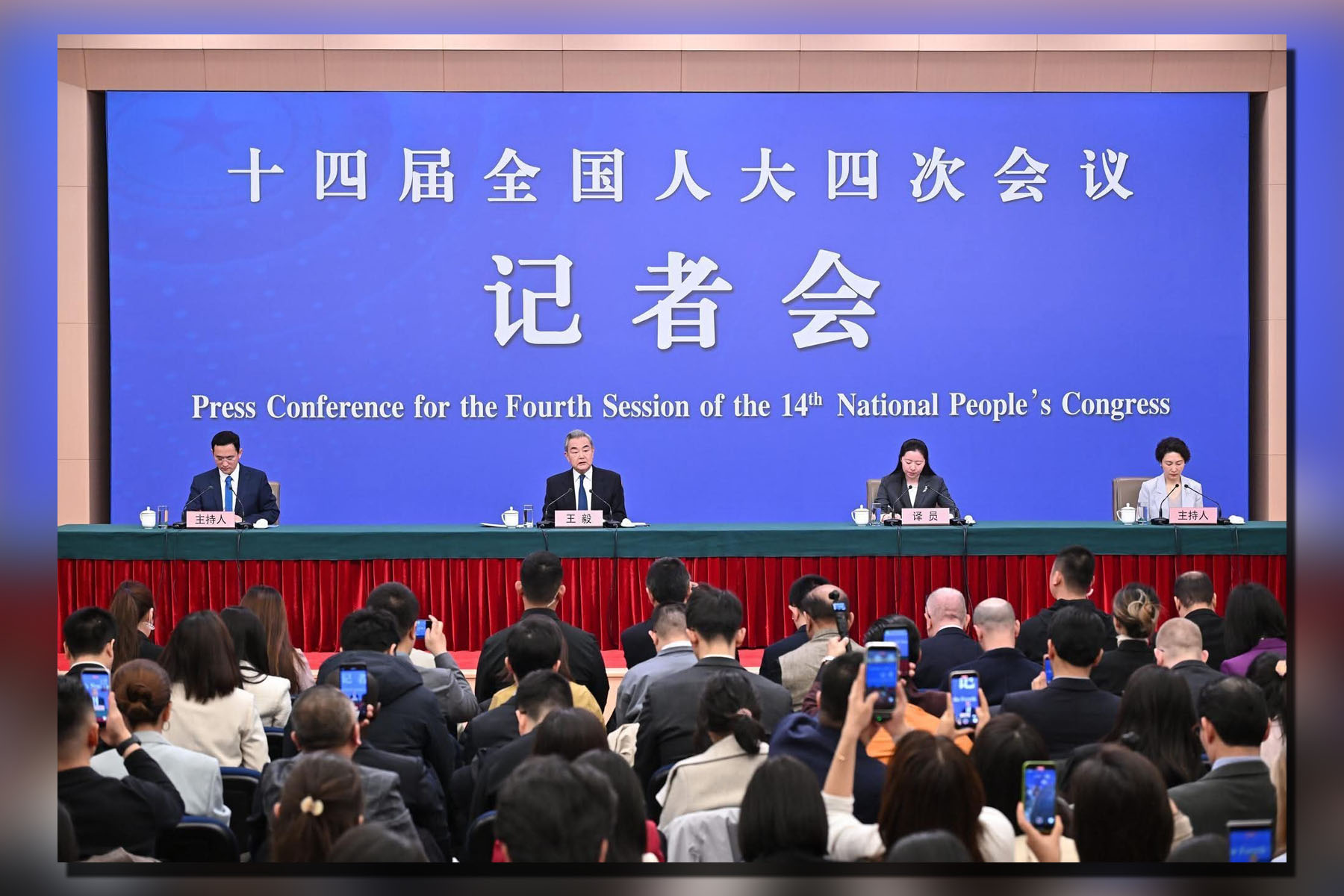
Chinese Foreign Minister Wang Yi, also a member of the Political Bureau of the CPC Central Committee, answered questions from Chinese and foreign media on 8 March at the sidelines of the event. Echoing the Chinese FM’s words during the press conference, it can be seen that China’s policy on global peace, global governance, and the role of the Global South remains consistently unchanged, promoting the practices of multilateralism with values of the United Nations at the core.
He reiterated the vital role of the United Nations in a very hectic, aggressive and volatile international landscape. The UN remains at the position of the cornerstone to prevent the world from returning to the law of the jungle, said the Chinese FM, encouraging the Global South countries to unite and cooperate in defending their rights and interests.
Impressively, he also dismissed the rhetoric ideology of ruling the world by a few major countries, asserting that global governance should be engaged by all countries; and global affairs should be decided by all countries on an equal basis. “China has inscribed in its Constitution that it follows an independent foreign policy and is committed to pursuing a path of peaceful development. Chinese leaders have often declared to the world that no matter how the international situation evolves and how strong China becomes, it will never seek hegemony or expansion,” he said.
Motivated to build a shared future, the FM affirmed that the 15th Five-Year Plan will not only be a new blueprint for China’s development but also a new vision of win-win cooperation with the rest of the world. To abridge, Chinese commitment to follow a community with a shared future not only for domestic prosperity but also for the global well-being is obviously observed in the recent Two Sessions event.