
By Min Min Zan
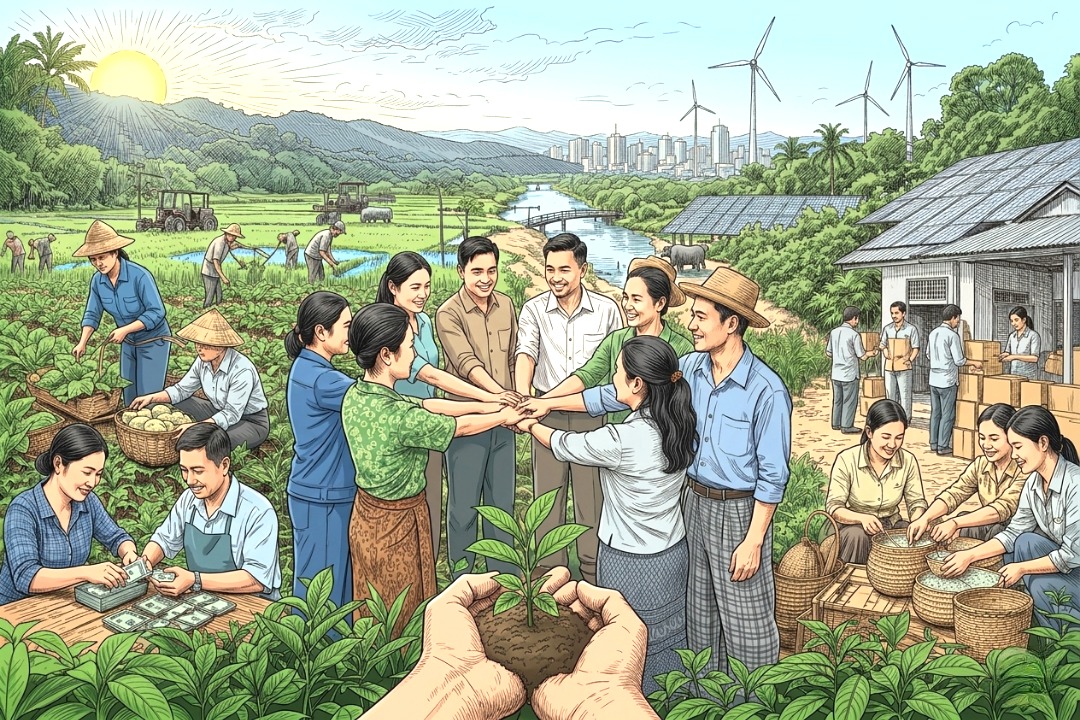
COOPERATIVES have long played an important role in improving the economic and social well-being of people around the world. They are organizations formed by individuals who voluntarily work together to achieve common economic, social, and cultural goals. In Myanmar, cooperatives have become an important mechanism for supporting rural development, promoting entrepreneurship, and improving the living standards of ordinary citizens. As a member of the international cooperative movement, Myanmar recognizes the significance of cooperatives in national development. At a time when the world economy faces numerous challenges, including inflation, geopolitical conflicts, climate-related disasters, and economic uncertainty, the cooperative system offers a practical and sustainable approach to achieving inclusive growth and prosperity.
The Central Cooperative Society of Myanmar became a member of the International Cooperative Alliance (ICA) on 7 September 1993. Since 1995, Myanmar has celebrated the International Day of Cooperatives every year. The cooperative movement promotes the principles of self-help, self-responsibility, democracy, equality, equity, and solidarity. These principles encourage people to work together for mutual benefit rather than pursuing individual interests alone. The annual celebration of the International Day of Cooperatives highlights the importance of cooperation in solving economic and social problems and in building stronger communities.
Throughout the world, economic inequality remains a serious concern. Although technological progress and globalization have created enormous wealth, many people continue to live in poverty. In many countries, a small percentage of the population controls a large share of national wealth, while millions struggle to meet their daily needs. This situation is especially challenging for workers, farmers, and small business owners who often lack sufficient capital to expand their activities or improve their productivity. As a result, many people seek ways to increase their income and improve their quality of life through collective action. Cooperatives provide an effective solution by enabling individuals with similar interests and needs to pool their resources and work together.
The fundamental idea of a cooperative is that people can achieve more through cooperation than through individual effort. Tasks that are too difficult or expensive for one person can often be accomplished when people combine their resources, skills, and knowledge. Cooperative members contribute funds, share responsibilities, and participate in decision-making processes. Because cooperatives are democratically managed, each member has a voice in determining the direction of the organization. This democratic structure promotes transparency, accountability, and fairness. It also strengthens trust among members and encourages active participation in community development.
Myanmar is a developing country with a population of more than fifty million people. Agriculture remains one of the most important sectors of the economy, providing livelihoods for a large portion of the population. In addition to agriculture, Micro, Small, and Medium Enterprises (MSMEs) play a critical role in generating employment, supporting local industries, and stimulating economic activity. However, these enterprises often face significant challenges, including limited access to finance, inadequate infrastructure, fluctuating market conditions, and rising production costs. In such circumstances, cooperatives can help entrepreneurs and farmers overcome difficulties by providing access to credit, shared equipment, training opportunities, and collective marketing channels.
Myanmar’s economy has experienced considerable difficulties in recent years. Economic growth has been affected by political instability, natural disasters, supply-chain disruptions, foreign exchange shortages, and rising energy costs. According to recent assessments, the country’s economic recovery remains fragile. The Asian Development Bank projects Myanmar’s economic growth to be around 2.4 per cent in 2026.
Furthermore, the World Bank has reported that Myanmar’s economy continues to face substantial pressures from rising fuel prices and external economic shocks. Increased energy costs have raised transportation and production expenses, making it more difficult for businesses to operate efficiently. Economic activity has shown some signs of stabilization, but structural challenges remain significant. Continued uncertainty, trade disruptions, and foreign exchange constraints continue to affect both businesses and consumers.
In this difficult environment, cooperatives can provide valuable support to communities and businesses. Agricultural cooperatives can help farmers purchase seeds, fertilizers, and equipment at lower costs. Savings and credit cooperatives can offer affordable financial services to individuals who may not have access to commercial banks. Consumer cooperatives can help members obtain essential goods at reasonable prices. Producer cooperatives can strengthen the bargaining power of small manufacturers and entrepreneurs by enabling them to market their products collectively. Through these activities, cooperatives contribute to income generation, employment creation, and poverty reduction.
The importance of cooperatives extends beyond Myanmar. Across the world, cooperative organizations serve hundreds of millions of people and operate in sectors such as agriculture, finance, healthcare, housing, retail, and energy. Many successful cooperatives have demonstrated that businesses can be profitable while also serving social objectives. By prioritizing the needs of their members rather than maximizing profits for external shareholders, cooperatives often promote more equitable and sustainable forms of economic development.
The global economy in 2026 presents both opportunities and challenges. International organizations project moderate global growth, but the pace remains below historical averages. The International Monetary Fund estimates that global economic growth will be around 3.1 to 3.3 per cent in 2026. However, the world economy continues to face risks from geopolitical conflicts, inflationary pressures, energy market volatility, and financial uncertainties. Rising commodity prices and disruptions in international trade have affected both developed and developing countries.
One major concern is the impact of geopolitical tensions on global economic stability. Recent conflicts in various regions have increased energy prices and disrupted supply chains, creating uncertainty for businesses and consumers worldwide. The World Bank has warned that higher fuel costs and geopolitical instability could slow economic growth and increase inflation in many countries. Developing economies are particularly vulnerable because they often depend heavily on imported fuel and essential commodities.
Another important trend shaping the global economy is technological innovation, particularly in artificial intelligence (AI). Advances in AI are creating new opportunities for productivity growth, business innovation, and economic expansion. Investment in technology sectors continues to drive growth in many countries. However, technological change also raises concerns about income inequality, job displacement, and the need for workforce adaptation. Governments, businesses, and educational institutions must work together to ensure that the benefits of technological progress are widely shared across society.
At the same time, climate change has emerged as a major economic challenge. Extreme weather events, floods, droughts, and natural disasters are causing significant economic losses around the world. Agricultural production, infrastructure, and public health are increasingly affected by climate-related risks. Countries must invest in sustainable development, renewable energy, and climate resilience to protect future economic growth. Cooperatives can contribute to these efforts by promoting environmentally sustainable practices, supporting local communities, and encouraging responsible resource management.
In Myanmar, the cooperative movement can play an especially important role in supporting rural development and economic resilience. Rural communities often face challenges such as limited access to markets, financial services, and modern technology. By organizing farmers, artisans, and small entrepreneurs into cooperative groups, communities can improve productivity, reduce costs, and increase their bargaining power. Cooperatives can also help members adapt to changing market conditions and environmental challenges through education, training, and collective action.
The success of cooperatives depends on strong leadership, effective management, active member participation, and supportive government policies. Government agencies, cooperative societies, and community leaders must work together to strengthen the cooperative sector. Investments in education, financial literacy, digital technology, and infrastructure can further enhance the effectiveness of cooperatives and increase their contribution to national development.
In conclusion, cooperatives are powerful instruments for promoting economic development, social inclusion, and community empowerment. In Myanmar, where many people face economic challenges and uncertainty, cooperatives provide practical solutions that enable individuals to work together for mutual benefit. They support farmers, workers, entrepreneurs, and rural communities by improving access to resources, finance, and markets.
In fact, Myanmar is not a country that is completely unfamiliar with the cooperative system. It is a nation that has accumulated a great deal of experience with cooperatives over many decades. If we can learn from the mistakes of the past and work together through close cooperation between the government and the people, Myanmar’s social and economic development can achieve success far beyond our expectations. On the occasion of the International Day of Cooperatives, I would like to present this message with sincere hope and confidence for a brighter future.