A well-organized and systematic farming approach must first be adopted as a foundation for advancing towards a modern, science-based livestock farming system.
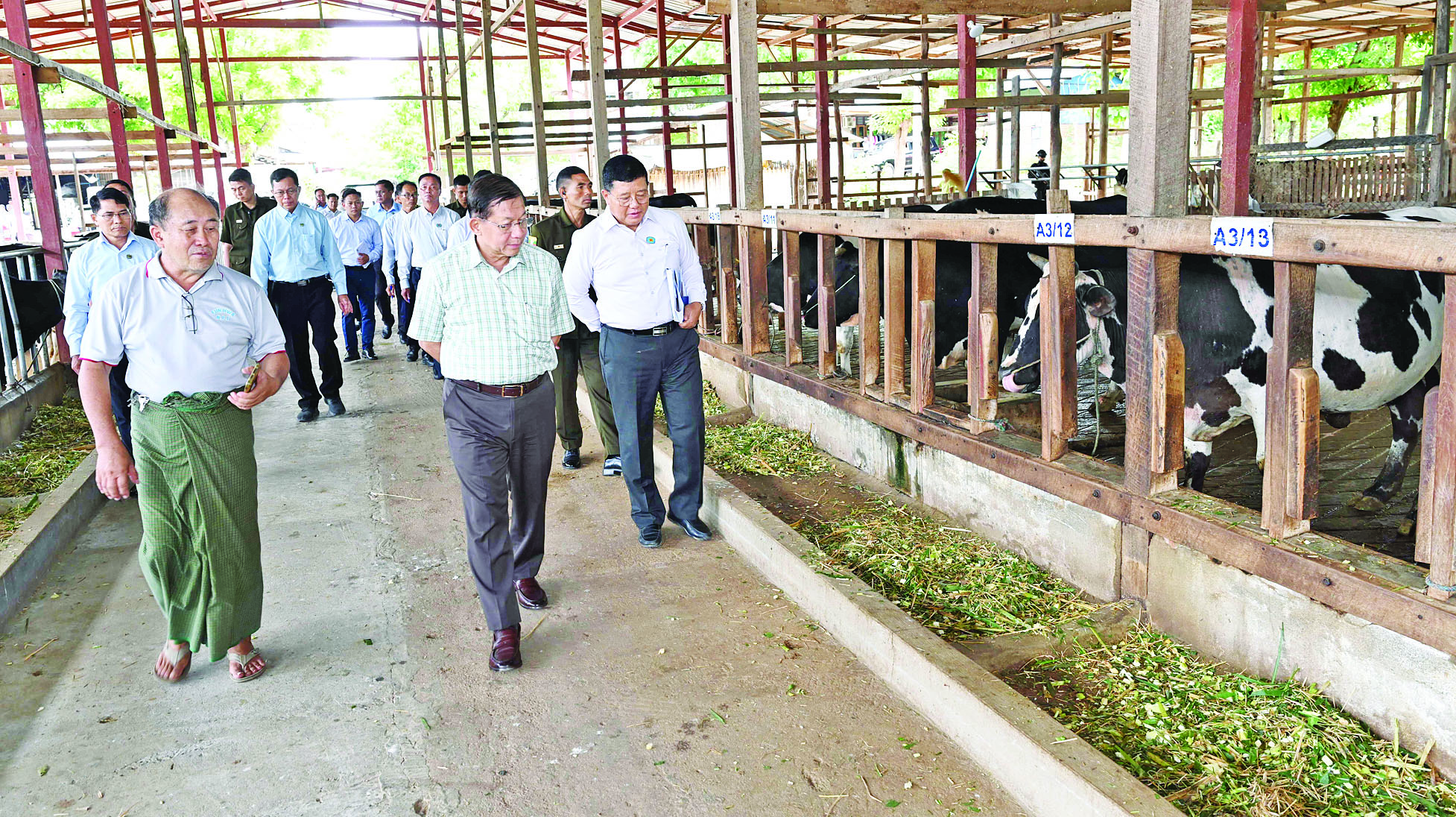
President of the Republic of the Union of Myanmar U Min Aung Hlaing conducted an inspection tour of livestock breeding activities in the Nay Pyi Taw Union Territory yesterday morning.
Accompanied by Vice-President U Nyo Saw, Union Ministers U Khin Maung Yi, U Min Naung and U Htein Lin, Nay Pyi Taw Council Chairman U Kan Myint Than and deputy ministers, the President observed the goat breeding farm of Sunlight Venture Co Ltd in Shwemyo Livestock Zone in Nay Pyi Taw Council Area. Businessperson U Myat Min Latt reported on operating the farm, feeding systems and plans.
In his response, the President said that feed and water systems must be properly arranged from the very beginning of the breeding process, and biosecurity measures also need to be systematically implemented. In addition to meat production, goat hides can also be distributed to the market. Moreover, forage grass cultivation for goats must be systematically carried out to ensure a continuous and sustainable production system.
The President inspected the pig breeding farm at the local battalion in the area of Shwemyo Livestock Zone. An official reported to the President on the work process, distribution of pigs, and sales of pork in various forms as meat, dry rations and ready-to-eat pork meals to relevant military commands.
Speaking on the occasion, the President underlined that rather than relying on the importation of pig breeds from abroad, efforts should be made to breed and expand livestock production independently. It is also necessary to study and conduct research on the operational systems of already successful pig-breeding businesses. Breeding, livestock management, feeding, and meat production systems must all be carefully implemented. Proper management is also required to ensure a sustainable livestock production system. In addition, it is necessary to further expand pig breeding operations beyond the current scale.
On arrival at the No 1 Kangyi Livestock Zone in Tatkon Township, businessperson U Twam Khin Win reported to the President on the breeding of dairy cattle and calves, the production of animal feed using locally available raw materials, and the operation of the milk processing factory and yogurt factory.
In giving guidance, the President stressed that it is necessary to study dairy cattle breeding methods practised in foreign countries, as well as to examine and implement feeding and watering systems and waste management systems.
At the poultry farm of U Myat San, the President viewed the operation of breeding broilers and raising layers. The farm owner conducted the President around the farm. The President underscored that the operational activities should be upgraded step by step, and automated systems for feeding, watering, and egg collection can be implemented. Layer chicken farming contributes to increasing food supply and enables the consumption of nutritious food at more affordable prices. He guided that roof tiles can also be replaced to reduce heat in poultry farms and used instead of the current roofing materials.
The President also visited the pig farm owned by U Tin Myaing and observed the breeding activities.
At the briefing hall, Nay Pyi Taw Council Chairman U Kan Myint Than reported on the operation of Kangyi, Shwemyo and Pyaunggaunggyi livestock zones in the Nay Pyi Taw Council Area, efforts to breed the designated number of animals, supervision for prevention of infectious diseases, and use of artificial insemination methods for breeding improvement.
In his speech, the President said that the implementation of livestock breeding zones across the entire country is intended to ensure that meat, fish, and various types of eggs can be purchased and consumed at affordable prices, and to achieve food security. Entrepreneurs who have already acquired land for these projects are also required to successfully implement their businesses. Before advancing to a modern, scientific livestock farming system, it is necessary to adopt a well-organized and systematic farming approach. Since current livestock activities involve raising animals in enclosed farm settings, priority should be given to establishing clean and proper feeding systems, as well as effective animal health care systems.
He highlighted that the areas designated for livestock breeding zones, such as Kangyi, Shwemyo, and Pyaunggaunggyi, have been selected because they can provide abundant animal feed resources. Therefore, livestock zones are being established in these areas. In implementing the projects, it is necessary to take into account both feed availability and market accessibility.
The President pointed out that if animal feed is produced using locally available agricultural raw materials and livestock production is carried out in a way that ensures sufficient supply for consumption, it will help reduce rising commodity prices.
Concerning breeding dairy cattle, the President stressed that only yoghurt is being produced in the country, and it is necessary to ensure sufficient production of widely used milk products such as condensed milk, fresh milk, and milk powder. In order to enable the population to consume nutritious food at affordable prices, efforts should be made to ensure the full availability of milk and eggs.
He noted that success in these activities will be achieved through the implementation of a systematic livestock farming system, ensuring adequate water supply, and improving cultivation and breeding methods.
He underlined that it is also necessary to arrange for good-quality production roads within livestock zones. Within each livestock zone and for each type of activity, proper fencing must be constructed, bushes and undergrowth cleared, and tree planting carried out in an orderly manner. — MNA/TTA