
By Khin Maung Myint
HUMAN behaviour has long been debated through the lens of nature versus nurture. Contemporary neuroscience adds another dimension by demonstrating that the brain is continuously reshaped by experience, while behavioural genetics suggests that certain individuals may inherit vulnerabilities towards addictive or compulsive tendencies. Yet neither biology nor environment alone determines destiny. Between genetic predisposition and environmental influence lies human awareness – the capacity for mindful engagement with one’s habits and choices.
Research has identified genetic variants associated with increased susceptibility to dependence. Variations in genes related to dopamine regulation (such as DRD2 and DRD4), alcohol metabolism (ADH1B and ALDH2), nicotine receptors (CHRNA5), and reward processing pathways may contribute to an increased tendency towards alcohol misuse, smoking, compulsive gambling, overeating, or other repetitive behaviours. However, these genes do not dictate behaviour. They represent vulnerabilities rather than certainties. Genetic predisposition loads the gun; experience, environment, and individual choices determine whether it is fired.
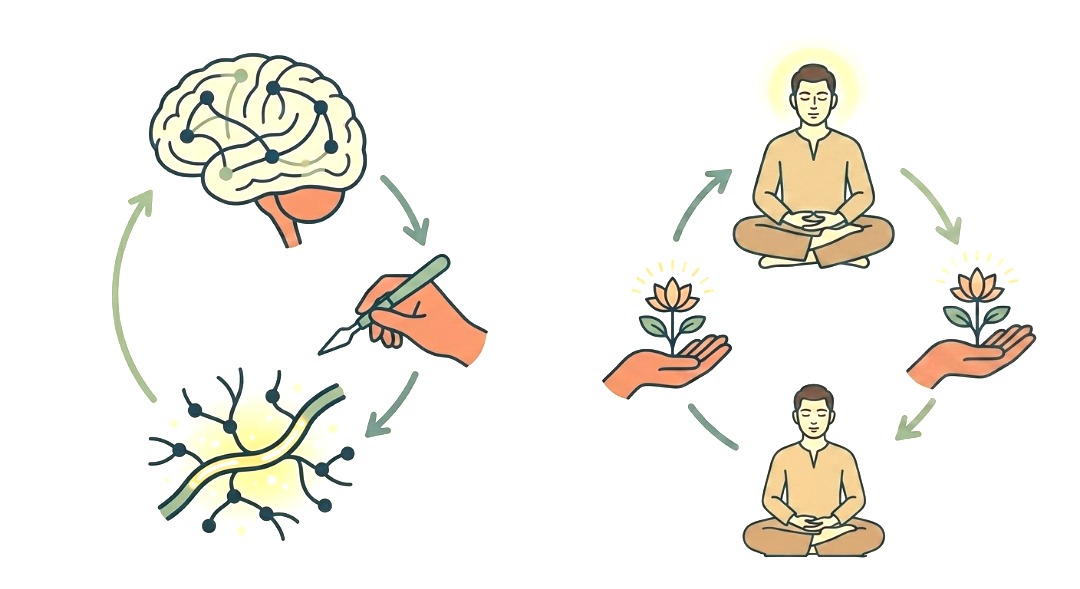
Modern neuroscience further demonstrates that the brain possesses remarkable plasticity. Neural circuits strengthen through repeated activation, encapsulated in Hebb’s principle that “neurons that fire together wire together”. Habits, whether constructive or destructive, become biologically embedded through repetition. The brain is therefore not merely an organ we inherit but one that we continuously sculpt through our daily actions.
This understanding resonates profoundly with Buddhist philosophy. The Buddha rejected both self-indulgence and severe asceticism, advocating instead the Middle Way (Majjhima Patipada). Having experienced both extremes personally, he recognized that liberation arises neither from rigid abstinence nor unchecked gratification, but from balanced awareness. In this framework, the central issue is not whether one engages in pleasure or restraint, but whether one does so mindfully.
Buddhist psychology identifies craving (Taṇhā) as a major source of suffering. Importantly, craving is not viewed as an immutable trait but as a conditioned mental process that can be observed and transformed. The practice of mindfulness (Sati) cultivates awareness of thoughts, emotions, and impulses without automatic reaction. Thus, eating is not inherently problematic; unconscious attachment to food is. Wealth is not the issue; clinging to wealth is. Even virtuous practices can become obstacles when pursued through ego or compulsion.
The concept of conditioning within Buddhism parallels contemporary notions of neuroplasticity. The Buddhist principle of mental cultivation (Bhāvanā) emphasizes that repeated wholesome actions strengthen beneficial mental states, while repeated unwholesome actions reinforce suffering. In both traditions, repeated experiences shape future tendencies. The mind and brain are not static entities but dynamic systems capable of change throughout life.
Philosophical traditions outside Buddhism echo similar themes. Aristotle’s doctrine of the Golden Mean proposed that virtue lies between excess and deficiency. Courage exists between recklessness and cowardice; generosity between extravagance and stinginess. Human flourishing depends upon cultivating moderation guided by wisdom rather than rigid adherence to extremes.
Consequently, discussions about “bad habits” require a nuanced perspective. Genetic factors may predispose individuals towards certain behaviours, and environmental influences may either strengthen or weaken these tendencies. Nevertheless, mindful awareness introduces the possibility of choice. Neuroplasticity provides the biological mechanism through which change occurs, while mindfulness provides the psychological and philosophical framework for directing that change.
From this perspective, the critical question is not simply whether one should abstain or indulge. Rather, it is whether one engages with habits consciously and intentionally. Each repeated action contributes to the ongoing construction of neural pathways, character traits, and behavioural patterns. We become, to a considerable extent, what we repeatedly practise.
As both neuroscience and Buddhism suggest, predisposition is not predestination. The seeds of vulnerability may exist, but their expression depends upon the conditions in which they develop. Through mindfulness, wise effort, and repeated practice, individuals possess the capacity to reshape both their minds and their brains.
Ultimately, human freedom may lie not in choosing the hand of cards dealt by genetics and circumstance, but in cultivating the wisdom to play that hand with awareness, balance, and compassion.