
By Maung Pyay (Sinbaungwe)
IN modern agriculture, it is generally considered that increasing profit per area (Profit per area) is more important than increasing crop yield per area (Yield per area). However, an ideal agricultural system can maintain a proper balance between both ‘profit’ and ‘yield’.
Understanding the Difference between ‘Yield’ and ‘Profit’
Yield per area means obtaining a higher crop output from a specific land area, for example, a paddy yield increasing from 70 to 100 baskets per acre (an extra 30 baskets). Internationally, crop yield is measured in metrics such as tons/hectare, kilograms/acre, etc.
Profit per area refers to the income that remains after deducting agricultural production costs. The profit calculation formula is: Profit = Total Income - Cultivation Costs. Even if a farmer achieves a very high yield, if the cultivation cost is excessively high, they will have a low profit or might even face a financial loss.
Why is Profit per Area More Important?
There are many reasons why it is more significant to consider profit per area.
(a) Long-term Survival of Farmers: Farmers cannot survive in the long run merely by having high yields; they can only survive on the profits they earn. A farmer’s primary objectives would likely be:
• to increase family income;
• to ensure the long-term sustainability of farming operations;
• to pay off existing debts;
• to make future investments in farming; and
• to raise their overall standard of living.
Plot A has a higher yield, but Plot B yields more profit. Therefore, high yields do not always mean successful farming.
(b) High Yields Often Require Substantial Inputs: To maximize yield, farmers often need to use more chemical fertilizers, employ intensive irrigation systems, apply more pesticides, and use expensive hybrid or genetically modified (Hybrid/ GMO) seeds. Additionally, they may face higher machinery costs and rising labour expenses, which increase cultivation costs and result in higher financial risks. Sometimes, the additional yield gained is not worth the extra cost – a concept known in economics as ‘Diminishing Economic Returns’.
(c) Market Price Determines the Actual Income: Even if yields are high, crop prices may drop at harvest time due to market overproduction, and expenses may not be immediately recovered. For example, a tomato harvest might be excellent, but if the market is flooded with tomatoes, prices will drop, and farmers may suffer losses. A remedy at such a time is to transform raw tomatoes into value-added products such as tomato juice, tomato sauce, tomato jam/puree, canned tomatoes, or tomato chutneys/pickles. Internationally, smallholder farmers do not usually operate these processing industries; instead, with government supervision and support, large merchants and companies establish factories near tomato fields.
Figure 1 Value-added Tomato Products
Therefore, profit depends not only on yield but also on the market economy.
Achieving Sustainable Farming
Some crucial aspects to consider in modern agriculture include water-use efficiency, nutrient-use efficiency, energy efficiency, carbon efficiency, and environmental sustainability. A system that yields slightly less but keeps costs low, minimizes environmental impact, and provides stable profits can ultimately be considered more successful than one that simply yields a lot. Consider the following examples.
(a) Rice Farming in Asian Countries:
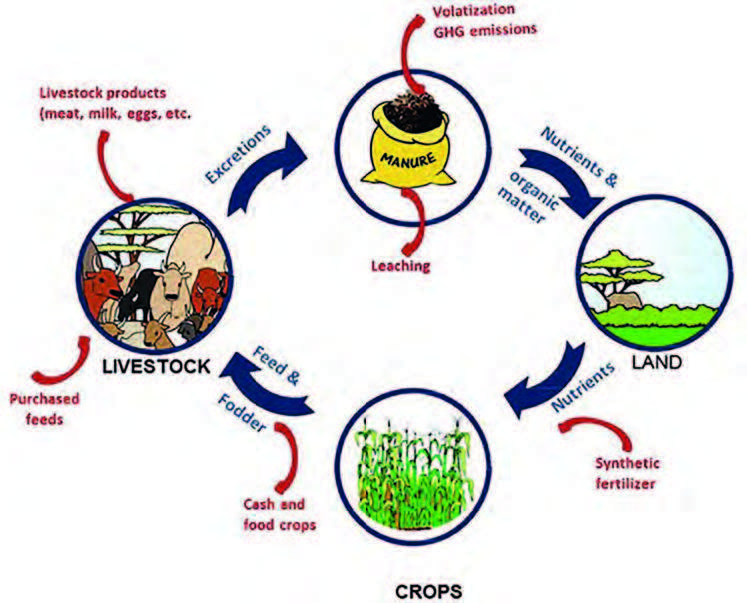
Some rice farmers in Asia are reducing the use of urea fertilizer, increasing the use of organic fertilizer, and decreasing chemical and pesticide use. They are also reducing water usage through the Alternative Wetting and Drying System (AWD) in paddy fields. Though yields may drop slightly, costs are significantly reduced, leading to higher net profits. For instance, if farmers want to use more organic manure like cow dung and buffalo manure (FYM – Farmyard Manure) in their fields, they can raise more draft cattle, buffaloes, or small-scale dairy cows, and grow pasture legumes for these ruminants. To encourage farmers, governments and cooperative societies to assist such Integrated Crop-Livestock Farming systems, which increase farmers’ income. As an additional consequence, soil nutrients will naturally increase, improving soil fertility in the long run.
Figure 2: Integrated Crop-Livestock System
(b) Organic Farming:
In organic farming, yields may be lower than in conventional farming methods, but because organic products fetch better prices and input costs are lower, farmers can earn higher profits.
This is not to say that high yields are not important. High yields remain necessary under conditions involving food scarcity, population growth, limited agricultural land, and risks to food security. Therefore, higher productivity, the use of improved varieties, and better crop management are still required for nations.
The ultimate goal of modern agriculture is to achieve a profitable and sustainable yield. This means it should not just be about maximum yield, but rather about achieving optimal economic efficiency.
Why are Farmers struggling to achieve their Ideal Goals in Myanmar?
The reasons for this state of affairs can be grouped into the following categories.
1. Focusing solely on Production without calculating the Economics
Instead of analyzing which crop offers a good Return on Investment (ROI), what the future market demand looks like, how production costs are rising, or where the break-even point is, most farmers simply continue with the mindset of ‘doing the same thing and growing the same crop every year’. For example, if the yield increases but the price drops, there is no profit; if input costs rise but the selling price does not, loan interest ends up eating into the profits. Therefore, despite doing agricultural work, it has not yet become a systematic agribusiness.
2. Weaknesses in the Agricultural Extension System
Although there are departments of agriculture in universities and institutes, knowledge transfer at the ground level is still weak. Experts possess the theory, while farmers know the field reality, but the two sides have not connected effectively yet.
Laboratory knowledge rarely reaches the actual fields, and explanations are seldom provided in accessible ‘farmer language’. Further, education on practical economics for farmers is lacking, and there is a shortage of demonstration fields across states and regions. There is also weak continuous monitoring (weak follow-up) of farmers adopting new technologies, leaving many farmers to rely solely on the advice of chemical companies, fertilizer companies, or pesticide salesmen.
3. High Input Costs and Unstable Output Prices
Farmers are not price setters; they remain price takers who must accept whatever market price is offered. They face uncontrollable input prices such as fertilizers, chemicals, diesel, labour costs, and transportation costs. Yet, at harvest time, sales depend heavily on middle brokers, export policies remain unstable, and due to a lack of updated market information, individual farmers continue to bear all the risks alone.
4. Few Value-Added Products
Most of Myanmar’s agricultural outputs are still trapped in a raw material economy. For example, for sesame and peanuts, there are a few trusted pure cooking oil brands. For rice, there is a lack of high-end branding or premium packaging comparable to internationally renowned Basmati or Jasmine rice. Corn and soybean meals are underutilized in the domestic livestock sector (weak feed industry), and processing industries for fruit juices, wine, etc., as well as the dairy industry, remain weak.
Consequently, other countries capture the high-profit segments of the value chain. For instance, although our country produces grapes, apples, and oranges, we still have to buy imported juices, milk, and dairy products at high prices (though high-quality import-substitute domestic products are gradually increasing).
5. Farm Mechanization and Technology Gaps
Agricultural labour is becoming scarce, with some rural youth going abroad. Another problem is that, unlike in other countries, precision agriculture is not yet utilized, smart irrigation systems are scarce, and agricultural drone adoption is low. Also, soil testing systems for farmers remain weak, and data-based farming is minimal, rendering farming exhausting and keeping profit margins low.
6. Smallholder Fragmentation
Most farmers operate on very small acreages. Rural farmlands are highly fragmented into small plots, which drives up mechanization costs and limits bulk selling. To make matters worse, farmers suffer from low bargaining power and a weak contract farming environment, forcing individual farmers to practice traditional ‘survival farming’ just to get by.
7. Teaching Agriculture Merely as a Science while Neglecting the Business Perspective
Universities teach subjects like plant pathology, entomology, agronomy, and soil science purely as scientific disciplines. However, what is truly needed are modern agricultural skills like agribusiness, farm management, marketing, domestic and international communication technologies, farmer psychology, supply chain management, and digital agriculture.
Concluding Remarks
When the author was young, a senior official from the Department of Agriculture once said: “If foreign markets depress rice prices, export lots of beans. Once we get dollars, we can just import and eat high-quality rice! The main thing is to have plenty of hard currency (Foreign Exchange - FE).”
Beyond modern technology, wouldn’t it be highly beneficial if all rural communities understood practical market economics and agricultural economics/agribusiness? Rice is a national staple crop and must be handled with care. However, for other cash crops, we want farmers to be at peace, earn profits, and escape the cycle of debt.
Just like the blind parents praying to see their son Suvannasama (သုဝဏ္ဏ သာမ), who lay fallen from a poisoned arrow, rise and carry a golden pot of wealth, we wish to kill three birds with one stone. What if we launch initial pilot projects in some farmlands across states and regions, shifting from an ‘increased yield per acre system’ to an ‘increased profit per acre system’? What if we try making that change?