
By Hu Wo (Cuckoo’s Song)
FORTUNATELY for our country, Myanmar, as a gift of nature, there can be seen three regular seasons circling alternately, unlike other countries all over the world. They are nothing but the summer or the hot season, the rain or the rainy season, and the winter or the cold season, each of which usually lasts four months within the space of a year. The seasons in our country distinctly come and go in turn, that is to say, in Myanmar, the summer is absolutely hot, sometimes as if our heart would have broken; it is almost always raining cats and dogs all four months after summer; and the snow often falls so heavily that nearby roads, paths and houses cannot even be seen sometimes. In the main, the Myanmar summer is actually hot and dry — for instance, Minbu in Sagaing Division has been listed as one of the hottest regions in the world this year (2026), as well as Chauk in Magway and NyaungU in Mandalay, which were among the hottest towns in the world last year (2025), as far as I can remember. Hence, it is natural if we, the Myanmar, are looking forwards to the early rain as soon as possible. We all strongly believe that this rain will certainly help put out the burning heat in our hearts to some extent, metaphorically speaking. Thus, we, young and old alike, are longing for the rainy season heart and soul.
As soon as the early rain has fallen in our country, especially in May and then to September or so, the whole environment there seems to come alive again. Thanks to a light rain, the entire ground has been wet to the extent that the rain brings the dust down; most dry old leaves due to the summer tend to fall off trees, while wet green leaves look strong in the trees; and all the environment in view appears to be clean and bright. Subsequently, if the rains have come to our country, the weather conditions get perfectly normal, which means that it will have been raining all day; thunder and lightning can be heard very often; and an atmospheric depression or a storm occasionally breaks out inland from the Andaman Sea and the Bay of Bengal, except that it can chuck it down or rain non-stop sometimes. No matter what is said, when the rain comes down with any regularity, Myanmar farmers, as well as we children, are very happy and warmly welcome it in our own way. As usual, in the Myanmar rain, not only can thick back rain clouds massing in the sky be seen here and there, but we could encounter freezing rain, fine rain or even acid rain. Nevertheless, we, the Myanmar, like to enjoy both our country and its rainy season.
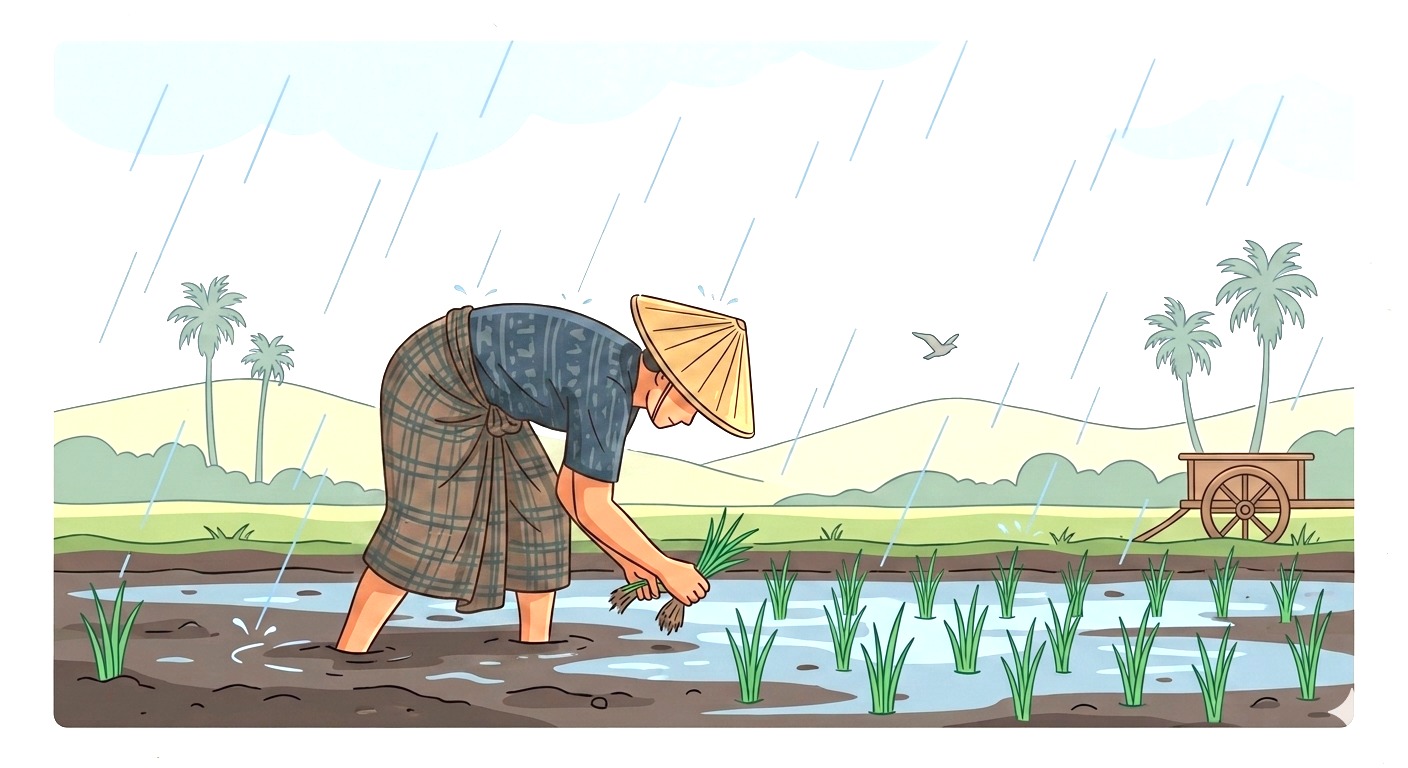
In the past, old Myanmar farmers used to prepare for their rice cultivation in the rainy season in that they would always mend their ploughshare noisily with the `doung-din´ sound. For their farming, cattle were brought up like their biological children by being fed quite enough. With the rainwater, farmland got soft and gentle and then farmers ploughed fields with the help of bulls or buffalos from dawn to dusk. At that time, the fields were almost full of rainwater and several yellowish holes of crabs were found beside the paddy dykes. While the farmers were ploughing the earth, the existing ripples struck towards the crabs’ holes, then these holes got flooded and overflowed in a moment. However, the crabs rarely went out of their holes at the time. Instead of this, dragonflies with golden fluttering wings came to rest and flew over the blocks of dark ploughed earth. Just at that moment, the short-legged farm hut could be seen standing alone in the field under the slightly raining dark sky. The wild young grass was growing green and stiff all through the paddy dikes, looking up at the sky. Also, water spinach and other aquatic plants were living in clusters in the paddy fields. In this advanced technological age, many Myanmar farmers prefer tractors to traditional ploughshares for their modern farming methods.
The rainy season in Myanmar was one of our most enjoyable childhood periods as well. But our enjoyment of the rain was completely different from that of our farmers. We, children, enjoyed the rainy season just for fun, not for any other particular reasons. The boys were playing football happily together with their buddies in the rain. The girls were playing tag or frog-hopping while the rain was pouring down. Sometimes, we loved wallowing in the muddy cart tracks behind our village due to too much rainwater. But sometimes, we went out to uproot pea seedlings on the village farms, putting on bamboo helmets each. Strangely enough, those seedlings had white-yellowish colours and long slim stems under the black heaps of pea shells, bundled as natural fertilizers, in the absence of sunlight. And sometimes, we plucked newly-born tamarind leaves, no matter whether they were greenish or reddish, from the trees not far away from the village school for some evening soup at home. Of course, in the early rain, the last mangoes in summer fall out from the trees. At such times, we children tried to pick up mangoes on the ground ahead, which had fallen owing to a strong wind of the rainy season. Speaking honestly, as children, we hardly ever knew if the natural phenomena, such as a thunderbolt in the rainy season, were life-threatening dangers.
Quite frankly, I did not always like the rainy season in my childhood, mainly because the season is wet everywhere and we cannot easily go anywhere outside we wish. But later, I love the rain so much for the possible reason that as long as I am getting older, I would like to stay at home only, and unlike the winter, the coldness of the rainy season comes out in peace and quiet to me. Whatever is said, to think it back again, our agricultural country, Myanmar, owes much to the rainy season so as to reduce the high cost of crop husbandry. In actual fact, not all people like the rainy season for sure, for various reasons. Despite this, since the rainy season is distinct only in Myanmar, such a season is something very rare to experience even all around the globe. Many moons ago, it took the rainy season about five months to turn up in our country, together with the three-month hot season and the four-month cold season, to my certain knowledge. Here, there must be found diverse perspectives and feelings of poets and composers about the rainy season. Most of the Myanmar poets and composers think of the rain as full of remembrance, sorrow and tragedy rather than joy and happiness. For them, raindrops look like soulful tears dripping from the sky. Whoever says it, I am constantly longing to see the rain again, to say the least.