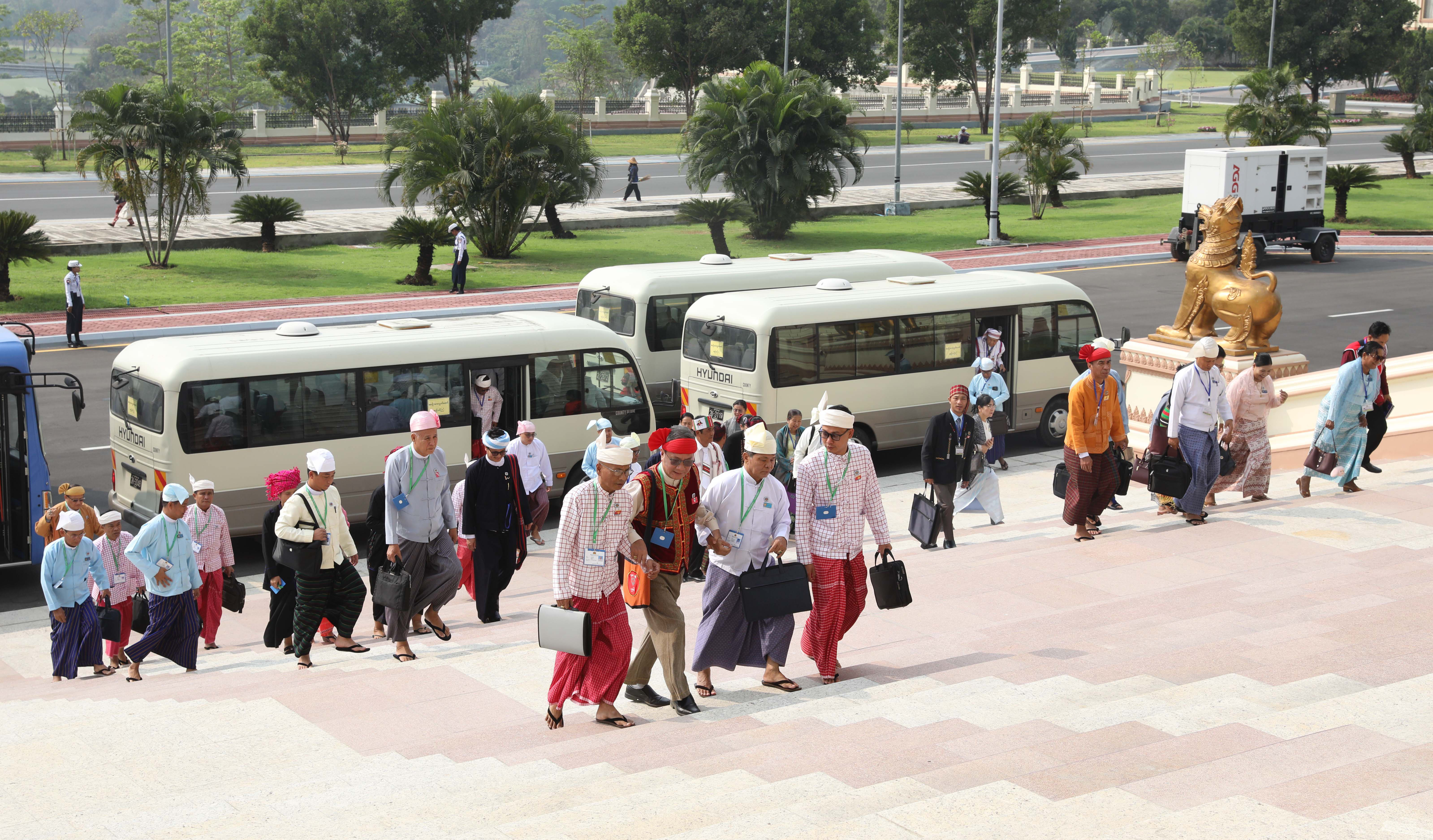
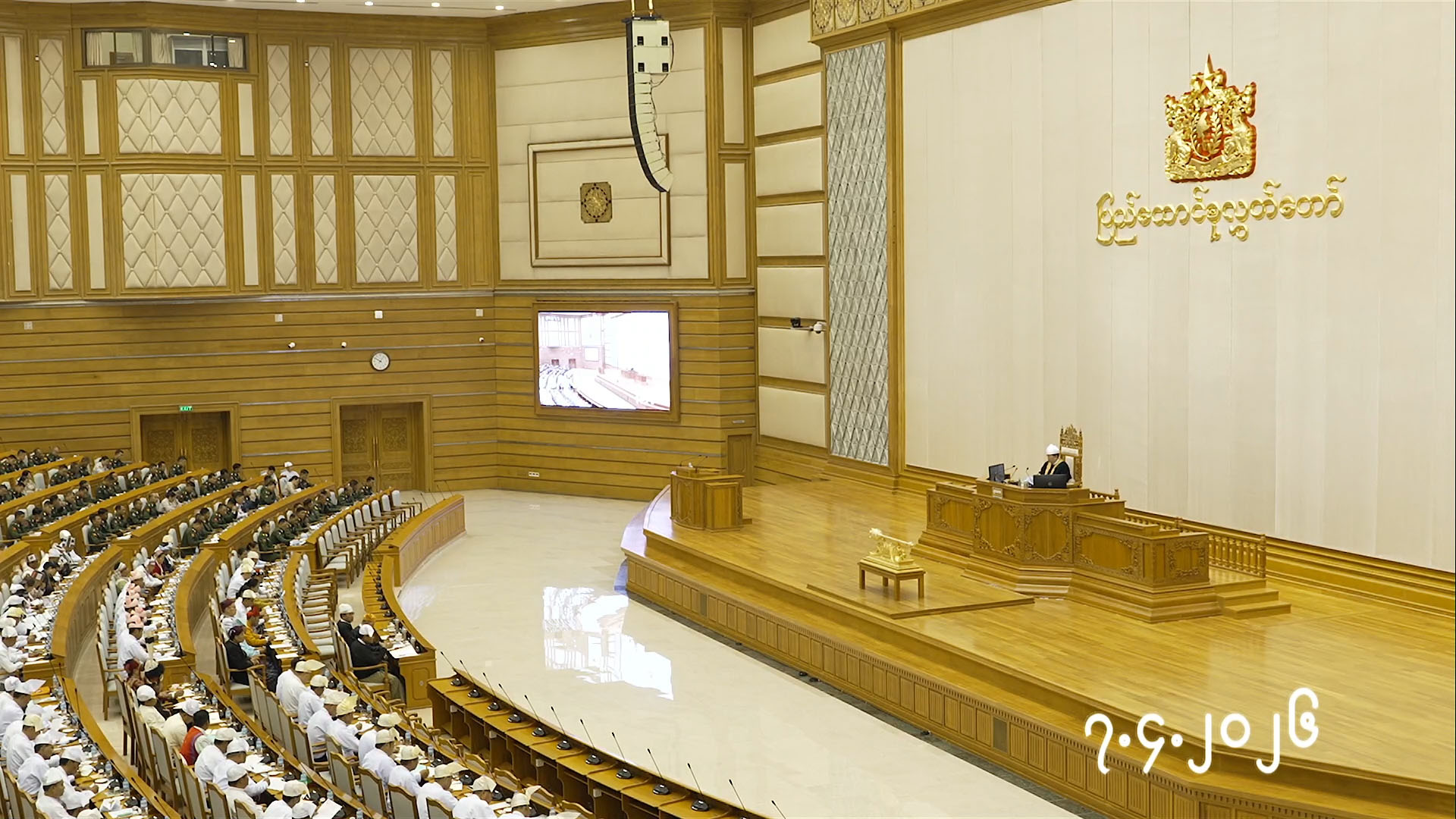
THE first regular session of the Third Pyidaungsu Hluttaw continued its fourth-day meeting at the convention hall of the Pyidaungsu Hluttaw in Nay Pyi Taw yesterday morning, with 581 out of 585 Pyidaungsu Hluttaw representatives in attendance.
Formation of the Union Supreme Court
The Pyidaungsu Hluttaw Speaker said that the President-Elect had submitted.
a proposal to the Pyidaungsu Hluttaw that the Supreme Court of the Union should be established with nine Supreme Court Judges, including the Chief Justice of the Union, in accord with the provisions of the Constitution (2008) and the Union Judiciary Law. As there was no one Hluttaw representative to discuss the proposal, the Speaker announced that the Pyidaungsu Hluttaw approved the formation of the Supreme Court of the Union with nine Supreme Court Judges, including the Chief Justice of the Union.
The Pyidaungsu Hluttaw Speaker stated that the President-elect had already submitted the nomination of U Tha Htay to the Pyidaungsu Hluttaw for appointment as Chief Justice of the Union. As there were no objections raised regarding the nominee, the Pyidaungsu Hluttaw announced its approval to appoint U Tha Htay as Chief Justice of the Union.
Constitution of the Union Election Commission
The Speaker continued that 15 members of the Union Election Commission nominated by the President-elect have submitted to the Pyidaungsu Hluttaw. He stated that as there were no objections raised regarding the nominee, the Pyidaungsu Hluttaw approved the appointment of U Than Soe, U Aung Moe Myint, U Aung Lwin Oo, U Myint Oo, U Khin Maung Oo, U Myint Thein, U Ko Ko Lwin, U Than Aung Kyaw, U Khin Zaw, U Than Htut Thein, U Aung Myint Lwin, U Khin Maung Gyi, U Myo Maung, U Kyi Thein and Daw Khin Hnin Wai as UEC members chaired by U Than Soe.
Discussions for Union Ministries
With regard to the number and title of the Union ministries proposed by the President-elect, U Myin San from the Mandalay Region Constituency 2 (PR System) said that successive governments have enacted laws related to farmers; however, their effectiveness on the ground remains weak. Although there are some 20 laws, including the Farmland Law and the Vacant, Fallow and Virgin Lands Management Law, they have limited impact on farmers and lack policy integration. Therefore, it was found that systematic coordination and oversight at the central level are needed.
He stated that if a Ministry for Farmers’ Affairs is established, the land management processes for farming households would become easier and more efficient. It would also enable the provision of modern technologies, machinery, improved seeds, and training in agricultural, livestock, and industrial skills. As a result, the country could progress from traditional farming practices to becoming a national- and global-level food-producing nation.
He discussed that a separate Ministry for Farmers’ Affairs should be established and led by a Union Minister. In the meantime, before such a ministry can be formed, it was suggested that a dedicated Department of Farmers’ Affairs be created under the Ministry of Agriculture, Livestock and Irrigation to specifically handle all matters related to farmers.
U Tin Myint from the Dala Constituency stated that under Section 96 of the 2008 Constitution, the Pyidaungsu Hluttaw has the authority to enact laws on matters included in the Union Legislative List set out in Schedule One. In this regard, under Item (5) relating to the agriculture and livestock sector, sub-clauses (e), (h), and (j) provide for matters concerning the supply of irrigation water for farmers, the promotion of mechanized farming, the production of fertilizers and pesticides, and the rights of farmers. Therefore, a Ministry of Farmers’ Affairs should be established to ensure the provision of sufficient agricultural loans for farmers, the dissemination of technologies to enable systematic cultivation in line with the four key factors – seeds, soil, water, and techniques – and to secure the rights and entitlements that farmers deserve.
He also suggested that, to effectively implement cultural matters in accordance with the law, instead of forming a combined Ministry of Hotels, Tourism and Culture, separate ministries should be established – one for Hotels and Tourism and another for Culture.
Dr Nanda Hla Myint from the Kalaw Constituency stated that under the current situation, many towns designated as municipal areas have been damaged due to destructive acts by armed terrorist groups. In carrying out reconstruction, if the respective township municipal bodies are required to rely solely on tax revenues collected from residents, similar to other towns, they would face numerous difficulties.
Therefore, he noted that reconstruction efforts would progress more rapidly if undertaken at the Union level by the relevant ministries. Accordingly, he proposed that the municipal bodies, which are included under the administrative sector in Section 188 and Schedule (2), Item (8) of the 2008 Constitution, should be amended by the Hluttaw and reorganized as Union-level institutions.
The Pyidaungsu Hluttaw Speaker read out the clarification sent by the President-elect to respond to the discussions of three Pyidaungsu Hluttaw representatives. Regarding the number and title of the Union ministries, the Speaker read out that about 70 per cent of Myanmar’s population lives in rural areas, and since the majority of rural residents are farmers, enhancing the role of farmers is crucial. At present, matters related to farmers are being handled by the Ministry of Agriculture, Livestock and Irrigation as well as the Ministry of Cooperatives and Rural Development; therefore, a separate Ministry of Farmers’ Affairs has not been established. He noted that the Department of Agriculture has already been formed under the Ministry of Agriculture, Livestock and Irrigation.
Myanmar’s agricultural sector comprises crop cultivation, livestock and fisheries, and forestry sections, and this sector plays a vital role in the country. The Ministry of Agriculture, Livestock and Irrigation is implementing policies and work plans to identify and create opportunities within the agricultural sector. Through these efforts, quality agricultural and livestock products can be produced not only for domestic use but also for export to international markets. The Department of Agriculture is carrying out its vision, duties, objectives, policies, and programmes in order to fulfil the ministry’s goals and targets for the agricultural sector.
The vision of the Department of Rural Development under the Ministry of Cooperatives and Rural Development is to continuously promote rural development and improve the socioeconomic conditions of rural populations. Its responsibilities include constructing, maintaining, and upgrading roads and bridges for agricultural and livestock production; establishing revolving funds to support employment opportunities and business development for rural residents; conducting capacity-building and vocational training programmes to enhance the skills of rural people; and assisting in creating market linkages for local products.
At present, the Ministry of Agriculture, Livestock and Irrigation and the Ministry of Cooperatives and Rural Development are effectively coordinating to handle matters related to farmers. Looking at the structure of ministries in most other countries, it is evident that agricultural ministries are responsible for farmers’ affairs. Therefore, no separate Ministry of Farmers’ Affairs has been additionally established or expanded.
The purpose of combining Hotels, Tourism, and Culture into a single ministry is to utilize culture as a key driver of tourism while simultaneously generating economic, social, and cultural benefits. In many other countries, Hotels, Tourism, and Culture are similarly combined under one ministry. The potential benefits include coordinating tourism development with cultural preservation to support sustainable growth, providing visitors with more effective exposure to local traditions, arts, and historic sites, and increasing the incomes of local communities through cultural tourism. It can also minimize cultural impacts while protecting heritage as tourism develops, enhance the country’s attractiveness to foreign tourists, and allow for more efficient management of budgets, human resources, and infrastructure. Therefore, the combination of Hotels, Tourism, and Culture into a single ministry serves these purposes.
Section 188 of the Constitution (2008) of the Republic of the Union of Myanmar stipulates that “The Region or State Hluttaw shall have the right to enact laws for the entire or any part of the Region or State related to matters prescribed in Schedule Two of the Region or State Hluttaw Legislative List.” Schedule 2, Item (8), Subsection (a) includes the sector of “development affairs.” Furthermore, Section 249 of the Constitution provides that, “subject to the provisions of the Constitution, the executive power of the Region or State Government extends to the administrative matters which the Region or State Hlutttaw has power to make laws. Moreover, it also extends to the matters which the Region or State Government is permitted to perform under any Union Law.”
The Speaker read out that therefore, the “development affairs” sector falls within the legislative powers of the Region or State Hluttaw and within the administrative authority of the Region or State government. Development affairs involve day-to-day activities that directly affect residents. These activities are carried out by the Regions and States according to the law, allowing them to adapt to local conditions, timing, and circumstances. As a result, the Region and State governments will establish and operate development ministries in line with the agreement of their respective Hluttaws. Consequently, it was clarified that it is not appropriate to form a development ministry at the Union level.
The Speaker sought the approval of the Hluttaw representatives over the discussions on the number and titles of Union ministries proposed by the President-elect and announced that the Hluttaw approved a total of 31 Union ministries and their identifications.
List of Union Ministers
Furthermore, the Pyidaungsu Hluttaw Speaker read out the list of the Union Ministers nominated by the President-elect. The announcement for approval of the Pyidaungsu Hluttaw over the nominees and objections of Hluttaw representatives will be held at the Pyidaungsu Hluttaw meeting on 9 April, and the representatives who wish to object will be able to submit their names for consideration.
The Speaker also read out the nomination of eight individuals to be assigned as Supreme Court Judges proposed by the President-elect. The announcement for approval of the Pyidaungsu Hluttaw over the nominees and objections of Hluttaw representatives will be held at the Pyidaungsu Hluttaw meeting on 9 April, and the representatives who wish to object will be able to submit their names for consideration.
Formation of CBM
The Speaker stated that the President-elect nominated Dr Khin Naing Oo as Governor of the Central Bank of Myanmar, together with Deputy Governors U Zaw Myint Naing, U Thet Tun Aung and Dr Sanda Oo. He announced that the approval for the CBM Governor and deputy governors by the Hluttaw and objections of any Hluttaw representatives will be carried out at the Pyidaungsu Huttaw meeting on 9 April. So, the representatives wishing to object to the proposal must submit their names for consideration.
Establishment of Anti-Corruption Commission
The Speaker continued that the President-elect submitted a proposal to form a new Anti-Corruption Commission under the relevant law to the Pyidaungsu Hluttaw. To constitute the commission, the President-elect nominated three members, the Pyithu Hluttaw Speaker, three members and the Amyotha Hluttaw Speaker, three members, totalling nine. Moreover, the President-elect nominated one of the nine members to be assigned as the Chairman of the commission. Then, the Speaker read out the list of nine members for the commission.
The Speaker stated that the President-elect has submitted a proposal to appoint U Soe Thein as the Chairman of the commission. As such, he continued that the approval of the Hluttaw over the nomination to form the commission and objections of any Hluttaw representatives will be carried out at the Pyidaungsu Hluttaw on 9 April. As such, the Speaker invited any Hluttaw representatives wishing to object to the nomination to submit their names for consideration.
The Speaker of the Pyidaungsu Hluttaw announced that, as no Hluttaw representatives wished to discuss the proposed number of 30 Union Ministers submitted by the President-elect, the Hluttaw has expressed its approval of the proposal for 30 Union Ministers.
The Pyidaungsu Hluttaw’s fourth-day meeting was adjourned, and the fifth-day meeting will take place on 9 April. — MNA/TTA