
By Khin Maung Myint
The Modern Puzzle
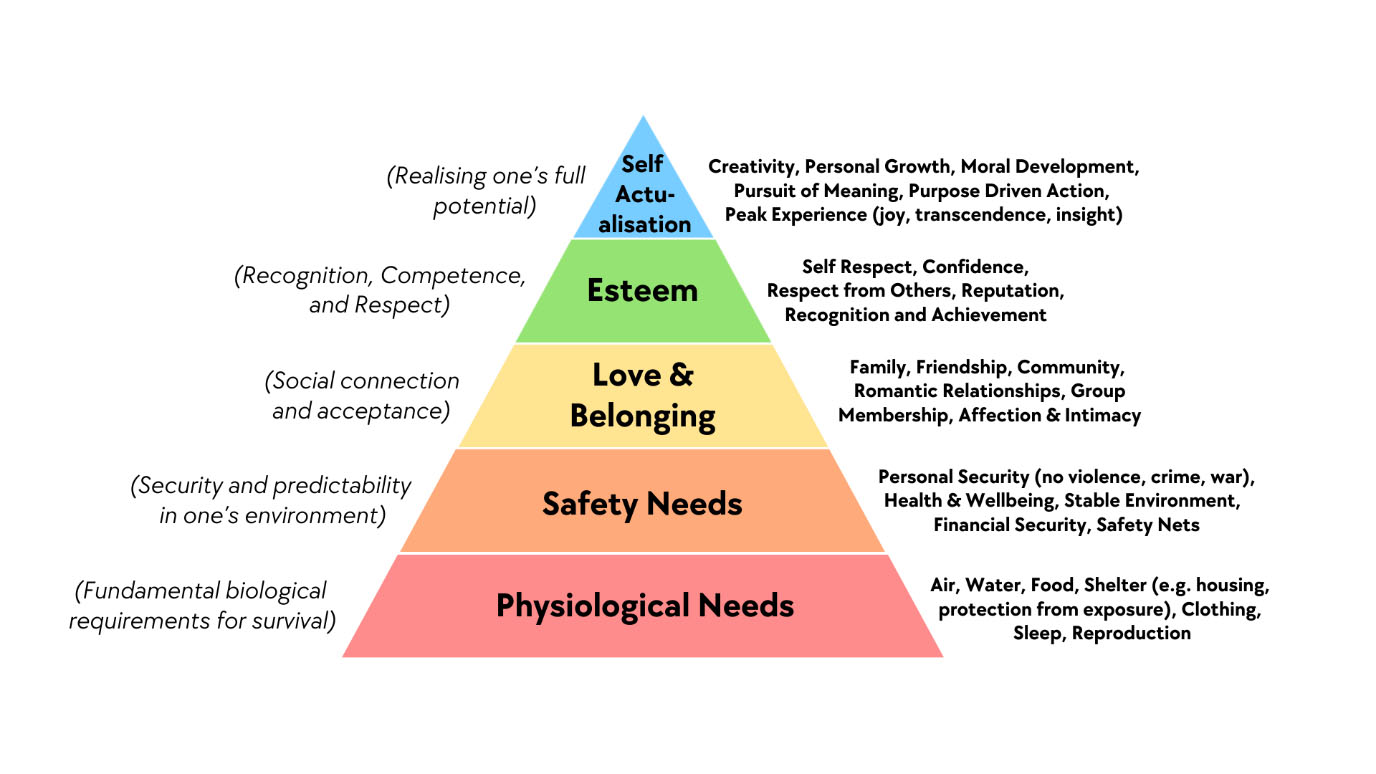
Many individuals today reach what society calls success – security, status, and recognition – yet experience a subtle inner stagnation. Psychology describes this as a plateau; in Maslow’s terms, it resembles a “maturation arrest”: development halts after lower and mid-level needs are fulfilled.
From a Buddhist perspective, this is less surprising than it appears.
Maslow: When Motivation Falls Silent
Abraham Maslow observed that once basic and psychological needs are satisfied, motivation weakens. The individual is no longer driven but merely invited to grow.
At this stage:
• Survival is secured
• Esteem is established
• Social identity is stable
Yet self-actualization – the highest level – requires voluntary engagement. Nothing compels it. Hence, many stop short.
This stopping point is what we may call maturation arrest: not failure, but unfinished development.
Buddhism: Attachment as the Hidden Brake
Buddhist thought adds a crucial layer: the role of attachment (upādāna).
A successful person may:
• Adhere to the Five Precepts
• Live ethically and responsibly
• Earn their rightful place in society
None of this is problematic. In fact, it reflects discipline and right conduct.
The difficulty arises when success becomes something to hold onto.
Not crude greed, but subtle forms:
• Attachment to reputation
• Identification with a role
• Fear of losing position
This quiet clinging acts as a psychological brake – not visible, but effective.
The Five Precepts: Necessary, Not Sufficient
The Five Precepts stabilise behaviour and reduce harm. They create the conditions for a well-ordered life.
But they do not, by themselves, dissolve:
• Ego attachment
• Identity fixation
• The illusion of permanence
Thus, a person may be:
• Morally disciplined
• Socially successful
Yet remain internally unfree.
The Noble Path and the Missing Movement
The Noble Eightfold Path points beyond conduct to the transformation of mind:
• Right View challenges illusion
• Right Mindfulness observes attachment
• Right Concentration steadies the mind
Without these, life remains externally complete but internally static.
In Maslow’s language, the person has fulfilled deficiency needs but has not entered sustained growth (being) motivation.
Where the Two Frameworks Meet
Maslow and Buddhism converge on a striking insight:
• Maslow: Growth at higher levels is not enforced
• Buddhism: Liberation requires letting go of attachment
Together, they explain the same phenomenon:
The individual stops growing not because they cannot, But because nothing pushes and something subtly holds.
That “something” is attachment.
“Deserving One’s Place” — Not the Problem
Striving, achieving, and occupying one’s rightful place are not in conflict with either framework.
Effort aligns with growth. Responsibility aligns with ethical living.
The issue is not achievement itself, but identification with achievement.
One may:
• Work diligently
• Succeed legitimately
• Contribute meaningfully
and continue to grow – if one does not cling.
The Resolution: From Possession to Participation
The way forward is neither withdrawal nor rejection of success, but a shift in relationship:
• From having to being
• From holding to engaging
• From identity to awareness
In Maslow’s terms, this is the movement into self-actualisation. In Buddhist terms, it is the loosening of attachment.
Closing Reflection
What appears as “maturation arrest” is not a failure of success, nor a flaw in discipline.
It is the natural point where: Motivation grows quiet, And attachment grows subtle.
Beyond this point, growth is no longer driven by need, but awakened by insight.