By Junior Thin
THERE are many kinds of success in life. Some people measure success by wealth, power, or fame. But for a teacher, true success is measured in a very different way. It is measured by the love, respect, gratitude, and remembrance of former students long after the lessons have ended and the years have passed.
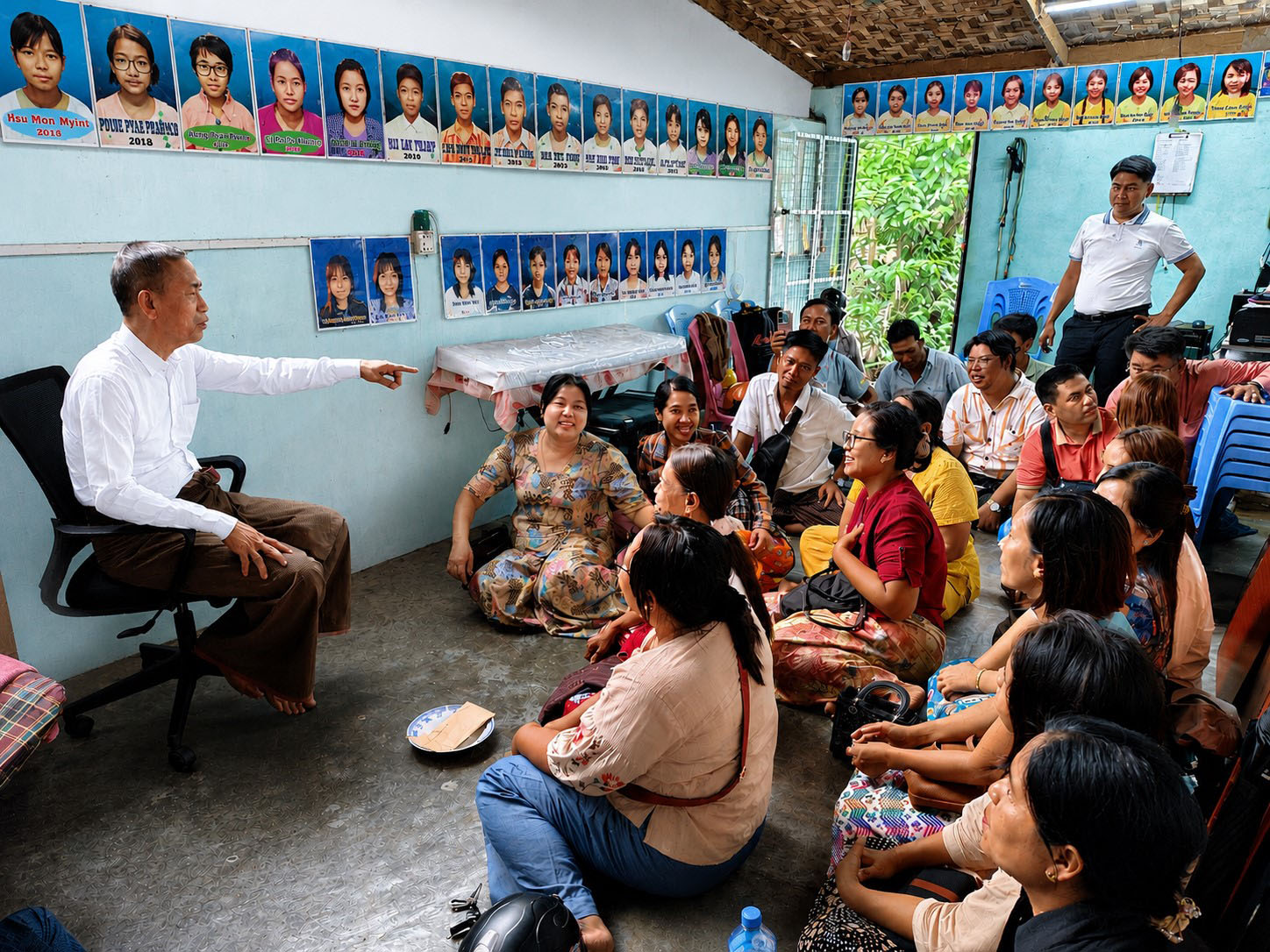
Recently, I experienced one of the most emotional and meaningful moments of my life. It was not a grand ceremony, nor was it an event attended by important officials or wealthy people. Yet, for me, it was more valuable than any worldly achievement. It was the moment when more than twenty of my former students came to my home to pay respect to me as their old teacher.
About twenty-five years ago, I taught many young students at a private tuition school called “Aung Myay” in Athoke, a town in Ayeyawady Region, Myanmar. At that time, they were only teenagers with dreams, worries, innocence, and youthful energy. Like every teacher, I simply tried my best to guide them not only in their studies but also in their character and discipline. I never imagined that after twenty-five years, those same students would still remember me with such deep affection and gratitude.
This year, on 24 May (Sunday), a ceremony to honour former teachers was organized at “Aung Myay” tuition school in Athoke. Many former students gathered there to pay homage to their old teachers. I sincerely wished to attend the event because it would have been a wonderful reunion after many years. Unfortunately, my health condition did not allow me to travel. Although the distance between Athoke and my current hometown, Kyaunggon, is only about eleven miles, I was physically too weak to make the journey.
At first, I felt disappointed and saddened. I thought I would miss the opportunity to see my former students and colleagues. However, what happened afterwards deeply touched my heart in a way I cannot fully express with words.
Instead of simply paying respect to me from afar at the ceremony, more than twenty of my former students personally travelled to Kyaunggon to visit me. They came not because of obligation, not because of social pressure, and not because anyone forced them to do so. They came because of genuine love, gratitude, respect, and the unbroken bond between teacher and student.
When I saw them gathered around me, sitting respectfully before me, I was overwhelmed with emotion. Some of them were once mischievous boys in my classroom. Some were shy and quiet students who rarely spoke. Yet now, they had all become mature middle-aged men and women, carrying the responsibilities of life on their shoulders.
Most of them are now around forty years old. They have families, children, careers, and businesses of their own. They are no longer the young students I once taught. They are parents guiding their own children through life. They are hardworking individuals contributing to society in their own ways. Seeing them successful, stable, and responsible brought me immense peace and happiness as a teacher.
For a teacher, there is no greater comfort than knowing that former students have grown into good human beings. Academic success alone is not enough. What truly matters is whether they become kind-hearted, respectful, responsible, and compassionate people. Looking at my former students that day, I felt proud not because of their wealth or status, but because their hearts remained humble and grateful.
In modern society, people are often too busy with work, business, and personal struggles. Relationships easily fade with time. Many people forget their old teachers as life moves forward. Yet these former students did not forget. Even after twenty-five years, they still valued the bond we once shared in the classroom.
Their visit reminded me that true education is not limited to textbooks or examinations. The deepest lessons are often lessons of humanity, kindness, gratitude, and respect. The fact that they personally came to see a sick and ageing teacher instead of merely sending greetings from afar made their gesture even more meaningful.
As they sat before me, paying respect in the traditional Myanmar way, I could feel not only their respect but also their sincere emotional attachment. Their eyes, smiles, and conversations carried memories from long ago. In those moments, the twenty-five years between us seemed to disappear completely.
I also realized something very important that day: although my body may have become weaker with age and illness, my life as a teacher has not been meaningless. Teachers do not always receive material rewards. Often, our efforts are forgotten, and our sacrifices remain unseen. But moments like this become priceless rewards that cannot be bought with money.
I deeply appreciate and value the respect my former students showed me. Their kindness gave me strength, comfort, and emotional healing. More importantly, it reminded me that the relationship between teacher and student is not temporary. It is a lifelong connection built on trust, care, guidance, and gratitude.
In Myanmar culture, paying homage to teachers is considered a noble tradition. However, what moved me most was not the ceremony itself, but the sincerity behind their actions. They did not merely follow tradition; they followed their hearts.
As I reflect on that unforgettable day, I feel nothing but gratitude. I am grateful that life allowed me to become a teacher. I am grateful that my former students still remember me after so many years. And I am grateful that they became successful adults with loving families and stable lives.
For me, this experience was not simply a reunion. It was proof that genuine kindness and sincere teaching never disappear with time. The seeds planted in the classroom twenty-five years ago have now blossomed into respect, compassion, and enduring human connection.
A teacher may grow old. A classroom may disappear. Time may pass quickly. But true respect and genuine gratitude can remain alive forever. That, perhaps, is the greatest reward a teacher can ever receive.