Dr Aung Tun
1. The Deadliest Threat We Do Not See
Non-communicable diseases (NCDs) are often described as silent killers because they develop slowly, progress quietly, and frequently remain undetected until serious complications arise. Unlike infectious diseases, they do not spread from person to person, yet they claim more lives every year than any other group of illnesses. Cardiovascular diseases, cancers, chronic respiratory diseases, and diabetes together account for the majority of global deaths today.
Globally and in Myanmar, NCDs have overtaken communicable diseases as the leading cause of mortality. They affect people across all age groups, including those in their most productive years, undermining national development and placing heavy social and economic burdens on families and health systems. Addressing NCDs is therefore not only a health priority but also a development imperative.
2. Understanding Non-Communicable Diseases
Non-communicable diseases are chronic conditions that tend to be of long duration and often require lifelong management rather than short-term treatment. The four major groups of NCDs are cardiovascular diseases, such as heart attacks and stroke, cancers, chronic respiratory diseases, including chronic obstructive pulmonary disease and asthma, and diabetes.
These diseases share common risk factors. Unhealthy diets, physical inactivity, tobacco use, harmful use of alcohol, and exposure to air pollution contribute significantly to their development. Over time, such behaviours lead to metabolic changes including raised blood pressure, high blood glucose levels, abnormal blood lipids, and overweight or obesity, all of which greatly increase the risk of premature death.
3. The Global Burden of Silent Killers
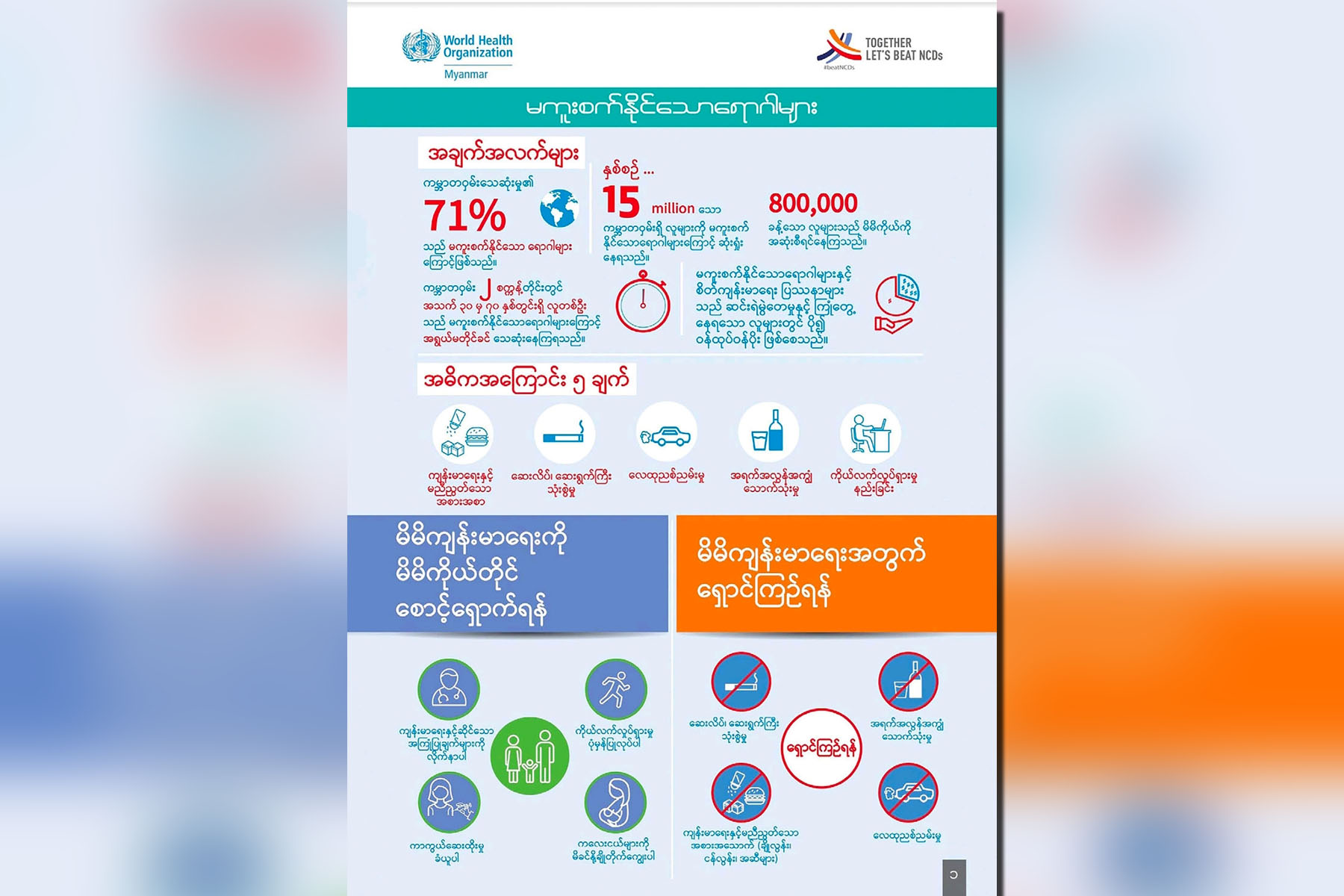
Non-communicable diseases account for nearly three-quarters of all deaths worldwide. A particularly alarming feature of this burden is the high proportion of premature deaths occurring before the age of 70. Millions of people die each year during their most productive years, resulting in major economic losses and social consequences.
Low- and middle-income countries carry the greatest share of the global NCD burden. Although NCDs were once considered diseases of affluent societies, nearly three-quarters of NCD-related deaths now occur in developing regions. Rapid urbanization, ageing populations, changing lifestyles, and limited access to preventive and curative health services have accelerated the NCD epidemic in these countries.
4. Myanmar’s Growing NCD Challenge
Myanmar is experiencing the same epidemiological transition seen globally. Non- communicable diseases now account for approximately 70 per cent of all deaths in the country. Cardiovascular diseases, particularly heart disease and stroke, are the leading causes of NCD mortality, followed by cancers, diabetes, and chronic respiratory diseases.
National risk factor data from the WHO STEPwise Approach to NCD Risk Factor Surveillance (STEPS) highlight the scale of the problem. The Myanmar STEPS Survey (2014), conducted among adults aged 25-64 years, reported that around one in four adults had raised blood pressure, while diabetes affected more than one in ten adults. Tobacco use remains widespread, particularly among men, with both smoked and smokeless tobacco contributing to increased risks of heart disease, stroke, cancer, and chronic lung disease. Harmful use of alcohol and rising levels of overweight and obesity, especially in urban areas, further compound the NCD burden.
Importantly, NCDs in Myanmar are not confined to older age groups. A significant proportion of deaths occur before the age of 70, resulting in premature loss of life, reduced workforce productivity, and increased household poverty due to long-term health care costs.
5. Risk Factors: Behavioural, Metabolic and Environmental
The major risk factors for NCDs can be grouped into behavioural, metabolic, and environmental categories. Behavioural risk factors include tobacco use, unhealthy diets high in salt, sugar and unhealthy fats, harmful use of alcohol, and insufficient physical activity. These behaviours are strongly influenced by social norms, commercial practices, and the physical environment.
Behavioural risks often lead to metabolic changes such as raised blood pressure, high blood glucose, abnormal cholesterol levels, and overweight or obesity. Among these, elevated blood pressure is one of the leading contributors to NCD-related deaths globally and in Myanmar.
Environmental factors also play a major role. Indoor and outdoor air pollution contribute significantly to cardiovascular diseases, stroke, chronic respiratory diseases, and lung cancer. In Myanmar, exposure to household air pollution from solid fuel use, as well as increasing urban air pollution, remains a major public health concern.
6. Socioeconomic Impact and Development Consequences
Non-communicable diseases pose a serious threat to national development and the achievement of the Sustainable Development Goals. Chronic illness reduces productivity, increases absenteeism, and places long-term financial strain on households. Many families affected by NCDs face catastrophic health expenditures that can push them into poverty.
Vulnerable and socially disadvantaged populations are disproportionately affected. Limited access to health services, lack of early detection, and delayed treatment contribute to higher rates of complications and premature death. Without strong health systems and social protection mechanisms, the growing NCD burden risks reversing hard-won development gains.
7. Prevention and Control: From Policy to Personal Action
The good news is that many non-communicable diseases are preventable. Cost-effective, evidence-based interventions exist to reduce exposure to major risk factors and to promote healthier lifestyles. Strong tobacco and alcohol control policies, promotion of healthy diets, encouragement of physical activity, and actions to reduce air pollution can significantly lower NCD risk at the population level.
8. Individual-Level Prevention: What Each Person Can Do
While government policies and health systems are critical, individual actions remain central to preventing NCDs. Every person can take practical steps to protect their health:
• Avoid all forms of tobacco use and protect family members from second-hand smoke. • Choose a healthy diet rich in fruits, vegetables, whole grains, and legumes, while reducing salt, sugar, and unhealthy fats. • Engage in regular physical activity, such as walking or cycling, for at least 150 minutes per week. • Limit or avoid alcohol consumption. • Maintain a healthy body weight. • Check blood pressure, blood sugar, and cholesterol levels regularly, particularly after the age of 40. • Seek early medical advice and adhere to treatment if diagnosed with hypertension, diabetes, or other chronic conditions.
Early detection and continuous care are essential. Strengthening primary health care to provide screening, diagnosis, and long-term management of NCDs is a cost-effective approach that saves lives and reduces the need for expensive hospital-based treatment.
9. Myanmar’s Response to the NCD Challenge
Myanmar has taken important institutional and policy steps to address the growing burden of non-communicable diseases. Within the Ministry of Health, a dedicated Non-Communicable Disease (NCD) Unit was established under the Department of Public Health (DOPH) around 2015 to provide leadership in NCD prevention and control. The NCD Unit is responsible for developing and implementing national strategies, policies, and action plans aimed at reducing morbidity and mortality from major NCDs.
A cornerstone of Myanmar’s response is the adoption and expansion of the World Health Organization’s Package of Essential Noncommunicable Disease Interventions (PEN). Through PEN, cost-effective interventions for the prevention, early detection, treatment, and referral of cardiovascular diseases, diabetes, chronic respiratory diseases, and related risk factors are delivered at the primary health care level. This approach strengthens early diagnosis, improves continuity of care, and promotes equitable access to essential NCD services across the country.
Myanmar’s NCD response also emphasizes surveillance and evidence-based planning. National risk factor data generated through WHO STEPS surveys provide a foundation for monitoring trends in tobacco use, harmful use of alcohol, unhealthy diets, physical inactivity, hypertension, and diabetes. These data guide policy formulation, resource allocation, and programme prioritization.
Multi-sectoral collaboration is another key element of Myanmar’s response. The Ministry of Health works with other government sectors, development partners, civil society organizations, and coordinating mechanisms such as the Myanmar Health Sector Coordinating Committee to address the social, commercial, and environmental determinants of NCDs. Together, these efforts aim to reduce preventable risk factors, improve service delivery, and strengthen health system capacity nationwide.
10. From Silent Killers to Visible Action
Non-communicable diseases may progress silently, but their consequences are profound and far-reaching. In Myanmar, as in the rest of the world, NCDs are now the leading cause of death and a major challenge to health systems, economic productivity, and sustainable development.
Myanmar’s response — anchored in strong institutional leadership, primary healthcare-based interventions such as WHO PEN, improved surveillance through STEPS surveys, and multi- sectoral collaboration — demonstrates a clear commitment to tackling this growing epidemic. However, sustained political commitment, adequate investment, and active community participation remain essential to translate policies into measurable health gains.
By combining effective national programmes with individual responsibility for healthier lifestyles, Myanmar can move from reacting to silent killers toward preventing them. Making NCDs visible, preventable, and manageable is essential for protecting lives today and securing a healthier future for generations to come.
References
1. World Health Organization. Noncommunicable Diseases: Fact Sheet and Overview, 2024.
2. World Health Organization. Global Action Plan for the Prevention and Control of Noncommunicable Diseases 2013–2030.
3. World Health Organization. WHO Global Status Report on Noncommunicable Diseases, 2022.
4. Institute for Health Metrics and Evaluation. Global Burden of Disease Study 2021 Results, published 2024.
5. World Health Organization South-East Asia Region. Noncommunicable Diseases Country Profile: Myanmar, 2018.
6. Ministry of Health and Sports, Myanmar & World Health Organization. Myanmar STEPS Survey on NCD Risk Factors, 2014.
7. MOHS, National Strategic Plan for Prevention and Control of NCDs(2017-2021)
Myanmar, 2017
8. United Nations. Transforming our World: The 2030 Agenda for Sustainable Development (SDG Target 3.4), 2015.