
THE agriculture sector should seek professional advice on climate resilience technology as preparations for reducing impacts on the yield of crops, said meteorologist U Win Naing.
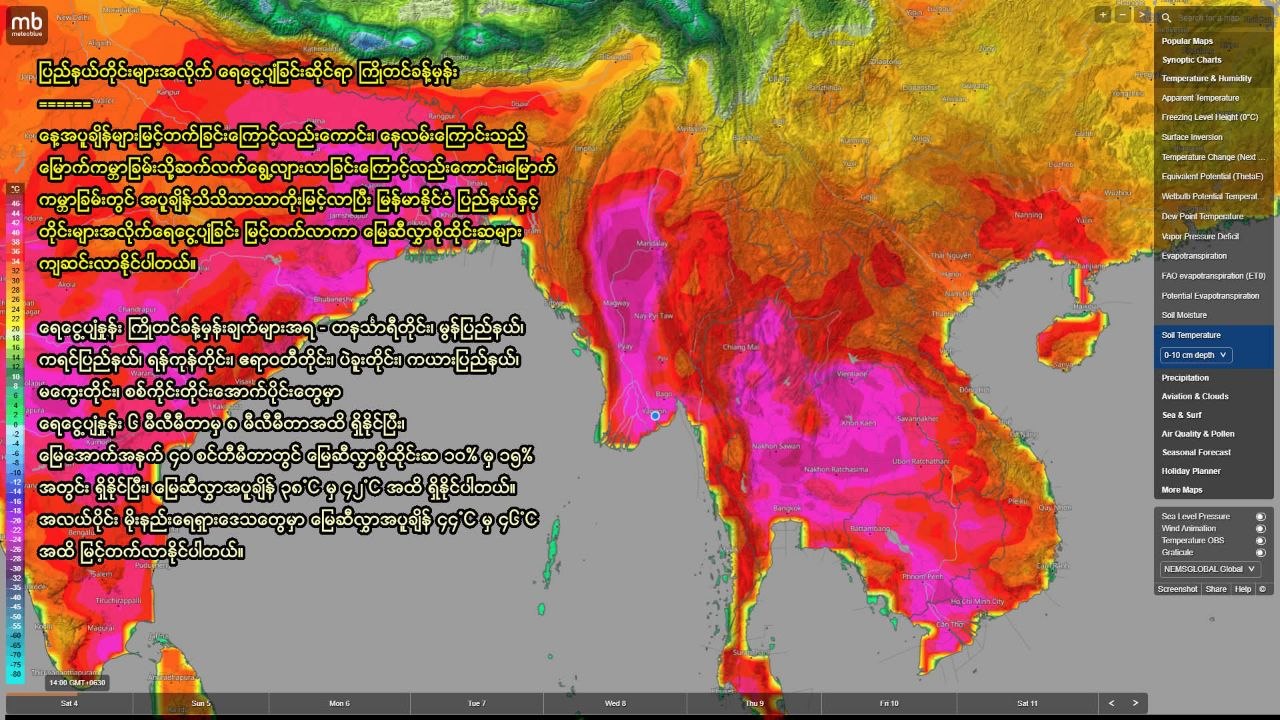
The temperature has increased visibly in the Northern Hemisphere due to the elevated daytime temperatures from April to May and the Sun’s path shifting to the Northern Hemisphere, leading to increased evapotranspiration and a decline in soil moisture in regions and states of Myanmar.
According to predictions, the evapotranspiration will be six to eight millimetres in Taninthayi Region, Mon State, Kayin State, Yangon Region, Ayeyawady Region, Bago Region, Kayah State, Magway Region and lower Sagaing Region, while the soil moisture will be 10-15 per cent in 40 centimetres deep and the soil temperature will be 38-42 degrees Celsius, he said.
In the dry zone located in central Myanmar, the soil temperature will be 44-46 degrees Celsius, he said. In the rest of the regions and states, evapotranspiration will be 3.5-5.5 millimetres, the soil moisture will be 16-26 per cent in 40-centimetre-deep soil, and the soil temperature will be 24-36 degrees Celsius.
He suggested that farmers should take advice on technology for heat stress tolerance from agricultural experts, in order to prevent losses in crop production. — MT/ZS