Through effective leadership and lessons learned from past events, the nation must strengthen its political, economic, and defence capabilities to enhance its dignity and reputation on the international stage.
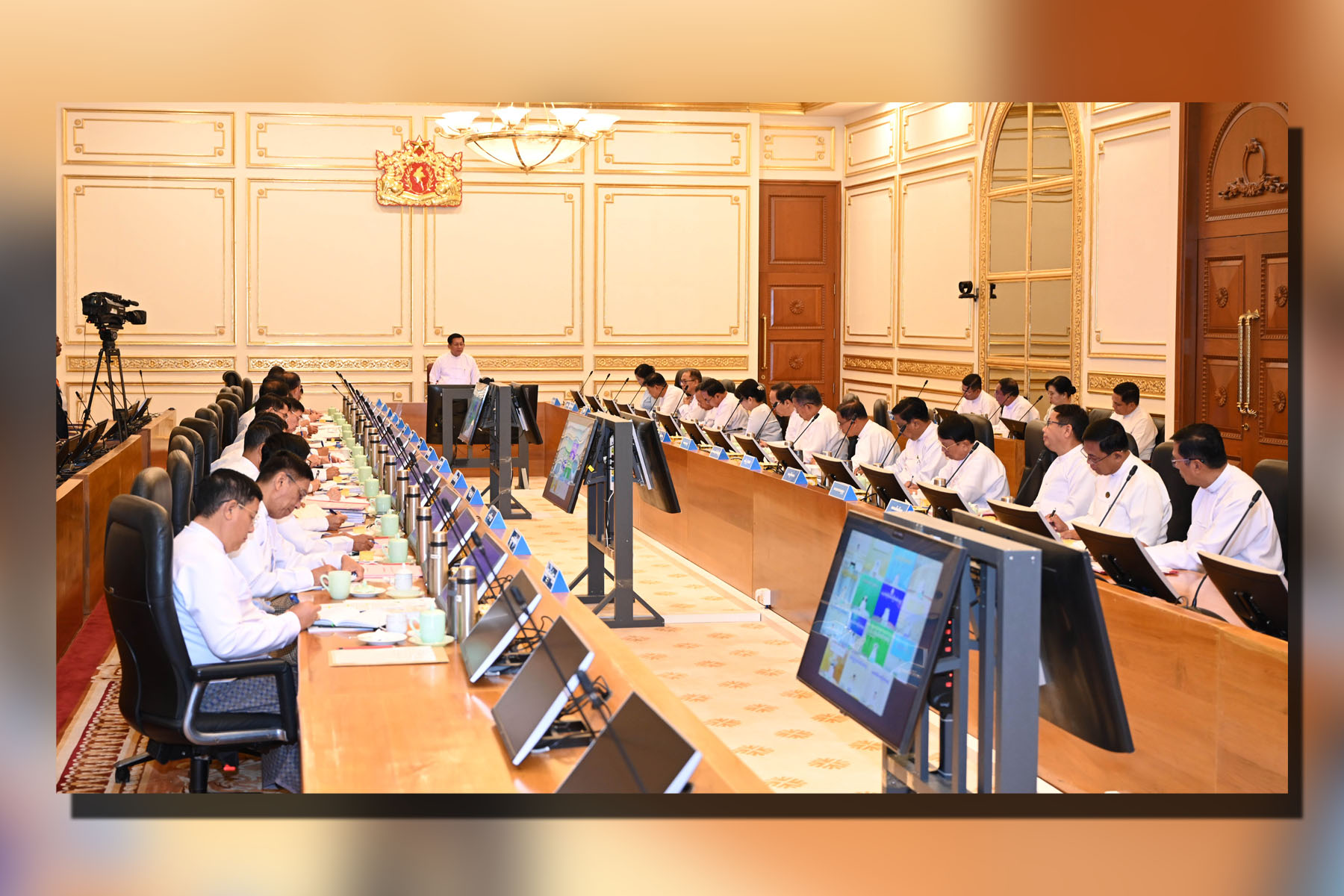
IF the historical developments that have taken place in the country are reviewed, it is necessary to assess them in relation to the domestic political situation and international relations from the post-independence era to date, said President of the Republic of the Union of Myanmar U Min Aung Hlaing at the Union government meeting at the President’s Office in Nay Pyi Taw yesterday morning.
Speaking on the occasion, the President revealed that concerning security matters, when the government first assumed responsibilities, EAOs were invited to carry out peace talks within 100 days. At present, engagements are already being conducted at the ground level with some Ethnic Armed Organizations (EAOs).
He highlighted that the government has decided to pursue the vision of achieving lasting peace within five years.
The Government continues to extend invitations and offers for peace; however, it is also necessary for armed groups to have a sincere conviction and commitment, a genuine desire to achieve peace, and a willingness to cooperate for the country’s development.
Speaking on the occasion, the President recounted that a caretaker government assumed responsibility in 1958, and the Revolutionary Council took over the State responsibilities in 1962. During that period, political leaders, young people, and officials from Tatmadaw had some level of awareness of socialism, and it was a time when democratic, capitalist, liberal, and socialist systems were in competition. Subsequently, those who favoured democratic, capitalist, and liberal systems had no political outlet, which led to protests and unrest. At the same time, disagreements also emerged within the ruling party regarding economic matters, and simultaneously, ethnic armed conflicts also intensified.
He continued that at that time, in terms of international relations, Myanmar’s relations with the United Nations were generally good, and leaders who served in the United Nations also emerged. However, difficulties arose during the time of the White Chinese invasion. The country initiated the Myanma Socialist Programme in its own way. This was a period when global ideological competition among different political systems was particularly intense.
The President continued his discussions, saying that during the process of moving towards a democratic system, NGOs and INGOs entered the country, and foreign assistance was received from abroad. At that time, countries that supported democracy also assisted Myanmar. The population and housing censuses conducted in 1973 and 1983 showed that the country already had weaknesses in education since that period.
Taking advantage of these weaknesses, some NGO and INGO organizations engaged in activities that fostered negative perceptions of the government and encouraged opposition against it. Due to underdevelopment, Myanmar also applied for Least Developed Country (LDC) status in order to receive foreign assistance, which further weakened public confidence in the State.
As a result, in 1988, the country experienced an economic decline, administrative mismanagement, and social and economic hardships among the public. The illegal declaration of currency also occurred, which ultimately led to the outbreak of unrest.
The President added that Myanmar was not yet a member of ASEAN at that time. Some powerful countries attempted to influence Myanmar to act in accordance with their own interests. Although Myanmar regularly attended United Nations General Assembly sessions, its participation in international affairs and within the United Nations system was relatively limited.
The President also retold that due to economic decline and a lack of internal peace and stability, negative perceptions arose internationally towards the country. The GDP was very low, and production levels were also significantly limited. It can be observed that the national economy was being sustained largely through the extraction and sale of natural resources.
In terms of political development, although a National Convention was convened during the SLORC period in an effort to move towards a multiparty democratic system, it was later suspended for various reasons. During the SPDC period, the National Convention was reconvened, and efforts were initiated to proceed towards a multiparty democratic path desired by the people.
He explained that Tatmadaw assumed responsibility for the affairs of the State in 1988, and it worked to restore internal peace, implementing ceasefire arrangements based on mutual agreements between the two sides in 1989.
Moreover, the President continued that during the transition towards a democratic path, the Nationwide Ceasefire Agreement (NCA) was able to be signed. At that time, amendments were made to the electoral law, which allowed the NLD party to participate in politics.
At that time, he noted that NGOs and INGOs became involved in political matters and interfered in the country’s internal affairs. During the 2020 multiparty democratic general election period, foreign countries supported, through various means, the party that could implement their own preferences. When Tatmadaw assumed responsibility in 2021, NGOs and INGOs became involved in matters related to ethnic armed organizations. The President urged Union Ministers and Chief Ministers of Regions and States to take careful note of the historical experiences the country has gone through. Lessons should be learned from past events and experiences, and efforts should continue to be made to ensure that such incidents do not occur again in the future.
Drawing lessons from the country’s historical experiences and political systems, the Government will strive to strengthen political, economic, and defence sectors through effective leadership, and to enhance the country’s prestige on the international stage. He urged Union-level officials, Union ministers, and chief ministers of regions and states to think broadly and act with a wide-ranging perspective when dealing with political, economic, and security matters.
The President vowed that the government will work to firmly establish a multiparty democratic system and build a Union based on democracy and a federal system. It should also be clearly understood that the federal system referred to is a territorially based one, not an ethnicity-based federal arrangement. In national affairs, efforts will be made to ensure the country’s prosperity. To achieve this, it is necessary to create employment opportunities, enable people to access real jobs, and develop practical skills and work capacity.
He highlighted that it is necessary to promote the expansion of employment opportunities and job creation at both the Union level and within regions and states, and to implement measures that enable people to work productively.
Regarding land use, the President underlined that laws on farmland and vacant, fallow, and virgin land have already been enacted. Accordingly, activities must be carried out strictly in accordance with the granted permissions and existing regulations.
He noted that political reforms have already been firmly implemented, and there is no reason for disagreement. Therefore, it is necessary to work together on a peaceful democratic path.
Compulsory education up to KG+9 must be implemented, and access to education in all schools must be ensured. Only through education can employment opportunities be created in rural areas. If school education is not encouraged, children will face difficulties in their life paths in the future. Hence, it is necessary to make all schools clean, pleasant, and beautiful, and to provide the required basic infrastructure and other necessary support to improve conditions in schools.
The President gave guidance that the budget allocations intended for development projects are used properly, accurately, and to their full benefit. Returning unused funds as surplus due to an inability to utilize approved allocations results in losses for the State; therefore, such funds must be spent and managed correctly and effectively.
Union Ministers submitted reports on their respective sectors.
In response, the President stressed that regarding online gambling, responsible officials in the region and state governments are required to cooperate with relevant organizations, conduct on-the-ground inspections, and carry out effective measures to combat online gambling.
The President also gave guidance on important measures of the fuel oil and edible oil sectors, and the disbursement of loans to entrepreneurs.
In conclusion, the President urged that efforts are being made to quickly repair hospitals, schools, government offices, and religious buildings that were damaged and destroyed due to armed conflicts in Chin State. Necessary construction materials are being supplied for this purpose. Priority will be given to the restoration of hospitals and schools, and public markets, as well as other government office buildings will also be repaired. He also urged that regions and states contribute and cooperate to the best of their ability in the rehabilitation of Chin State.
Also, present at the meeting were Vice-Presidents U Nyo Saw and Nan Ni Ni Aye, Union ministers and the Nay Pyi Taw Council chairman, together with region and state chief ministers through videoconferencing. — MNA/TTA