
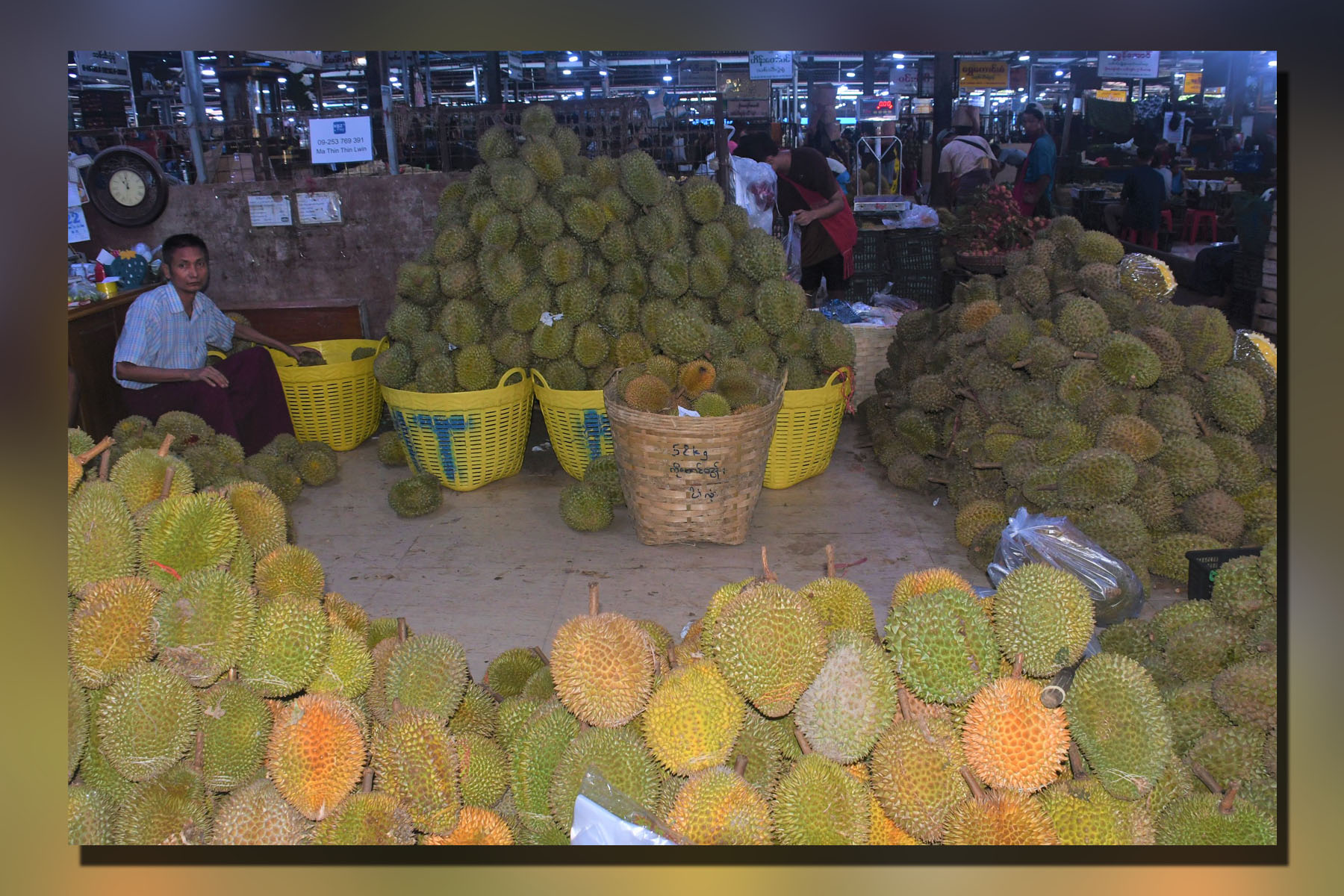
AS the durian season begins, enthusiasts are snapping up the fragrant fruit, driving a sales boom at Yangon’s Thirimingala Market in Hline Township.
While durian is cultivated across Myanmar – primarily in Mon State, Kayin State, and the Taninthayi Region, with newer plantations in Yangon and Bago – Thai imports remain the premium choice. Consumers generally favour Thai, Mawlamyine, and Toungoo varieties. Thai durians are prized for their thick, creamy flesh and small seeds, commanding the highest prices, whereas Mawlamyine and Toungoo varieties offer a sweeter taste but larger seeds.
Despite strong demand, prices have actually dropped compared to last year, making the fruit more accessible.
“At the start of last season, Thai durians reached K80,000 per kilogramme, but this year they are down to K60,000,” explained U Maung Tun, a vendor at Thirimingala Market. “Similarly, Myanmar durians have dipped from K30,000 last year to around K25,000. Smaller Myeik and Mawlamyine durians are currently retailing between K8,000 and K20,000. Because prices are lower, sales have been excellent, and we are supplying both Yangon and other regions.”
The fruit, which derives its name from Duri (the Malay word for thorn), is native to the rainforests of South- East Asia and holds a long-standing place in local culture.
Production in the Yangon Region is also expanding. Following a commercial trial of 800 trees planted in 2000, the first 200 trees began bearing fruit this year, proving the crop’s local viability. According to the Yangon Durian Group, the region now boasts over 6,000 acres of durian orchards across Hlegu, Hmawby, Kawhmu, and Twantay townships, with further expansions planned for Taikkyi Township this rainy season.
Beyond its distinct taste, durian is highly nutritious – rich in calories, vitamin C, fibre, protein, and essential minerals that provide an instant energy boost. However, because it is traditionally viewed as a “heating” food that can cause bodily discomfort if eaten in excess, locals recommend pairing it with mangosteen, a traditional cooling remedy. — Thitsa (MNA)/MKKS