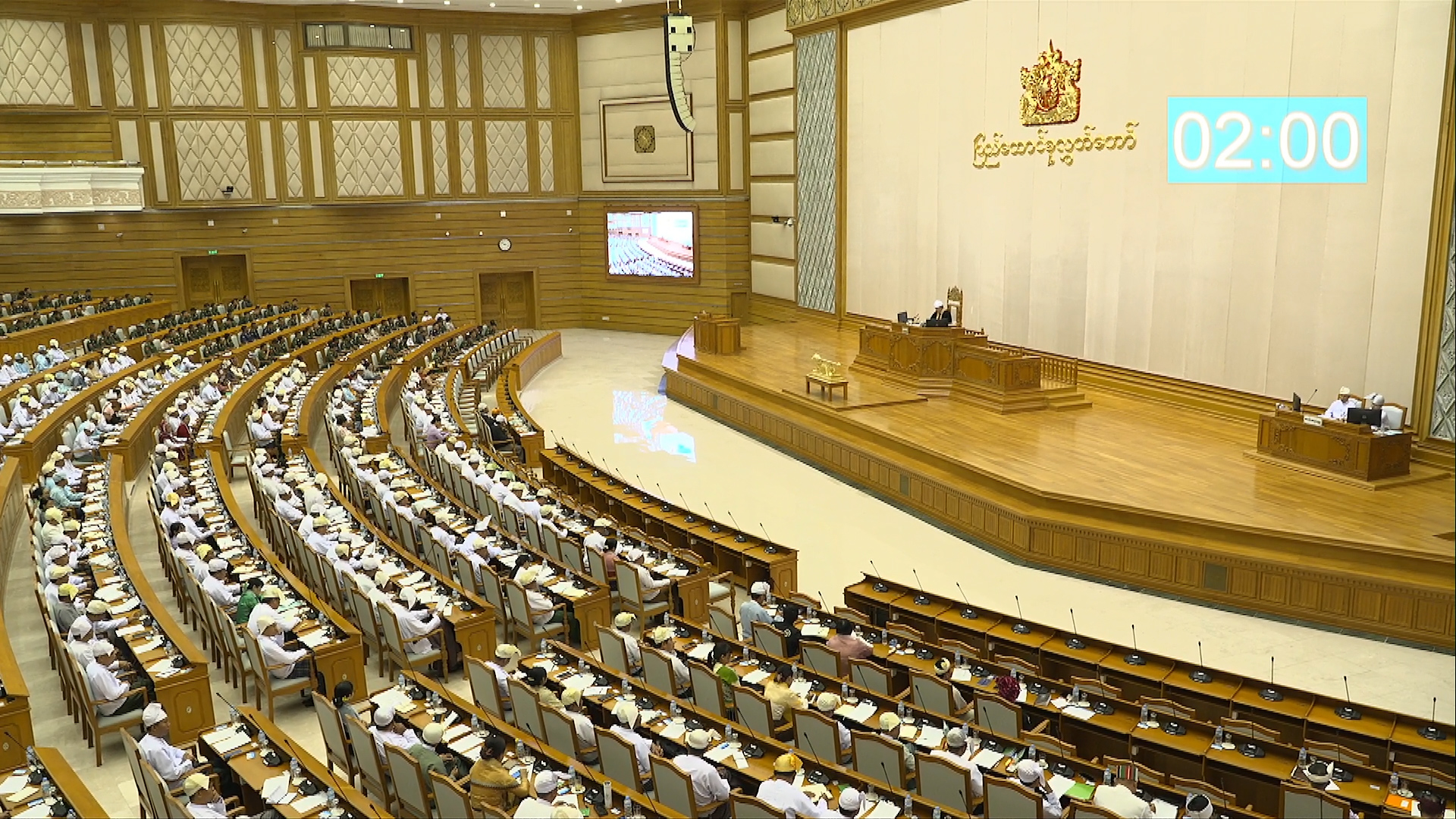
At the eighth-day meeting of the second regular session of the Third Pyidaungsu Hluttaw yesterday morning, Speaker U Aung Lin Dwe submitted the message sent by the President on amendments and additional points to the Constitution (2008) and recorded it.
He also sought the approval of the Pyidaungsu Hluttaw for the formation of the Joint Coordinating Committee on Parliamentary Development (JCC).
The Pyidaungsu Hluttaw continued with the debates of Hluttaw representatives over the motion tabled by Dr Nanda Hla Myint from the Kalaw Constituency, urging the Union government to necessarily review the ASEAN Five-Point Statement that undermines Myanmar’s equality within ASEAN and is inconsistent with ASEAN’s fundamental principle of non-interference in the internal affairs of a member state in addition to the non-alignment with the ASEAN’s fundamental principles and Myanmar’s current actual political situation.
The Hluttaw representatives discussed that ASEAN exerted pressure at the United Nations meetings to impose sanctions and prevent most countries around the world from recognizing the State Administration Council. Regrettably, such actions disregarded ASEAN’s traditional principles of unity, mutual respect, and adherence to common agreements.
Such actions have created hope among groups opposing the government, resulting in the further escalation of violence and unrest within the country and causing greater destruction. At present, the country is facing its most challenging period, with severe economic and security risks and turbulent circumstances. Despite these difficult conditions, the country’s leaders have continued their efforts with determination and awareness to prevent the nation from collapsing.
At present, the country is being administered in accordance with the 2008 Constitution through the separation and exercise of the three branches of state power — legislative, executive, and judicial powers. Hence, the ASEAN Five-Point Statement should be reviewed and reconsidered.
The ASEAN Five- Point Statement was adopted because Myanmar’s political crisis is not merely an internal matter but has affected regional stability, humanitarian issues involving refugees and displaced persons fleeing to neighbouring countries, and transnational crimes. However, the implementation of the statement went beyond the role of mediation and became a form of intervention in Myanmar’s internal affairs.
According to Article 20 (a) of Chapter VII of the ASEAN Charter, as a fundamental procedure of ASEAN, all decisions must be made through the “consensus” of all 10 member states. Although Myanmar is currently proceeding in accordance with its Constitution, ASEAN member states need to respect Myanmar’s democratic process and its constitutional government.
It is regrettable to observe that the ASEAN Five-Point Statement appears to have been adopted based on external pressures, without taking into consideration the actual situation on the ground in Myanmar, the country’s legal positions, and national security challenges.
The principles and equality of ASEAN are the fundamental standards that recognize all member states as sovereign and equal nations, while guaranteeing equal rights and equal responsibilities.
However, the ASEAN Five-Point Statement emphasizes specific political actions designated for Myanmar, which has resulted in the perception that ASEAN is attempting to directly influence the internal affairs of a member state. This issue raises questions regarding the principles of non-interference in internal affairs and equality among member states as stated in Part II of the ASEAN Charter.
It is urged that ASEAN acknowledge and accept the factual assessment that the current situation in Myanmar is significantly different from the circumstances in 2021.
Although countries around the world have recognized, welcomed, and accepted Myanmar’s ability to achieve a political transition through democratic elections, it is regrettable to observe that ASEAN’s views and stance toward Myanmar have remained unchanged to date.
The statements and actions of ASEAN member states in this regard disregard Myanmar’s democratic political transition. They not only overlook the election process but also make disparaging remarks against the various legislative bodies formed through the elections and the government selected and entrusted with responsibilities by the legislatures.
Such actions are a violation of ASEAN’s fundamental principles enshrined in the Treaty of Amity and Cooperation, including the principles of non-interference in the internal affairs of member states and respect for the independence, sovereignty, equality, and national identity of each country.
The ASEAN Five-Point Statement is inconsistent with ASEAN’s fundamental principle of non-interference in the internal affairs of a country and does not align with the actual situation in Myanmar.
The ASEAN Five-Point Statement is unnecessary for Myanmar and represents a clear violation by ASEAN of the rules and principles that member states are required to follow. The Five-Point Statement, which was unilaterally adopted while interfering in and disrupting Myanmar’s internal affairs, undermines Myanmar’s equality and is not consistent with the realities of the country’s current political situation.
Myanmar should demonstrate its initiative and proactive engagement toward ASEAN. In order to allow ASEAN to make a graceful and amicable exit from the current situation, the government and the parliament should jointly establish an ASEAN Five- Point Statement Special Committee and implement direct engagement with ASEAN within the coming five months.
It should be noted that following the successful completion of the Myanmar President’s visits to India and China, Western media outlets, including The New York Times and Investigate Asia, have begun launching anti-government and anti-Myanmar media campaigns. This issue should not be addressed only through domestic media.
State-level officials, responsible authorities, and parliament representatives, with genuine concern for the country, need to respond boldly, actively, and effectively through international media outlets and social media platforms.
The ASEAN Five-Point Statement on Myanmar issued by the alternate ASEAN Chair, as a statement of the rotating ASEAN Chair, has gone beyond the powers granted under Myanmar’s Constitution and attempted to interfere in the country’s internal affairs. Moreover, as it directly affects Myanmar’s equality and status within ASEAN, the time has come for the Union Government to take appropriate measures and respond accordingly.
A free and fair multiparty democratic general election was held in accordance with the 2008 Constitution, resulting in the establishment of legitimate legislatures and a newly elected government through the choice of the people. Therefore, ASEAN should review the actual situation in Myanmar and, through building trust based on equality and friendship, enhancing mutual respect, and strengthening cooperation, work together to promote peace and stability in the region.
The Speaker announced that a plan was set to continue the discussions of remaining Hluttaw representatives at the Pyidaungsu Hluttaw session to be held on 9 July.
The Pyidaungsu Hluttaw will continue on 9 July. — MNA/TTA