By Ms Moon
IN INTERNATIONAL relations, state visits represent far more than ceremonial exchanges between leaders. They symbolize mutual respect, trust, friendship, and a shared commitment to strengthening cooperation. Good-neighbourly relations, mutual understanding, and long-standing friendship are invaluable assets that contribute to peace, stability, and prosperity among nations. In today's rapidly changing global environment, countries increasingly recognize that strong diplomatic partnerships are essential for addressing common challenges and promoting sustainable development. Against this backdrop, the recent State Visit of the President of the Republic of the Union of Myanmar to the Lao People's Democratic Republic marks a significant milestone in the history of relations between the two neighbouring countries.
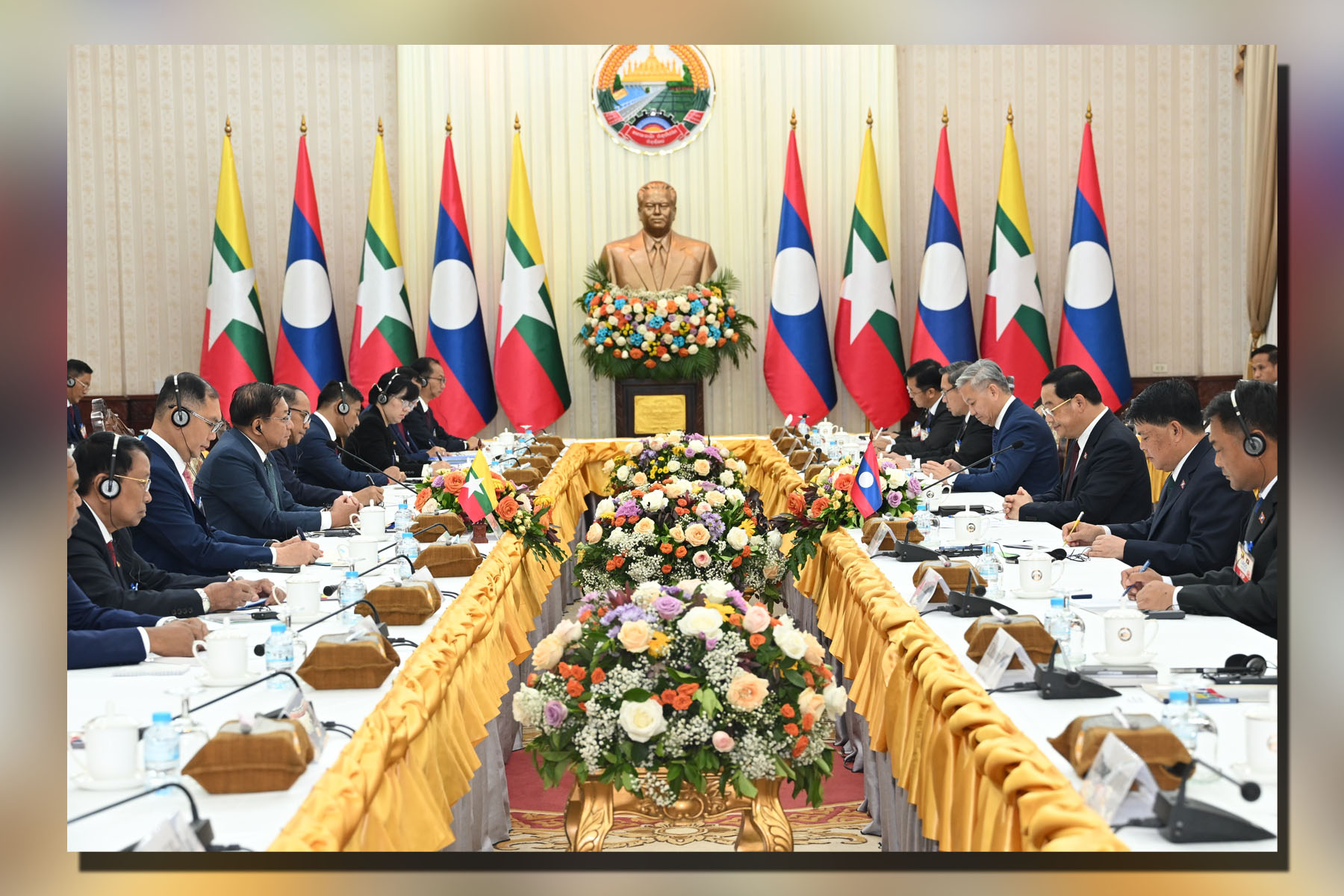
On 3 July, the leaders of Myanmar and Laos met in Vientiane, the capital of Laos, to discuss matters of mutual interest and to further strengthen bilateral cooperation. The visit took place at the invitation of His Excellency Mr Thongloun Sisoulith, President of the Lao People's Democratic Republic. This important diplomatic engagement demonstrated the close ties that have existed between the two countries for decades. It also reflected their shared determination to expand cooperation in political, economic, social, and cultural fields. The successful discussions and agreements reached during the visit are expected to benefit not only the governments of the two countries but also their peoples.
The State Visit is particularly noteworthy because it was the first state-level visit undertaken by Myanmar's President to an ASEAN member country following the country's recent political developments, including the holding of a multiparty general election and the formation of a new government. As a result, the visit carried special diplomatic significance. It provided an opportunity for Myanmar to reaffirm its commitment to regional cooperation and to strengthen its role within the ASEAN community. At the same time, it allowed Laos to demonstrate its support for continued engagement and constructive cooperation with Myanmar.
Myanmar and Laos share many characteristics that naturally bring them closer together. Although they are neighbouring countries connected by geography, their relationship extends beyond physical proximity. The two nations possess similar cultural traditions, religious values, and historical experiences. Buddhism plays an important role in the lives of the people of both countries, influencing their customs, moral values, and social practices. Such cultural similarities have contributed to a sense of familiarity and mutual respect between the peoples of Myanmar and Laos for generations.
The friendship between the peoples living along the border regions is especially remarkable. For many years, communities on both sides have maintained close social and cultural connections. In the Shan language, the expression "Pi Naung Kan" is used to describe the relationship between the two peoples, while in the Lao language, the term "Phi Nuan Kan" conveys a similar meaning. Both expressions refer to brothers and sisters, highlighting the deep sense of kinship and friendship that exists between the neighbouring communities. These people-to-people connections serve as an important foundation for broader diplomatic relations and contribute significantly to mutual understanding and cooperation.
The diplomatic relationship between Myanmar and Laos has developed steadily over more than seventy years. Throughout this period, both countries have consistently maintained friendly relations and supported one another in various regional and international forums. Despite changes in the global political landscape, the friendship between Myanmar and Laos has remained strong and stable. Such continuity reflects the mutual trust that has been carefully cultivated by successive generations of leaders and citizens. The recent State Visit therefore represents not the beginning of a new relationship but rather the continuation and strengthening of a long-standing partnership.
One of the most important outcomes of the visit was the commitment to expand cooperation in a variety of strategic sectors. The two countries agreed to deepen collaboration in defence, trade, tourism, manufacturing, education, healthcare, and energy development. Cooperation in defence can contribute to regional security and stability, while expanded trade relations can create new economic opportunities for businesses and citizens in both countries. Increased collaboration in tourism may encourage greater cultural exchange, attract investment, and generate employment opportunities. Similarly, partnerships in education and healthcare can improve human resource development and enhance the quality of life for people in both nations.
Energy cooperation is particularly important in the current global context. Around the world, countries are facing increasing challenges related to energy security, sustainable development, and climate change. By working together in the field of electricity and energy development, Myanmar and Laos can support economic growth while addressing the needs of their populations. Such cooperation may also contribute to broader regional efforts to promote sustainable and environmentally responsible development.
A notable achievement during the visit was the signing of Memoranda of Understanding concerning the establishment of sister-capital relations between Nay Pyi Taw and Vientiane, as well as cooperation in tourism. These agreements are expected to strengthen institutional links between the two capitals and promote greater interaction between local governments, businesses, educational institutions, and civil society organizations. Sister-city and sister-capital arrangements have proven successful in many parts of the world because they encourage practical cooperation and direct exchanges among citizens. By establishing such relationships, Myanmar and Laos are creating additional channels for friendship and collaboration at multiple levels of society.
The tourism cooperation agreement is equally significant. Tourism not only contributes to economic growth but also promotes cultural understanding and goodwill among peoples. Both Myanmar and Laos possess rich cultural heritage, ancient religious sites, beautiful natural landscapes, and unique traditions that attract visitors from around the world. Enhanced tourism cooperation can facilitate the exchange of knowledge and best practices while increasing opportunities for economic development in local communities.
Another meaningful gesture during the visit was Myanmar's donation of domestically produced mosquito-repellent medicines to Laos. While modest in scale, this humanitarian contribution symbolizes the spirit of friendship, compassion, and mutual assistance that characterizes the relationship between the two countries. Acts of goodwill such as these strengthen trust and demonstrate a willingness to support one another during times of need. In international relations, such gestures often carry symbolic importance that extends beyond their material value.
The visit also highlighted the importance of mutual support within the ASEAN framework. As members of ASEAN, Myanmar and Laos share a commitment to regional cooperation, dialogue, and peaceful development. Laos expressed its continued support for Myanmar's efforts towards political reform, national reconciliation, peacebuilding, and the strengthening of the rule of law. Such support reflects the principles of friendship and constructive engagement that underpin ASEAN cooperation. It also contributes to confidence-building and regional stability at a time when many parts of the world are experiencing uncertainty and conflict.
The broader international environment further underscores the significance of strong bilateral relationships. In recent years, the global economy has faced numerous challenges, including geopolitical tensions, supply chain disruptions, inflationary pressures, public health concerns, and the lingering effects of economic slowdowns. Developing countries, in particular, have had to navigate these challenges while pursuing economic growth and social development. Under such circumstances, cooperation among neighbouring countries becomes increasingly important. By working together, Myanmar and Laos can enhance economic resilience, expand trade opportunities, attract investment, and support sustainable development goals.
Looking ahead, the future of Myanmar-Laos relations appears promising. The foundations of friendship established over many decades provide a strong basis for further cooperation. Through continued dialogue, mutual respect, and practical collaboration, the two countries can achieve shared objectives and contribute positively to regional development. Their partnership demonstrates how neighbouring nations can build strong and mutually beneficial relationships based on common interests, cultural affinity, and a commitment to peaceful coexistence.
In brief, the recent State Visit represents a historic milestone in Myanmar-Laos relations. It reflects the enduring friendship between the two countries, strengthens cooperation across multiple sectors, and reinforces their commitment to regional peace and prosperity. The agreements signed during the visit, together with the spirit of mutual trust and goodwill displayed by both sides, will undoubtedly contribute to deeper bilateral ties in the years ahead.
As Myanmar and Laos continue to work together, their relationship has the potential to serve as a model of good-neighbourliness, constructive partnership, and regional cooperation within ASEAN and beyond. The visit therefore stands as an important step towards a future characterized by greater understanding, stronger friendship, and shared prosperity for the peoples of both nations.