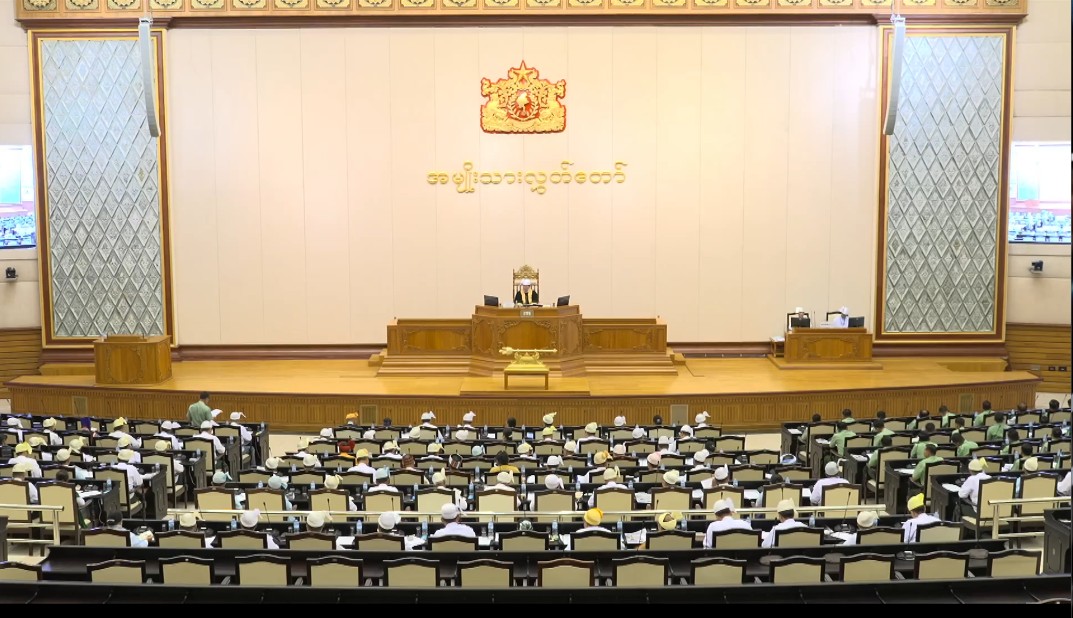
THE Amyotha Hluttaw continued for the 16th day at its convention hall in Nay Pyi Taw yesterday afternoon.
MP U Kyaw Kyaw Latt from the Yangon Region Constituency 10 asked about compensation for over 200 farmers for their confiscated farmlands in Dagon Myothit (North) Township. Deputy Minister for Home Affairs Maj-Gen Min Thu replied that regarding the remaining 204 farmers who are still awaiting farmland compensation, verification and necessary procedures are being carried out to provide compensation to 11 farmers. About the remaining 193 farmers, the relevant committees at various levels for reviewing cases of confiscation of farmland and other lands are conducting assessments in accordance with the 52 policy guidelines.
The deputy minister also responded to the questions raised by MP U Zaw Min Htoo from the Kayah State Constituency 11, saying that the process of granting land lease permits for lands within the municipal areas of Loikaw Township is currently being initiated. During the ongoing process, for industrial zones and MSMEs to be eligible to obtain loans from the State Economic Promotion Fund, arrangements are being made to provide loan disbursements where agricultural land use certificates (Form-7) are available. In addition, the Department of Land Records is undertaking urban land surveying works, and in areas where the surveys have been completed, arrangements are being made to issue land lease permits for residential and business purposes.
The deputy minister also answered the questions raised by MP U Yan Naing Win from the Ayeyawady Region Constituency 1, stating that the current residential conditions within the areas designated for urban land use shall be reviewed, and a Town Plan shall be prepared based on the projected future population growth in Kyonpyaw District. In accordance with the Town Plan, coordination and negotiations shall be carried out with the original landowners under the supervision of the Ayeyawady Region Government.
MP U Than Tun from the Rakhine State Constituency 3 asked whether a plan is implemented to build IDP camps for the people who fled their residences from Sittway Township of Rakhine State due to terrorist attacks. Deputy Minister Maj-Gen Min Thu answered that the internally displaced persons (IDPs) are living safely in buildings at temporary displacement camps arranged by the Rakhine State Government. Arrangements have already been made to provide monthly rice supplies for food, conduct mobile medical treatment services for healthcare, and provide educational support. Therefore, there is no need to construct additional buildings similar to IDP camps.
Hluttaw representatives participated in the debates over the motion tabled by MP Daw Soe Soe Myint from the Mon State Constituency 12, urging the government to implement tax administration and anti-corruption measures through effective strategies, through collaborative efforts of public and government departments to contribute to national development.
In response to the motion, Union Minister for Finance and Revenue Dr Kan Zaw stated that among the most significant measures undertaken are the introduction of the Aung Bar Lay Online Lottery system from 8 June 2023, enabling people to conveniently participate in the Aung Bar Lay lottery anytime and anywhere; the implementation of tax collection on mobile phone imports through the Central Equipment Identity Register (CEIR) system and Equipment Identity Register (EIR) system starting from 1 April 2026, to ensure the full collection of legally required taxes on imported mobile phones and to control illegal imports; and the ongoing efforts to introduce the Vehicle Automatic Valuation System (VAVS), which will automatically assess and calculate the payable value for motor vehicle purchases and sales.
The ministry has established eight strategic plans to ensure that tax system reforms are carried out systematically and is implementing phased projects to achieve nationwide coverage.
Previously, tax assessments were conducted under the Assumption-Based Assessment system, which relied on the estimated decisions of tax authorities. In place of this system, the system is being gradually introduced to shift towards an Evidence-Based Assessment system based on accounting records and factual data, and to exercise greater control over the discretionary authority of tax officers.
In the 2025-2026 FY, approximately 75 per cent of the total tax revenue collected by the Internal Revenue Department was collected through the Self-Assessment System (SAS). At SAS offices, digital tax administration systems, including the Tax Revenue Management System (TRMS), have been implemented; the taxpayer registration system with a Unique Taxpayer Identification Number (TIN) in line with international standards has been introduced; and online tax services have been facilitated through e-Registration, e-Filing, and e-Payment systems (m-Banking and IRD Tax Payment Hub), enabling taxpayers to fulfil their tax obligations online.
Efforts have also been made to obtain real-time information by linking with MyCO (DICA), MACCS (Customs), CBM-NET (Central Bank of Myanmar), and TradeNet 2.0 (Trade); to implement the Aung Bar Lay Online Lottery system; to modernize the Aung Bar Lay Lottery draw process by using the Air Blow Digital Machine; to establish the CEIR/EIR registration system to ensure that mobile phone imports are not exempted from applicable taxes; and to begin implementing the Vehicle Automatic Valuation System (VAVS), which enables the automatic assessment and calculation of taxes payable on motor vehicle purchases and sales.
In addition, to improve tax compliance, measures are being taken to develop and implement a Tax Compliance Improvement Strategy; establish a dedicated unit at the Head Office to analyze potential tax losses; conduct tax audits and supervision targeting business sectors with a high risk of tax loss; carry out field inspections and supervision of tax stamp affixing at restaurants, hotels, and gold shops; and effectively impose penalties in accordance with the Tax Administration Law.
Furthermore, Taxpayer Service Centres, tax service offices, and e-Services Help Desk Centres have been opened and are operating to enable taxpayers to fulfil their tax obligations conveniently and to provide timely solutions to difficulties encountered by taxpayers.
Daily SMS campaigns are being automatically sent to the mobile phones of taxpayers who have received tax services to directly inquire about their satisfaction with the services provided by tax offices, the conduct and interactions of staff, whether there have been any inappropriate requests, and any circumstances that may lead to corruption.
Tax system reforms and the widespread expansion of technology adoption depend on the establishment of a Digital Tax Ecosystem and the provision of necessary infrastructure, including computers, data centres, and internet coverage. Accordingly, efforts are being made to expand technology-based tax services to tax offices across the country as well as to individual taxpayers.
The Union minister urged that tax departments, taxpayers, and all MPs work together and cooperate to ensure that the public fulfils their responsibilities in a responsible and corruption-free manner in contributing to tax revenue collection. The Amyotha Hluttaw approved the motion of the submitter. The Amyotha Hluttaw will continue its session on 16 July. — MNA/TTA