
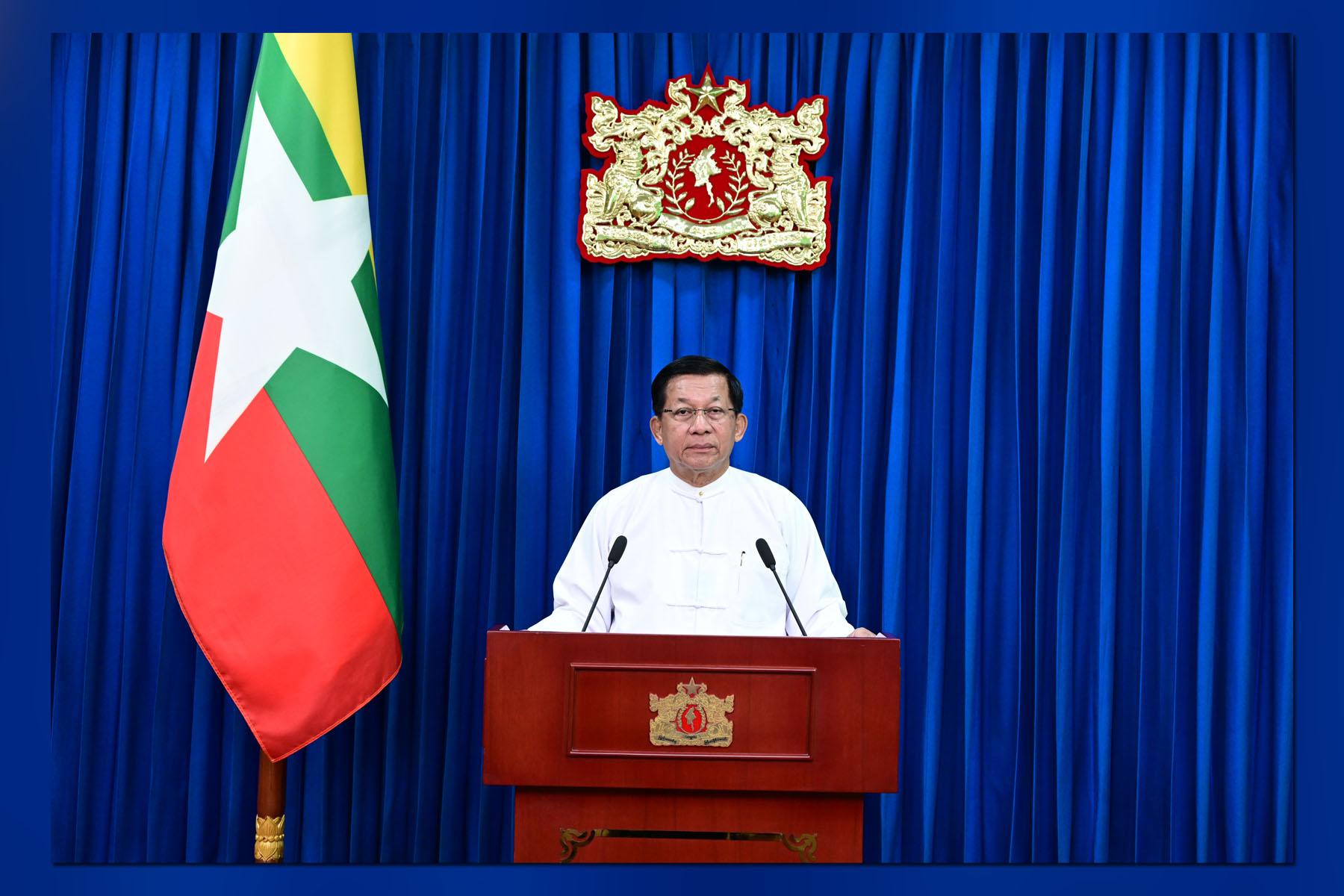
ACTING President of the Republic of the Union of Myanmar and State Security and Peace Commission Chairman Senior General Min Aung Hlaing delivered a video message at the ceremony to mark the International Anti-Corruption Day, which falls on 9 December 2025. The full text of the translated video message is as follows: -
Everybody, Mingalaba!
On the occasion of the International Anti-Corruption Day, observed on 9 December, today, I would like to extend my greetings and best wishes for good health and well-being to all Union-level dignitaries, chief ministers of states and regions, and guests attending the commemorative ceremony.
Corruption remains a major obstacle in implementing reforms and development activities needed for national progress. The government, prioritizing the national interest, is working with strong political will to eliminate corruption, aiming to build a genuine democratic state based on responsibility, accountability, transparency, integrity, fairness and the rule of law.
A clean government and an effective administrative system are essential to establishing a disciplined and fully democratic nation. Ensuring good governance requires the absence of corruption, and corruption itself is a barrier to effective administration. Therefore, only by establishing a corruption-free and sound governance system can the country achieve development across all sectors, leading to fairer and more prosperous social conditions for the public.
Short-term and long-term plans are needed to effectively carry out anti-corruption efforts, and all members of society must participate actively and transparently in the fight against corruption. Transparency, responsibility, and accountability in anti-corruption activities help prevent and eliminate corruption effectively. At the same time, tolerance, excusing, or ignoring corrupt acts only encourages such behaviour and must therefore be strictly avoided.
The United Nations Convention against Corruption has set this year’s International Anti-Corruption Day theme as: “Uniting with Youth Against Corruption: Shaping Tomorrow’s Integrity”. In line with this theme, the Commission will continue implementing awareness programmes and youth dialogue sessions aimed at educating young people, who play an important role in shaping the future, about anti-corruption issues. The Commission also emphasized the need to work continuously toward building a corruption-free society.
Integrity is an essential pillar of political, economic, and social institutions. For individuals and communities alike, integrity is vital for building trust, fostering healthy social and economic relations, and ensuring both physical and mental well-being. To ensure effective national reforms, integrity must be upheld not only in administrative processes but also within the legislative and judicial sectors. Such practices require cooperation not only from government institutions but also from individuals and the private sector. Only then can national and public interests be served with goodwill, honesty, and strong moral principles.
To build a corruption-free society, existing corrupt practices must be reduced by investigating and eliminating cases of corruption, while at the same time implementing the necessary reforms, management measures, and sustained efforts to ensure that corruption eventually disappears in the future.
In particular, it is necessary to identify and remove all root causes that give rise to corrupt practices. This includes addressing complex and difficult-to-understand laws, regulations, orders, instructions, rules, and procedures that can be misused by those in positions of authority. These must be revised and presented in a clear and accessible way so that the public can easily understand them. Such measures need to be incorporated into the formulation of national anti-corruption strategic plans.
The government is implementing its responsibilities with a focus on Our Three Main National Causes and is working to build a Union based on democratic and federal principles. This includes carrying out the national objective of “promoting national prosperity and ensuring food security” and the political objective of “strengthening a genuine, disciplined multiparty democratic system and building a Union based on democracy and a federal system”.
The National Defence and Security Council has set the objective “to implement a multiparty democratic system, with the participation of the people, to ensure the success of the multiparty democratic general election process and successfully move towards the multiparty democratic system aspired by the entire people”. Measures are being carried out accordingly.
To build a Union based on democratic and federal principles, it is essential to successfully hold free and fair elections. All eligible voters must have the opportunity to cast their votes, and elections must be conducted freely, fairly, and within the designated timeframe. The public is therefore urged to participate actively and responsibly in these processes. The authorities also call on all stakeholders to avoid inappropriate conduct and unlawful actions that may occur during the election process. Officials and citizens alike are encouraged to work together to ensure that the elections are free from corruption, impartial, transparent, and conducted in a disciplined and credible manner.
In conclusion, to cultivate a culture that does not tolerate corruption and to prevent misconduct, it is essential to prioritize balanced approaches to public awareness and preventive measures. In addition, in line with the objectives set by the State, action must be taken effectively in accordance with the law against anyone who commits corruption, without discrimination or favour.
Therefore, efforts must be made to establish a culture of zero tolerance for corruption, to expand public understanding of anti-corruption issues, and to build a society committed to rejecting and eliminating corrupt practices. In doing so, civil servants, public employees, business operators, civil society organizations, the media, and the general public must work together to distinguish clearly between public interest and personal gain, and to prevent any form of misconduct as part of honouring the 22nd International Anti-Corruption Day.
Thank you all.