By Ms Monn
AN IN-DEPTH Summary of Water Sources, Chemistry, and Their Importance for Brewing. Understanding where water comes from and how it changes as it moves through the environment is essential for brewers. Water is not a static or uniform substance; its composition is constantly altered by natural processes and human activity. This text explains how water travels through the hydrologic (water) cycle, how it acquires various chemical constituents along the way, and why these changes matter so much in brewing. Since water is the primary ingredient in beer, its chemistry directly affects brewing performance, flavour, and quality.
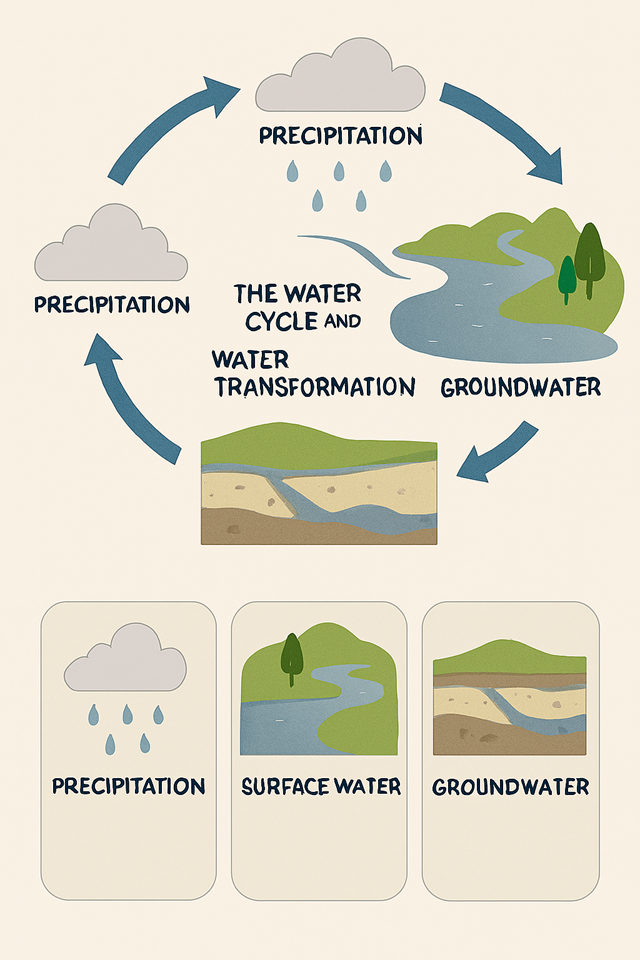
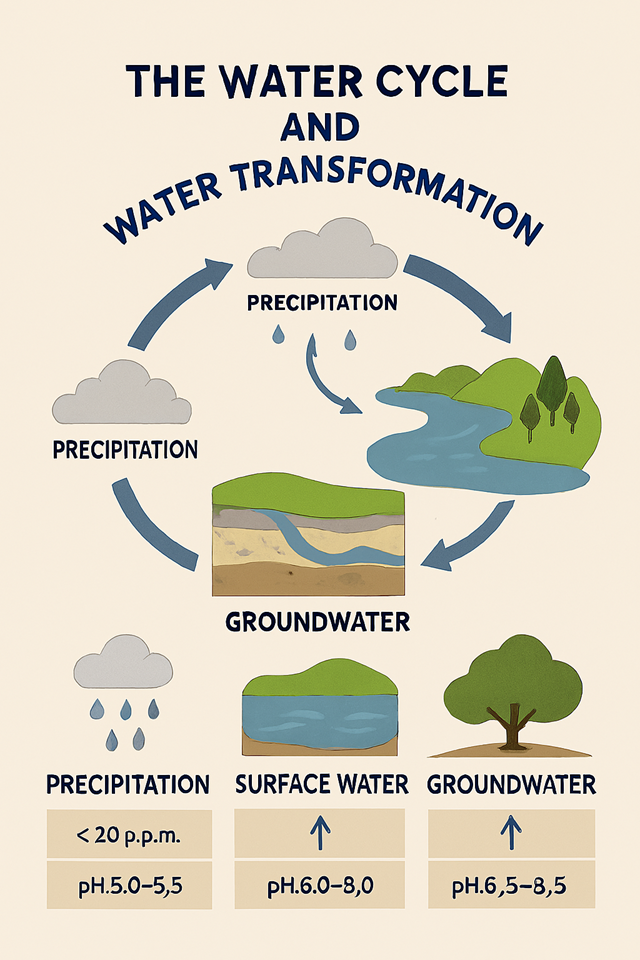
The Water Cycle and Water Transformation
The water cycle begins in the atmosphere, where water exists primarily as vapour. In this state, water is essentially pure H₂O. However, purity does not last long. As water vapour cools and condenses into droplets within clouds, it absorbs gases and particles from the surrounding air. Carbon dioxide is particularly important because it dissolves readily in water and plays a major role in determining water acidity. In addition to gases, dust particles and microscopic mineral crystals such as sand or sodium chloride also become incorporated into water droplets. These particles not only aid condensation but also contaminate water even before it reaches the ground.
As droplets grow larger, they fall as precipitation in the form of rain or snow. Once precipitation reaches the Earth’s surface, it becomes surface water. At this point, water begins interacting directly with soil, plants, rocks, animals, and human activities. The longer water remains on the surface, the more substances it absorbs. These substances may include organic matter such as decaying vegetation or animal waste, agricultural chemicals like herbicides and pesticides, and inorganic minerals such as calcium sulfate or sodium chloride.
Some surface water seeps into the ground, passing through layers of soil and rock. During this process, much of the organic matter is filtered out, but the water becomes exposed to additional minerals. This subsurface water is known as groundwater. Groundwater may remain underground for hundreds or even thousands of years, giving it ample time to dissolve minerals from surrounding geological formations. In regions with carbonate rocks, such as limestone, groundwater often develops high hardness and alkalinity – characteristics that are especially significant in brewing.
Eventually, groundwater returns to the surface through wells, springs, rivers, and streams. At any stage, water may also evaporate back into the atmosphere, completing the cycle. Each phase of this journey alters water chemistry, making no two water sources exactly alike.
Main Sources of Fresh Water and Their Characteristics
There are three principal sources of fresh water: precipitation, surface water, and groundwater. Each source has advantages and disadvantages for brewing.
Precipitation
Water from rain or snow is typically very low in dissolved minerals and organic matter. Its total dissolved solids are often below 20 parts per million. However, precipitation absorbs gases from the atmosphere, especially carbon dioxide, which forms carbonic acid and lowers water pH. As a result, rainwater is naturally acidic, with a typical pH between 5.0 and 5.5.
In industrialized or polluted regions, precipitation can contain elevated levels of sulfates, nitrates, heavy metals, and other contaminants. In extreme cases, pollution leads to acid rain with pH values as low as 2.6. Despite these potential contaminants, precipitation generally has very low alkalinity and minimal buffering capacity, making it chemically unstable for brewing without treatment.
Surface Water
Surface water includes rivers, lakes, ponds, and reservoirs. Compared to precipitation, surface water usually contains higher levels of dissolved minerals, organic matter, and alkalinity. Its pH typically ranges from 6.0 to 8.0.
The chemistry of surface water varies widely depending on geography, geology, flow rate, climate, and human activity. Fast-flowing Mountain streams often resemble fresh precipitation because water has little time to dissolve minerals. In contrast, large slow-moving rivers accumulate sediments, organic matter, and agricultural runoff as they pass through floodplains.
For example, the Mississippi River flows through limestone-rich regions and therefore has relatively high alkalinity and a pH near 8. The Amazon River, by contrast, flows through siliceous rock and organic-rich soils. Its water contains humic acids from decaying vegetation, giving it a brown, tea-like appearance and a lower pH, usually below 6.
Lakes can undergo seasonal changes due to thermal stratification. During summer and winter, layers of water form based on temperature and density. In spring and autumn, mixing occurs, redistributing nutrients and oxygen. These seasonal changes can promote algal blooms and microbial activity, which may produce unpleasant tastes and odours such as earthy or musty aromas caused by compounds like geosmin and MIB. Treating such water often requires activated carbon filtration.
Groundwater
Groundwater forms when surface water infiltrates soil and rock layers and accumulates in aquifers. The age of groundwater varies greatly, from less than a year to several thousand years, with a global average of about 250 years. Extended contact with rock and soil allows groundwater to dissolve significant quantities of minerals, sometimes resulting in highly mineralized water that is difficult to replicate artificially.
The pH of groundwater usually falls between 6.5 and 8.5. Water outside this range can dissolve undesirable metals such as iron and manganese, which are problematic for brewing, even in small concentrations.
Aquifers are classified in several ways. Hydrogeologists distinguish between confined aquifers, which are protected by impermeable layers like clay, and unconfined aquifers, which are more exposed to surface contamination. Geologists classify aquifers based on rock type, which provides insight into water chemistry.
The five main aquifer types identified by the US Geological Survey are:
Sand and gravel aquifers – Typically low in dissolved minerals but more vulnerable to contamination.
Sandstone aquifers – May contain gypsum and often produce highly mineralized water due to long residence times.
Carbonate rock aquifers – Composed of limestone and dolomite; commonly yield hard, alkaline water.
Sandstone and carbonate aquifers – Often produce very hard water; Burton-on-Trent is a famous brewing example.
Igneous and metamorphic aquifers – Low mineral content due to poor solubility of rocks like granite and basalt.
Each aquifer type influences water chemistry differently, which historically shaped regional beer styles.
pH, Alkalinity, and Buffers
Although pH measures acidity or alkalinity, it alone does not fully describe brewing water. More important is alkalinity, which reflects water’s buffering capacity – its resistance to pH change. Buffers, primarily bicarbonates in drinking water, react with acids and bases to stabilize pH.
Measuring pH without knowing alkalinity is misleading, much like measuring voltage without knowing battery capacity. Understanding both pH and buffering systems is essential for managing mash chemistry and brewing consistency.
From Source to Faucet: Municipal Water Treatment
Most brewers obtain water from municipal supplies rather than directly from natural sources. Municipal water may come from multiple sources blended to ensure year-round reliability. Although drinking water is treated to meet safety standards, it is not automatically suitable for brewing.
Typical treatment steps include screening, coagulation, filtration, aeration, softening, and disinfection. Organic matter and particles are removed through coagulation and filtration, while iron and manganese are oxidized and filtered out. Hard water may be softened using lime treatments. The final steps involve pH adjustment and disinfection. Utilities adjust pH to protect infrastructure and add disinfectants to prevent microbial growth in pipelines.
Chlorine and Chloramine in Brewing Water
Disinfection commonly uses chlorine or chloramine. Chlorine is effective but volatile and produces strong odours and harmful byproducts when reacting with organic matter. Chloramine, a combination of chlorine and ammonia, is more stable and produces fewer byproducts, but it is harder for brewers to remove and can negatively affect beer flavour.
Brewers can test for chlorine and chloramine using simple kits or sensory methods. Identifying and removing these disinfectants is critical for producing clean-tasting beer.
The key takeaway is simple but vital: know your water source and its characteristics. Water chemistry is shaped by the water cycle, environmental exposure, geology, and human treatment. Each source – precipitation, surface water, and groundwater – has unique strengths and challenges for brewing. Understanding these differences allows brewers to anticipate problems, make appropriate adjustments, and ultimately produce better beer.
“A day without water is like a day without life.” May we all understand the vital importance of water, just as expressed in this Myanmar proverb, and learn to protect and conserve it as something as precious as life itself.
Reference: Abridged from “Water” by John Palmer and Collin Kaminski