
Efforts must be made to increase per capita consumption of meat and eggs, thereby improving public health standards.
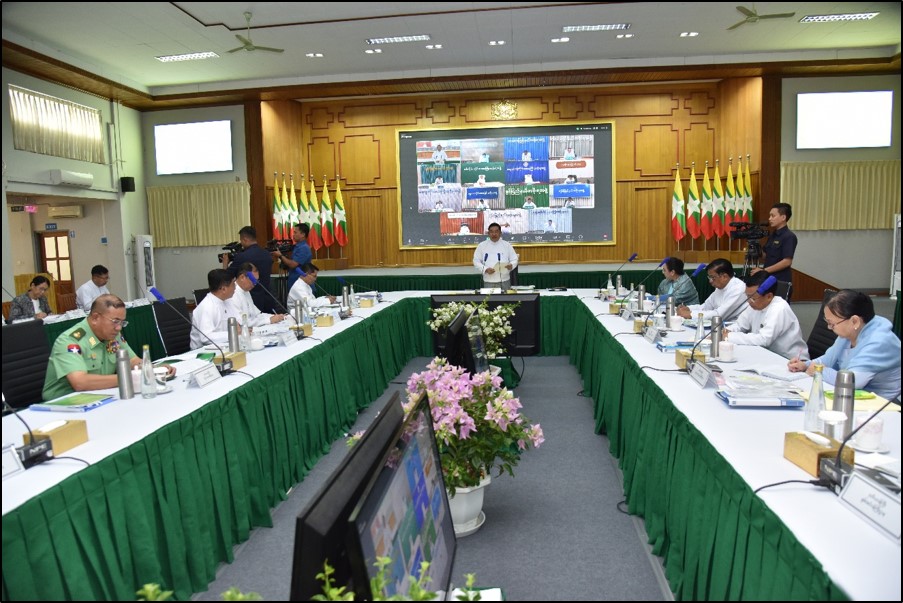
CHAIRMAN of the Agriculture and Livestock Development Commission, Prime Minister U Nyo Saw delivered a speech at the meeting 4/2025 of the commission at the Ministry of Agriculture, Livestock and Irrigation in Nay Pyi Taw yesterday morning.
The Agriculture and Livestock Development Commission Chairman, the Prime Minister delivered a speech. He recounted that to further develop agricultural and livestock enterprises, the Head of State has given guidance that priority be given to increasing target yields and promoting multiple cropping. In addition, efforts must be made to ensure that current monsoon rice cultivation areas achieve their target yields, and that summer rice cultivation is expanded depending on water availability. Furthermore, in hilly areas where land cannot be converted for cultivation, guidance has been issued to promote the planting of perennial trees.
He continued to say that since the expansion of oil crop cultivation is crucial, specific zones have already been designated for groundnut, sesame, and sunflower, which are major oil crops. However, the set targets have not yet been met. As guidelines to expand sunflower cultivation have already been issued since 2022, they must be effectively implemented to ensure success.
For domestic edible oil security and for export purposes, the expansion of sunflower cultivation is essential. Sunflower cultivation offers high yields, shorter growing periods, ease of cultivation, and contributes to economic development. By increasing sunflower oil production, the country’s edible oil demand will be met, imports will decline, and foreign exchange spending will decrease. Therefore, policies must implement sunflower expansion programmes.
Based on Myanmar’s estimated population of 51.3 million and annual consumption of six visses per person, about 500,000 tonnes of cooking oil are required. Although it is calculated that the current production of groundnut, sesame, sunflower, niger, and canola seeds could meet national consumption, groundnut and sesame are also widely consumed as whole seeds and exported abroad. Thus, there will still be a domestic oil shortage. To address this, sunflowers, which are primarily used for oil, must be expanded. Currently, about US$500 million worth of edible oil is imported annually, so expanding domestic sunflower cultivation is necessary to reduce import dependency.
Moreover, moving beyond a monoculture system dominated by rice and beans, the introduction of sunflower cultivation as a major crop allows farmers to achieve crop diversification. Research also indicates that crop rotation with sunflowers can help maintain soil fertility. Since domestic groundnut oil prices are high due to production costs, making edible oil affordable for consumers and ensuring the survival of local oil mills requires a comprehensive policy to expand oil crop cultivation. Therefore, the expansion of cultivated areas and the improvement of productivity must be carried out under the leadership of relevant regional and state governments.
Currently, apart from agricultural and livestock universities, 89 industry, agriculture, and livestock high schools have been established during this government’s tenure, with 5,091 students enrolled. Investment in human resources for agricultural research yields high returns for national development and plays a vital role in increasing productivity and competitiveness.
In addition to ten prioritized crops for continuous agricultural development, potato, onion, and garlic have also been designated as important crops. Regional and state governments are urged to focus on achieving the set yield targets for these crops.
For rice cultivation, the government has provided interest-free loans to promote direct seeding using drum seeders, ensuring better yields. Pilot programmes with drum seeders have been implemented in Nay Pyi Taw and six regions, with plans to expand support to other areas.
Since August of this year, under the leadership of the Agricultural and Livestock Development Commission and the Urea Fertilizer Import and Distribution Committee, fertilizers have been distributed to farmers at prices 25 per cent lower than market rates, with priority distribution in Nay Pyi Taw and major regions, and gradual expansion to other states and regions.
According to the guidance of the Head of State, in central Myanmar’s hot regions, tree planting is the best way to mitigate extreme heat. Without trees, soil erosion worsens, and in the absence of vegetation, thorny shrubs will spread. Therefore, preventive tree planting must be carried out as directed.
In livestock, dairy farming must be expanded to increase milk and dairy production, thereby reducing reliance on imports. Alongside dairy cattle, beef cattle farming must also be promoted.
Sheep and goat farming, already successful in the country, must be expanded further, along with large-scale pig and poultry farming, which is currently widespread. These modern livestock systems use a cage system and refrigeration technology. Efforts must be made to increase per capita consumption of meat and eggs, thereby improving public health standards.
Furthermore, aquaculture, including freshwater and saltwater fish and shrimp farming, plays a vital role not only in food security but also in foreign exchange earnings. Expanding livestock and aquaculture production, and exporting value-added products such as processed meat and fish, will promote the growth of micro, small, and medium-sized enterprises (MSMEs) and generate higher incomes for farmers.
The secretary of the commission clarified decisions from the third meeting of the commission. Union ministers who are Commission members, the Nay Pyi Taw Council Chairman, regional and state chief ministers, deputy ministers, the president of the Union of Myanmar Federation of Chambers of Commerce and Industry and officials discussed accomplishment of the previous meeting’s decisions, and further cooperation of relevant ministries, organizations and entrepreneurs in development of agriculture and livestock sectors.
The Prime Minister coordinated discussions and gave a concluding remark. — MNA/ TTA