
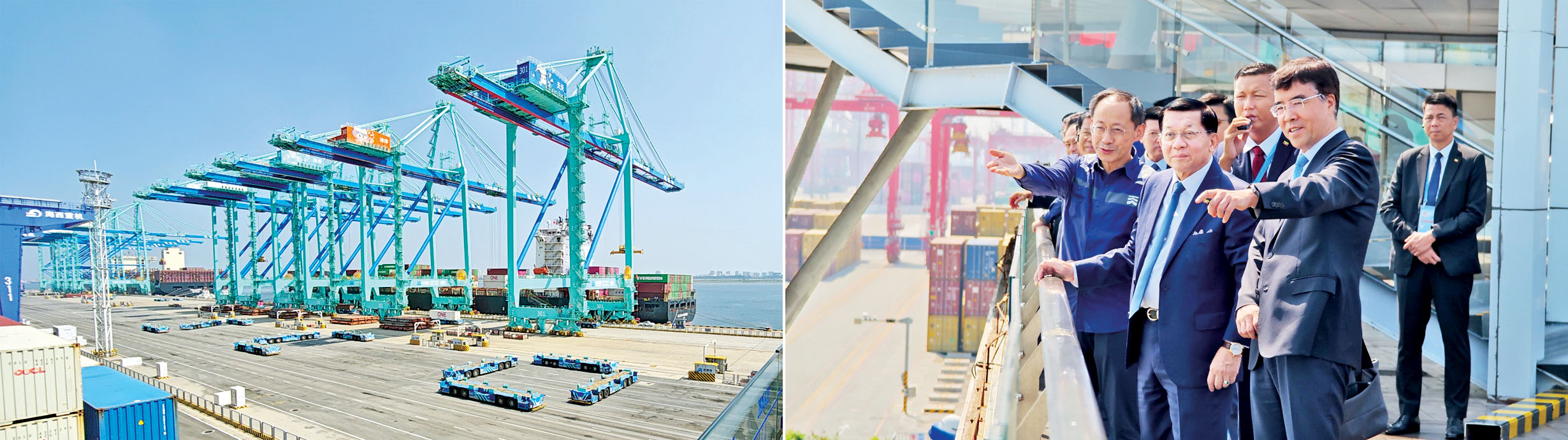
ACTING President of the Republic of the Union of Myanmar and Chairman of the State Security and Peace Commission of the Republic of the Union of Myanmar Senior General Min Aung Hlaing, who is currently in China on his working visit, together with his entourage, visited Tianjin Port at 10 am Chinese standard time yesterday.
The high-level Myanmar delegation, led by the Acting President and SSPC Chairman of the Republic of the Union of Myanmar, left the Tengle Hotel in Tianjin by car and viewed round urban development activities along the route.
At Tianjin Port, the port in charge and an official reported to the Senior General on the functions of the port, transport of commodities from Tianjin Port to other domestic destinations and abroad, transnational trade measures, construction of the port, handling containers through AI technology, efforts to shape the carbon-free port, and operation of functions with wind power.
The Acting President and Chairman of the SSPC of the Republic of the Union of Myanmar enquired about the port.
They observed the handling of containers through the AI system at the port and the work process at the port.
Container trucks equipped with AI technology demonstrated the SCO logo, representing the Shanghai Cooperation Organization (SCO) Summit 2025, at the port.
The Acting President and Chairman of the SSPC of the Republic of the Union of Myanmar, along with the party, had documentary photos taken and exchanged gifts with the port in charge.
Tianjin Port is located within the Binhai New Area (BNA) District of Tianjin Municipality, which is the primary special economic zone in northern China. The port is located in the Tianjin Municipality Administrative Region, west of Bohai Bay, near the Hai River. The port aims to become a logistics hub for the northern part of China. The Deep-Water Seaport/Riverport, built on a 470-square-kilometre area, including 121 square kilometres of land, was commissioned into service in October 1952. The port admits 217 jetties, including 140 production jetties. It utilizes an AI system to handle containers. Tianjin Port is built on 22 metres (77 feet) of water and can accommodate the docking of 300,000-tonne vessels. Annually, the port handles more than 500 million tonnes of commodities and 13 million containers. It gives services to 14 provinces and regions of China, which is more than half of the country. — MNA/TTA