
The State funded K500 billion to support the reconstruction of homes and buildings of the people damaged by the disaster, and a further K2 trillion to continue supporting reconstruction and rehabilitation efforts.
A CEREMONY to commence the Post-Earthquake Technical Forum under the title of technically reviewing post-earthquake construction and renovation process and preparing potential technical challenges in the future took place at Mingala Thiri Hotel in Nay Pyi Taw yesterday morning, with an address by Chairman of the State Administration Council, Prime Minister Senior General Min Aung Hlaing.
The Senior General and forum participants observed a one-minute silence for the demise of monks and people in the devastating Mandalay earthquake to mark its fourth month of the incident.
They all viewed a video clip on the technical reviewing post-earthquake construction and renovation process, and preparing potential technical challenges in the future.
Speaking at the forum, the Senior General said that the established infrastructure must meet earthquake-resistant standards and quality benchmarks in order to effectively protect the lives and property of the people from losses and damages.
The State has initially provided K500 billion as funding to support the reconstruction of homes and buildings of the people damaged by the disaster. In addition, a further K2 trillion is being provided to continue supporting reconstruction and rehabilitation efforts.
Due to the major Mandalay earthquake, he recounted that a total of 3,739 monks and civilians lost their lives. In terms of infrastructure damage, more than 50,000 residential homes were destroyed, along with roads, bridges, towers, schools, hospitals, religious buildings, and numerous factories and workplaces.
The Senior General stressed that many quake-affected countries, including Japan, China, and Indonesia, have been able to construct skyscrapers, high-rise buildings, and advanced structures using high-quality construction materials and advanced technology. As such, Myanmar has to consider how to build similar buildings like aforesaid countries.
The Senior General expressed gratitude to all experts, professionals and technicians for their efforts in overseeing high-rise and public-use building projects, jointly conducting assessments, setting the level of damage based on a colour-coded system, and formulating Standard Operating Procedures (SOPs) to guide the repair of earthquake and disaster-affected infrastructures.
To ensure the proper implementation of standards in construction activities, he noted that as the Ministry of Construction, together with the Myanmar Engineering Council, the Myanmar Architects Council, the Federation of Myanmar Engineering Societies, the Myanmar Geosciences Society, the Myanmar Earthquake Committee, and various urban engineering and earthquake-related organizations, jointly coordinated efforts, the Myanmar National Building Code (MNBC), which was first issued in 2012, was revised and reissued once in 2016 and again in 2020.
He underlined that only when all levels of stakeholders within the construction industry including cement, iron, and steel material importers and sellers, local manufacturers, structural design professionals, developers, contractors, supervising engineers, and quality inspectors—collaborate systematically and with awareness can the basic infrastructure we are responsible for building today ensure the safety of people’s lives and homes when facing future earthquake risks.
The Senior General emphasized that the 2025 edition of the Myanmar National Building Code (MNBC), developed based on the latest geoscientific data from the recent major Mandalay earthquake, incorporates updated standards and specifications that are adequate for potential future earthquakes. It includes more detailed and region-specific seismic zone maps and an analysis of the modes of failure observed in buildings damaged during the earthquake. Moreover, it introduces seismic load calculation methods tailored to different building types. As such, MNBC 2025 is expected to serve as an effective Earthquake Resilient Design Framework for Myanmar.
At today’s Post-Earthquake Technical Forum, he continued that participating experts have to engage in open and collaborative discussions to identify practical solutions for constructing earthquake-resistant buildings. The aim is to thoroughly examine the current state of the construction industry in the country and explore how to ensure full compliance with the established rules, regulations, and standards.
The Senior General urged government officials, engineers and architects from the private sector, developers, producers, importers, distributors, and sellers of construction materials, all stakeholders, to join work collaboratively in the Post-Earthquake Technical Forum to create safe and secure basic infrastructure for citizens in the future, ensuring protection from hazards and peace of mind.
The Senior General presented honourary documents of appreciation to chairs from the Myanmar Engineering Council, Myanmar Architects Council, Myanmar Engineering Society, the Expert Committee for the Supervision and Inspection of High-Rise and Public-Use Building Construction Projects, the Myanmar Geosciences Society, and the Myanmar Earthquake Committee.
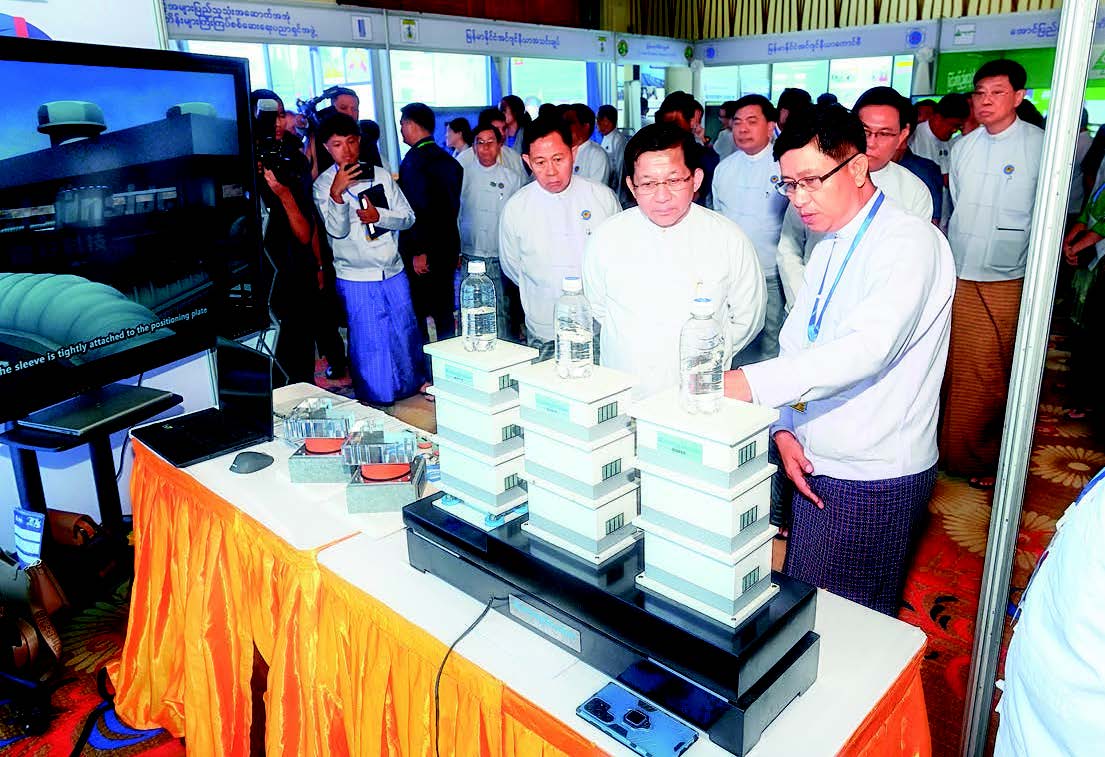
Speakers and resource persons of papers to the forum introduced themselves to the Senior General. The Senior General visited the booths to mark the Post-Earthquake Technical Forum.
Also, present at the forum were SAC Vice-Chairman, Deputy Prime Minister Vice-Senior General Soe Win, Council Joint Secretary General Ye Win Oo, SAC members, union-level dignitaries, union ministers, senior Tatmadaw officers from the Office of the Commander-in-Chief, deputy ministers, experts at home and abroad, chairs and members from the engineering and architectural related organizations, and guests.
The Post-Earthquake Technical Forum is organized with the objectives of technically reviewing the reconstruction of infrastructure damaged by the major Mandalay earthquake and discussing solutions to proactively prepare for potential future technical challenges. It is reported that the forum will continue until 29 July. — MNA/TTA