Elections must be conducted with utmost effort to enhance the State’s image and set its political course on the right path.
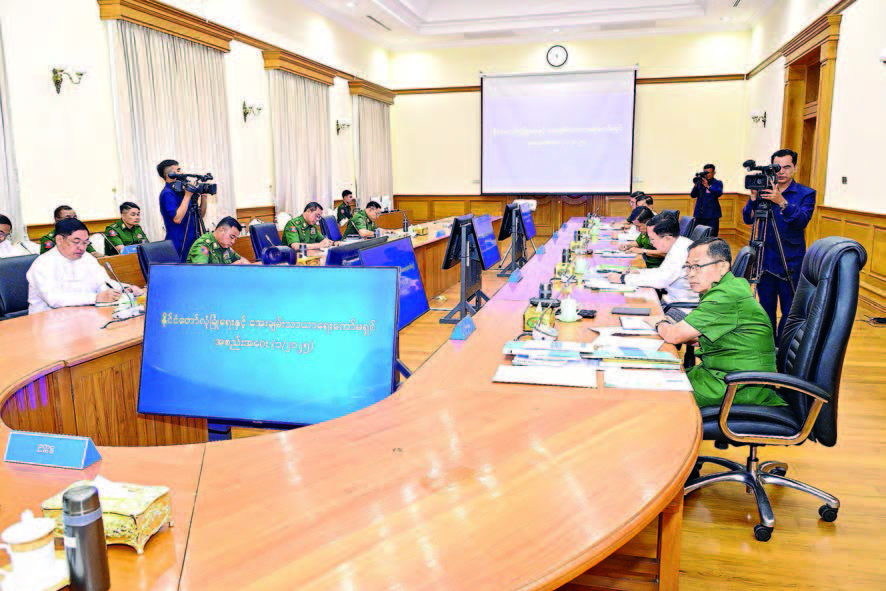
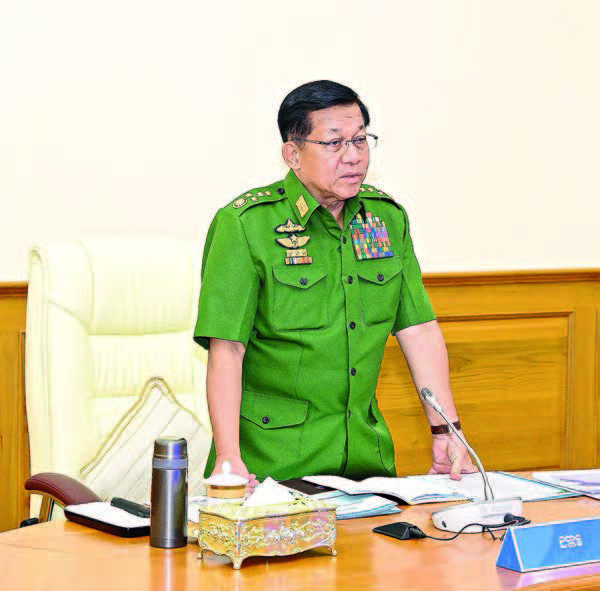
THE State Security and Peace Commission held its first meeting yesterday morning, with an address by Senior General Min Aung Hlaing, Chairman of the State Security and Peace Commission of the Republic of the Union of Myanmar.
Speaking at the meeting, the Senior General said that the National Defence and Security Council has formed and assigned the State Security and Peace Commission to provide necessary guidance and to effectively coordinate efforts for national defence, security and peace, and for the successful holding of a multiparty democratic general election.
He continued that it is to ensure the successful holding of a multiparty democratic general election and, after the election, to enable the government formed by the Hluttaw to take the responsibilities of the State.
The Senior General highlighted that the election must be held without fail, and efforts have been made to ensure the accuracy of voter lists, including the successful implementation, to a certain extent, of the 2024 census, which is part of the preparations for the election.
He added that, to ensure the successful holding of the election, the Union Election Commission was reconstituted, and activities were carried out to collect data by constituency as well as to gather security-related information by region.
He underscored that holding the election is important to convene and form the respective Hluttaws, and it is essential that the election be successful and under the law.
The Senior General emphasized that, regarding the need to secure the required number of representatives for the Hluttaw session to be valid, Section 85 of the Constitution states that for the first Hluttaw session to convene, more than half of the representatives entitled to attend must be present. If this requirement is not met, the second session shall be valid if at least one-third of the representatives entitled to attend are present. Therefore, in order to ensure that at least 50 per cent of Hluttaw representatives can attend when the Hluttaw convenes, efforts are being made to hold elections in all townships where elections can be conducted.
He underlined that all eligible voters will be enabled to cast their votes, and arrangements will also be made for displaced voters affected by natural disasters to vote in advance. Measures will be taken to ensure that all eligible voters in safe locations do not lose their right to vote.
In foreign countries, he noted that there will be those that support and welcome the holding of a multiparty democratic general election in Myanmar, as well as countries that may take a critical stance toward the election.
Therefore, the Senior General stressed that the upcoming election must be conducted as a free and fair election, and it must be free from fraud.
He explained that necessary protections must be provided to ensure that political party members and candidate representatives participating in the election can safely carry out their activities from the campaign period through to the voting period.
He pointed out that regarding the allegations and killings labelling government staff and the public as “informants,” such incidents may increase during the election period, so effective prevention and protective measures need to be implemented.
In the education sector, the Senior General recounted that a review of the schedules for the 2024-2025 and 2025-2026 academic years shows that all regions and states have experienced insufficient student enrolment and weak grade promotion rates. Therefore, the relevant ministry needs to conduct research and seek solutions to address the weaknesses in education.
He noted that suppressing and preventing illegal trade will help uphold the rule of law and reduce armed violence.
He said that armed terrorists in border areas use the profits from illegal trade to strengthen their forces, which undermines national stability and the rule of law. Looking back at the country’s history, it is evident that illegal trade routes have caused significant damage to the national economy.
The Secretary of the Commission Joint Executive Chief discussed reviews on holding the election in portions in townships of relevant regions and states, use of Myanmar electronic voting machines; the Commission member Union Minister for Home Affairs, comparison of security and rule of law activities in years, formation of people’s security and violence combat groups, and plans to raise security measures; the Commission member Chief of the General Staff (Army, Navy and Air), undertaking of military operations and security measures in military command areas and regions, plans to beef up regional control measures to hold the election in townships; and the Commission member Union Minister for Foreign Affairs, casting advance votes, studies for casting vote process in global countries.
The Vice-Chairman of the Commission discussed activities of anti-government organizations and EAOs in regions and states, achievements of Tatmadaw in military operations, and collaborative efforts of Tatmadaw, People’s Security and Violence Combat Group and people’s militia in combating drug and illegal trade and illegal businesses.
Commission members Prime Minister U Nyo Saw, Executive Chief U Aung Lin Dwe, and Union Minister for Defence General Maung Maung Aye also participated in discussions on preparations to successfully hold the election, distribution of MEVM, working procedures in accord with the election rules, dissemination of techniques to use the MEVM to the people, and raising public awareness to cast votes to strengthen the multiparty democratic path.
In his additional guidance, the Senior General explained military and security measures for increasing number of townships to hold the election, management for holding the election in portions, use of MEVMs, raising security measures for relevant individuals of political parties, their offices, and urban wards, public awareness for successfully holding the election through media, and enhancing support of the people with aspiration to experiencing democracy to hold the election successfully.
The Senior General emphasized that groups and individuals who do not desire national peace, stability, and development may attempt to sabotage the success of the election and carry out attacks. They may also engage in covert attacks through means such as drugs and online gambling, potentially undermining national and regional security. While efforts to combat drug trafficking are already being emphasized, it is necessary to intensify and conduct these operations more effectively.
He stressed the need to carefully handle drug eradication, combatting telecom fraud and illegal trade eradication.
Also present at the meeting were Vice-Chairman of the Commission Vice-Senior General Soe Win, Commission members Prime Minister U Nyo Saw and Executive Chief U Aung Lin Dwe, Commission Secretary Joint Executive Chief General Ye Win Oo, Commission members General Maung Maung Aye, Lt-Gen Tun Tun Naung, U Than Swe, Lt-Gen Yar Pyae and General Kyaw Swa Lin. — MNA/TTA