By THAN HTUN (GEOSCIENCE MYANMAR)
EPISODE:64
JADEITE FROM BURMA
This article is a continuation of Episode 63, featuring jadeite from Burma, contributed by H.L. Chhibber in 1934.
4. The Uru Boulder Conglomerate Jadeite-Workings
The Uru Boulder Conglomerate is worked for jadeite in numerous places, and these workings can be classified as follows:
- Stream-bed workings, where mining is possible throughout the year.
- Hillside workings, where the rock is quarried during the rains, which help in sluicing away the overburden and the matrix of the conglomerate.
The following section is generally observed in the Bounder Conglomerate workings for jadeite.
- Alluvium at the top, of variable thickness.
- A layer of pebbles and gravel, which the miners called “Kadi Kyaw”.
- Boulder Conglomerate, which is locally called “Kyauk Kyaw”.
- Sand-rock with boulders, locally known as “Thai Kyaw,” which is generally gold-bearing, and, according to the miners, jadeite boulders of better quality are found in this layer. When this layer is absent, it is thought that the place is not worth working, and valuable finds are not expected.
- Bedrock, locally called “Phah”, and mining is stopped when it is reached. Jadeite boulders are found only in III and IV.
In the neighbourhood of Hpakan (25° 36’ 38”, 96° 18’ 40”)
Hpakan is an important mining centre, and workings for the jadeite exist in several neighbouring localities listed below:
- Pantinmaw, opposite the confluence of the Uru and the Mowmoan Chaungs. Here, some fine, typical sections of the Boulder Conglomerate are visible. Monyin Chan, about 1 1/3 miles east of Hpakan on the right bank of the Uru Chaung.
- An-ma. These workings are situated 5/8ths of a mile east of Hpakan on the left bank of the Uru River. There is a thick capping of alluvium, approximately 14 feet thick, at the top of the Boulder Conglomerate, and the thickness of the latter is nine feet. At the time of my visit, women were washing for gold here.
- Mowmoan Chaung, near Mowmoan village (25° 36’ 53”, 96° 19’11”) and in the lower course of the stream of the same name.
- Mowmoan Chaungbyba (upper working). Jadeite workings extend right up to the source of the Mowmoan Chaung and in some of its tributaries.
- Mow-Maung, in the stream of the same name, north-west of Hpakan (25° 36’38”, 96° 18’ 40”).
- Shulunghka. In the neighbourhood of Shulunghka (25° 36’23”, 96° 17’28”), there are both stream-bed (in Sabyi hka) and hillside workings. From the number of deserted pits and water leads seen here, it appears that jadeite mining must have been more years ago than it is at the present day.
- Kalamaw (25° 36’ 55”, 96° 16’ 55”). These workings are situated a mile above Shulunghka and lie in the Sabyi hka stream. Old iron pipes are still lying about here. The village is surrounded by high cliffs of the Boulder Conglomerate on all sides.
- Sabyi and Sabyi Wa (25° 37 24”, 96° 16’ 15”) (both deserted).
- Hpakangyi. A little over one-third of a mile ESE of Hpakan (25° 36’ 38”, 96° 18’ 40”), on the left bank of the Uru chaung. Opposite these workings are precipitous cliffs about 200 feet high above the level of the river bed.
- Mowtaung, a little below Hpakangyi.
In the neighbourhood of Sankywe (Sanchoi) (25° 35’ 25”, 96° 17’ 47”)
- Sankat, about 7/10ths of a mile, some five degrees west of South of Hpakan, on the right bank of the Uru Chaung.
- U-mar, about 4/5ths of a mile N.E. of Sankywe ( 25° 35’ 25”, 96° 17’ 47”) on the left bank of the Uru chaung.
- Sankywe (marked Sanchoi on the map, 92 C/6).
In the neighbourhood of Parpyin (25° 35’ 21”, 96° 16’ 40”).
- Mena-aik, a little over 1 ½ miles ENE of Mamon (25° 35’ 10”, 96° 15’ 57”). This locality was once worked for gold, in addition to jadeite.
- Nampagon, a little above Parpyin.
- Parpyin. In one pit near the stream, the following section was observed:
In the neighbourhood of Mamon (25° 35’ 10”, 96° 15’ 57”).
- Thabeymaw, about half a mile north-east of Mamon (25° 35’ 10”, 96° 15’ 57”) on the right bank of the Uru Chaung.
- Mamon, in the neighbourhood of the village of Mamon.
- Meikkye.
- Htintingyi.
- Htingtingale.
- Sabwe, in the Sabwe Chaung.
The workings 20-22 all lie along the Uru Chaung below Mamon.
In the neighbourhood of Nammaw (25° 38’ 20”, 96° 15’).
- There are several important jadeite workings in the neighbourhood of Nammaw.
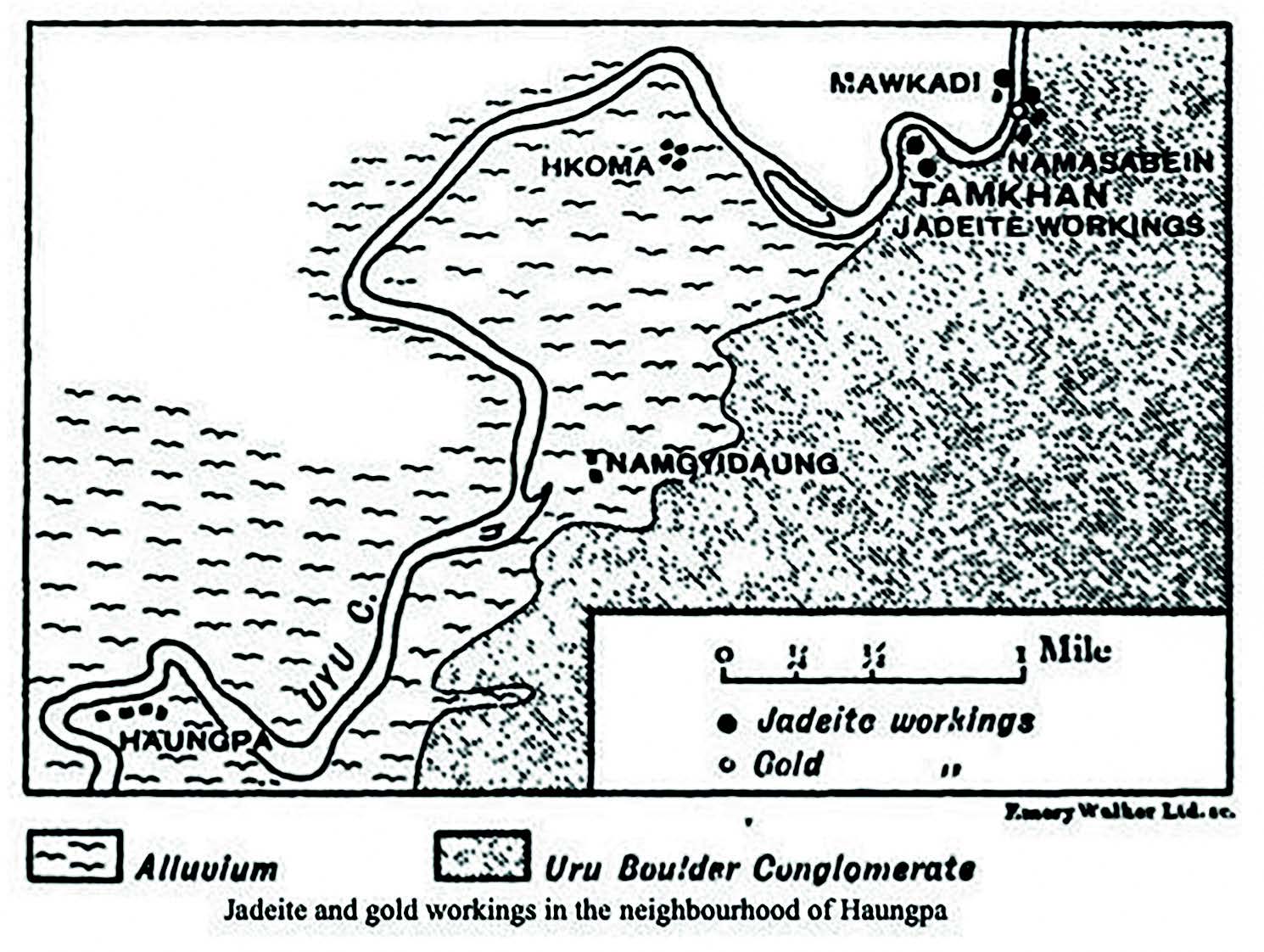
In the neighbourhood of Haungpa (25° 30’, 96° 6’ 15”).
The following important workings for jadeite occur in the neighbourhood of Haungpa.
- Namasabein.
- Mawkadi.
- Tamkhan.
- Tape.
In the region, Tamkhan is the most important mining centre, and the area enclosed by the inverted U-shaped bend of the stream (Uru Chaung) is worked. The mining methods are the same as in the north.
The interesting working of Sietaung must not be omitted. They are situated about two miles south-south-east of Saingmaw (25° 35’, 96° 17’30”) or about one-fifth of a mile south-west of the confluence of the Nammaw and Hwehka chaungs. This locality was worked for precious stones even during the time of the Burmese kings, but was subsequently deserted. About nine years ago, jadeite mining was renewed, and one stone was sold for Rs6000. Several deserted pits number about 1,000. The workings are situated on both sides of the Hwehka Chaung; however, those on the left bank constitute the majority. The thickness of the Boulder Conglomerate varies from 1 ½ feet to six feet at the most. In 1929, only one pit was being worked in, which overburden constituted 13 feet five inches, underlain by a boulder-bed six feet in thickness, which overlies the serpentine forming the bed-rock; but a comparatively larger number of people are engaged in the industry during the rainy season. It appears that this Boulder Conglomerate was deposited by the Hwehka Chaung since it disappears at a distance of about 100 yards from the stream. The nature of the boulders is also different from those seen towards the north, the majority of them being granodiorite, diorite, granophyre, and quartz.
Methods of mining: Before commencing mining, Jade-Nats (Spirits) are propitiated by almost every worker, irrespective of their nationality. It is believed that if the Nats are pleased, the miners will make valuable finds quickly.
Generally, at the top of some overburden (alluvium), which is sluiced away by a water race formed by diverting the channel of a stream. Then the Boulder Conglomerate is quarried with picks, crowbars, and mamooties, so that a steep face is obtained. A water dammed a little upstream is made to flow as a race over this steep face, washing away all the earth, earth, leaves the boulders exposed to view. They are carefully examined for jadeite. If water is not available from the stream, then a pit is dug in its bed, and it is replenished from the Boulder Bed. Then it is pumped out by an ingenious contrivance, described below, onto the desired place. On the other hand, in the bed of the Uru Chaung and some of its tributaries, water almost invariably fills the pits dug in the Boulder Conglomerate, so that to carry on mining, it is necessary to empty the pits. For this purpose, a long bamboo is used as a pipe or pump cylinder in which a wooden plunger with a T-shaped handle at the outer end and a leather valve at the inner end is worked. It is remarkable how it exhausts the water so rapidly. The number of pumps employed in a pit depends on the amount of water to be bailed out. At Mawkalon, in an exceptionally large pit, as many as eight or nine pumps have to be worked simultaneously.
It must be noted here that the work is not all carried out on up-to-date scientific lines, but in the old, primitive fashion. The people work blindly, believing entirely in their luck.
The miners are not all scrupulous in selecting the locality they propose to work. In this way, they are entirely guided by instinct. If in a particular spot, some valuable find is made, almost all the coolies flock to it. Such methods very often result in considerable wastage of labour and money, as no record is kept of the worked-out places. Not infrequently, the same spot is dug over three or four times with obvious results.
Another important drawback is that the work is not systematic. Their present methods result simply in picking up the best pieces of jadeite and neglecting entirely the less valuable ones. The whole industry requires reorganisation.
In the Boulder Conglomerate workings, every race and nationality is represented. Kachins, Shans, Burmans, Chinese, and occasionally an Indian are to be seen: the Shans probably form the majority. The labour is financed by jadeite merchants.
5. Workings in the Uru Chaung
Occasionally, jadeite workings are situated in the Uru Chaung itself. A stray labourer might search for jadeite boulders from the bed of a stream. This is a laborious task as the man has not uncommonly to stand in water, about thigh deep, all the time while, as a rule, the reward of his exertions does not arrive very promptly.
In places, the Shans dive in the Uru chaung in search of the previous stone. This method is used at Mamon and Chaunglon. The latter locality is about a quarter of a mile east-north-east of the confluence of the Nammaw and the Uru chaung. (to be continued).
References: Chhibber, H L, 1934: The Mineral Resources of Burma, Macmillan and Co, Limited, St Martin’s Street, London.