By Maung Moe
(Continued from yesterday)
At the very heart of the world, Myanmar stands anchored in its millennia-old civilizational roots, bearing witness to a rich and resilient cultural identity. Looking forward, it is the solemn historical duty of every citizen to safeguard, uplift, and advance Myanmar’s cultural legacy, ensuring that more of its heritage sites are recognized globally and that the nation’s distinct Identity continues to shine on the world stage.
The religious and cultural traditions of Myanmar are not mere relics of the past; they are the lifeblood of the nation, intertwining social unity, moral elevation, artistic refinement, and historical depth. By preserving these enduring values, Myanmar reveals to the world a timeless story: that of a nation that, with its own crown, its own throne, and its own sceptre, has for centuries stood with dignity at the crossroads of history and heritage.
Social Value
The traditional Myanmar Htamin- Wain—the family meal circle – is far more than the mere act of sharing food. It is a cultural inheritance that embodies familial unity, ancestral customs, and deeply held social values. Within this circle, members of the household – elders and youth, parents and children – gather around a shared table, sitting together without distinction of rank or age. Meals are served and enjoyed in common, with every dish shared in a spirit of equality and togetherness.
This sacred tradition is more than a daily ritual; it is a symbol of cohesion. It nurtures love within the family, fosters open dialogue, and strengthens bonds that transcend generations. Welcoming guests into the Htamin-Wain is a gesture of hospitality rooted in heritage, expressing the timeless Myanmar code of graceful generosity.
At its heart, the Htamin-Wain reflects the broader values of Myanmar society: rural unity built upon the foundation of family, reverence for tradition and religion, and a deep-seated ethic of compassion, honesty, and harmonious living. It signifies an egalitarian spirit—where dignity is shared, and respect is given freely to all.
Moreover, Myanmar’s deeply ingrained culture of charity and generosity stands proudly among the highest in the world. Despite being a developing country and one marked by internal conflict, Myanmar consistently ranks at the very top in global indices of giving and selfless contribution. This is no coincidence – it is a reflection of the moral fibre of the Myanmar people.
Though Myanmar may often be labelled a developing nation, or one mired in conflict, the enduring tradition of heartfelt generosity — our timeless culture of giving without hesitation — stands as an unyielding gem, gleaming with the moral clarity of true compassion. These values shall remain, like an unsullied emerald in the mud, a testament to a people rich in faith and humanity, radiant upon the world stage.
The Value of Union Spirit
The Union Spirit stands as the lifeblood and very soul of the Republic of the Union of Myanmar. It embodies the noble sacrifices of the past, the resilience in the face of present-day challenges, and the graceful hopes we hold for a peaceful and prosperous future. The Union is not a mere concept; it is the indispensable foundation upon which the unity, harmony, dignity, and enduring stability of a nation composed of diverse ethnicities, faiths, and cultures rests.
Given Myanmar’s diverse geography, ranging from hills to plains, from forests to rivers—and its multitude of indigenous brothers and sisters of varied ethnicities, traditions, and cultural identities, the Union binds them all as one: siblings born of the same land, nourished by the same waters. Though varied in origin and appearance, they are bound by shared destiny and common heritage.
The Union Spirit exemplifies the power of unity. It calls for the construction of long-term, sustainable progress through collective will, collaborative effort, and a spirit of familial solidarity. In building such a future, every challenge faced by the State must be met and overcome with a renewed commitment to this spirit of unity.
From the days of regaining national independence and sovereignty, to today’s endeavour of building lasting peace across the country and recovering from the devastating blows of natural disasters, the journey must continue under the strength of Union Spirit. It is this spirit that must carry us forward.
Preserving and manifesting this cherished value is not the duty of the government alone. It is a solemn obligation shared by every citizen, every community, and every ethnic group across the nation. It is only through this collective responsibility that the Union shall remain steadfast, and the future of Myanmar be made secure.
Myanmar Values in the Testing Ground
In the aftermath of the 2020 general elections, a grave distortion of democratic principles unfolded. The then-governing administration, along with the Election Commission, engaged in actions that starkly contravened the spirit of a free and fair electoral process. These included the artificial inflation of voter lists through questionable methods, the conduct of voting procedures in certain constituencies in violation of legal frameworks, and a lack of transparency in the collection and declaration of election results.
Such manoeuvres, carried out under the guise of administrative authority, constituted an unlawful attempt to seize the reins of state power by illegitimate means. It was in this critical moment – when the sovereignty of the nation and the very foundations of its democratic order stood at risk – that Tatmadaw (Myanmar Armed Forces), under Article 417 of the Constitution, assumed responsibility for the governance of the country.
In doing so, the State Administration Council (SAC) was formed to safeguard the Union, preserve national sovereignty, and uphold the democratic system that had come under assault. This pivotal juncture became a solemn test of Myanmar’s Union Spirit – a test of its resilience, of its resolve to protect the sanctity of its national values, and of its unwavering commitment to unity, legality, and justice.
At the very same moment, we witness a troubling phenomenon: the deliberate amplification of discord – through divisive ideologies, ethnic tensions, and conflicting political systems – all tactically deployed to inflame conflict rather than to resolve it. These orchestrated efforts exacerbate existing fractures, further deepening the instability within the nation.
Amidst political turbulence, mounting economic challenges, and the shifting balance of power on the global stage, Myanmar continues to struggle for a dignified and resolute standing in the international community. The State Administration Council, as the governing body, has been striving through various means to stabilize the nation’s political landscape, which has been shaken by persistent conflict. With unwavering determination, it continues to advance forward, adhering to its strategic roadmap despite the daunting obstacles.
Yet, due to a range of internal and external provocations—instigations, encouragements, and systematic reinforcements of unrest – the resulting impact has been felt profoundly across the nation. The consequences are far-reaching: from the livelihoods of the people to their access to healthcare and education, the nation’s essential development sectors have suffered both directly and indirectly.
In truth, amid the chaos and disarray, the intrinsic values of Myanmar – those that once served as guiding standards – have begun to fade, growing faint beneath the weight of persistent adversity.
Alongside the prevailing political instability, Myanmar has also been tested by severe natural disasters – events that have challenged not only the nation’s resilience but also its capacity for recovery and reconstruction. In the present era, all nations around the globe are grappling with the intensifying consequences of climate change, manifesting in increasingly extreme and unpredictable weather patterns. Myanmar is no exception.
In May 2023, Cyclone Mocha struck the country with devastating force, followed by the aftermath of Typhoon Yagi in September 2024, whose residual storm clouds brought widespread flooding across vulnerable regions. Each of these events demanded strength, coordination, and endurance from the nation and its people.
Yet nature’s sternest trial came on the afternoon of March 28, 2025, when a powerful earthquake measuring 7.7 on the Richter scale struck Mandalay and surrounding areas. The devastation was indiscriminate. It spared neither rich nor poor, made no distinction of ethnicity, religion, age, or political affiliation. It touched the lives of all humans and animals alike throughout the length and breadth of the country.
In the affected regions, the impact was profound: communities were uprooted, livelihoods disrupted, and critical infrastructure, including roads, bridges, and basic facilities, shattered. Perhaps most heartrending of all was the destruction of sacred and revered heritage – pagodas, monasteries, temples, lakes, and ancient stupas – collapsed and buried beneath the earth they once sanctified. For many, the sorrow was unbearable, the loss beyond consolation.
This, too, stands as a solemn test – a trial set forth by the forces of nature – upon the cherished values of Myanmar. It is a reminder that in moments of great upheaval, the strength of a nation is not only measured by its endurance, but by the unyielding spirit of its people and the sacredness of what they hold dear.
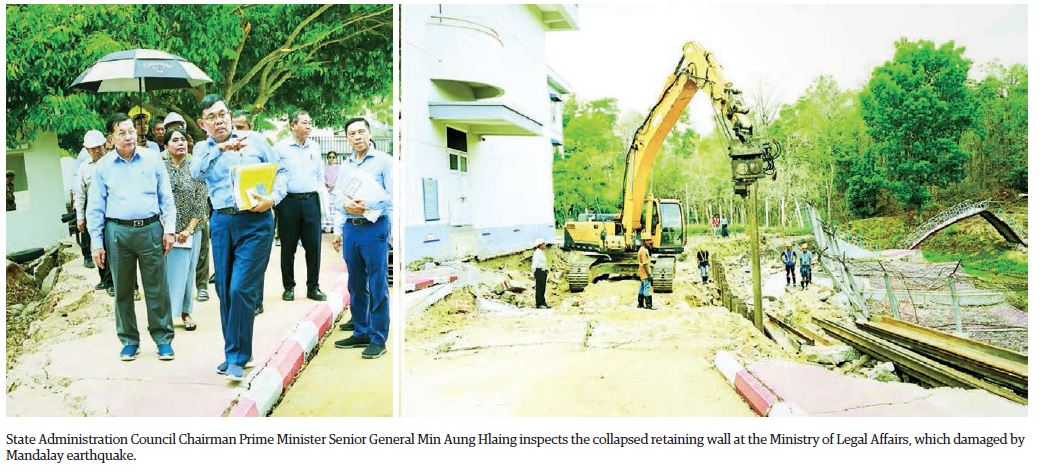
From the very moment the earth ceased its violent tremor, the nation’s highest leadership – headed by the Head of State and senior government officials – swiftly mobilized into action. They conducted immediate on-site inspections of the most severely affected areas and ensured that urgent humanitarian assistance was dispatched without delay. In close coordination with both domestic and international rescue organizations, they worked tirelessly to reach those trapped beneath the rubble and to carry out life-saving interventions with all possible haste.
Temporary shelters were promptly established for the displaced, providing a measure of safety and dignity amidst chaos. Meanwhile, the process of national recovery was set into motion with a structured, multi-phased approach aimed at restoring not only infrastructure but hope.
In the first phase, emergency repairs were undertaken on damaged roads, collapsed bridges, and vital infrastructure, enabling access and connectivity to the afflicted regions. The second phase focused on restoring essential services – communication lines, electrical grids, and water supply systems – thereby reestablishing the basic functionality of daily life.
Finally, in the third phase, structurally unsound buildings were carefully demolished, clearing the way for comprehensive reconstruction efforts. These were not mere restorations, but deliberate steps toward building resilient, long-lasting structures that could stand the test of time and nature.
This systematic response reflects not only the government’s resolve but also the enduring spirit of a people who, even in the aftermath of destruction, choose to rebuild – stronger, safer, and united.
Assistance was received from ASEAN and various international organizations, facilitating the acquisition of technology, expertise, and financial support. Myanmar’s unity and resilience were prominently highlighted in international media, underscoring the steadfast spirit of its people. To ensure sustainable long-term development, revised standards and benchmarks were established for the construction of earthquake-resistant infrastructure. Furthermore, training programs were conducted to enhance human resource capacity in natural disaster risk prevention and management. Efforts to restore religious and cultural heritage also served to uplift public morale, providing psychological strength to communities affected by the earthquake.
“Though the powerful earthquake, measuring 7.7 on the Richter scale, shattered roads, bridges, and sturdy edifices built of brick, stone, and steel into ruins, it found no foothold against the unbreakable spirit of the Myanmar people -- undaunted, unwavering, and unyielding amid the rubble.”
The State Administration Council is actively collaborating with the international community to expedite the restoration of damages caused by the earthquake and to build a more resilient and prosperous socio-economic system for the future.
Simultaneously, the State Government continues to advance peacebuilding efforts to resolve ongoing political challenges. Since February 1, 2021, there have been numerous unilateral ceasefire declarations by the Tatmadaw, reflecting a commitment to enduring peace. Following the devastating earthquake in Mandalay on 28 March, the military once again upheld ceasefire measures as a special priority, enabling focused efforts on reconstruction and the welfare of the people.
In furtherance of this commitment, the government convened the Peace Talk-2025 in March and the Peace Forum-2025 in June. These gatherings brought together a broad spectrum of stakeholders: members of the National Unity and Peace Coordination Committee; retired military officers; representatives of the Joint Monitoring Committee (JMC) overseeing ceasefire compliance; delegates from political parties; signatories of the Nationwide Ceasefire Agreement (NCA) from various ethnic armed organizations; dedicated peace practitioners; international guests; diplomats from foreign embassies; scholars and experts; media personnel; officials from union ministries and organizations; university professors; association delegates; and researchers. The broad participation and vigorous dialogue clearly demonstrate the government and people’s strong, shared aspiration for peace.
Accordingly, the Chairman of the State Administration Council and Prime Minister, Senior General Min Aung Hlaing, emphasized during these peace dialogues that, “Peace policies are the essence of the NCA and embody the accumulated wisdom gained through successive peacebuilding efforts. These are immutable truths that must be respected and upheld to consolidate the current peace process. Our ultimate national aspiration is to establish a ‘Union State’ founded on democracy and federalism.”
In light of this, despite the natural disasters confronting Myanmar and the internal and external sabotage threatening the unity of the Union, the government, military, and people are united – like a phoenix rising from the ashes – in their tireless efforts to strengthen the invaluable spirit of union. Together, we endeavour to transform the nation toward a brighter, more harmonious future.
Myanmar’s Future
The State Administration Council, grounded in the principle of a “Self-Reliance Policy,” is steadfastly working in close partnership with the people to build a prosperous and united Union of Myanmar. Looking ahead to December 2025, Myanmar is scheduled to hold a free and fair multiparty general election, representing a critical milestone in the ongoing pursuit of a federal democratic union.
The multiparty democratic system anticipated to emerge from this election is expected to facilitate the effective implementation of power-sharing and resource-sharing mechanisms through legislative institutions, thereby reinforcing the broader national peace process. Beyond its procedural significance, the election embodies the collective aspirations of the populace, representing a pivotal step toward inclusive governance and lasting stability.
The election holds the promise of revitalizing and advancing Myanmar’s distinct national identity, character, and core values, while laying the foundation for a future marked by inclusive growth and opportunity. Through this democratic process, Myanmar seeks to reaffirm its sovereign presence and articulate its national aspirations with clarity and dignity on the international stage.
The election will serve as a vibrant renaissance for Myanmar’s cherished values, restoring their brilliance to paint a hopeful future. The enhancement of these values is inseparable from the progress of Myanmar’s democratic development.
Given the current circumstances, this election cannot be regarded simply as routine. Rather, it represents the threshold to a future Union grounded firmly in democracy and federalism. Passing through this gateway, Myanmar will cultivate constructive political habits, resolving conflicts through dialogue and consensus-building around the political table, and will thus lay the foundations for unity and the elevation of national values.
The forthcoming election represents a critical juncture in Myanmar’s political trajectory, serving as a pivotal bridge toward the establishment of a democratic and federal Union. It may be aptly characterized as a ‘Gateway to Democracy,’ wherein collective aspirations coalesce to pave the way for a renewed and inclusive national future.
Myanmar’s Way — Myanmar’s Future
Myanmar’s path toward a stable and prosperous future is complex and fraught with challenges, requiring sustained commitment to navigate political, social, and economic obstacles while capitalising on emerging opportunities. At the heart of this endeavour lies the successful conduct of a free and fair multiparty democratic general election, which remains fundamental to the country’s democratic transition and long-term development.
As Myanmar progresses along its chosen trajectory toward the implementation of future national strategies, it is imperative to preserve and uphold the country’s historical legacy, foundational political values, economic potential, geographic centrality, religious and cultural heritage, and core social principles. Equally essential is the cultivation of a shared sense of civic responsibility, cooperation, social cohesion, and collective resilience among all citizens – elements that are indispensable to building a strong, unified, and enduring Union.
At this critical juncture, as Myanmar seeks to emerge from the turbulence of recent years, it is essential to embrace the rich diversity of its peoples and cultures as a foundation for national renewal. Advancing toward a stable, peaceful, and prosperous future will require a sustained commitment to inclusive development, harmonious coexistence, and the equitable pursuit of shared progress.
“To safeguard and breathe life into Myanmar’s timeless values and to honour the weight of its pivotal place on the world’s map, we must ignite a fierce patriotic flame and awaken the power of an Active Citizen. It is this very spirit that will rekindle the fading light of our cherished heritage, lifting ‘Myanmar values’ high once again – as we join hands and stride boldly toward the radiant dawn of our nation’s tomorrow.”