
The project using naturally growing plants and waste materials aims to generate employment opportunities for women by developing and manufacturing commercial products.
Green Banana Myanmar, located in the Nyaunghnapin Industrial Zone of Hmawby Township, Yangon, has developed a new type of loom to produce consumer goods from greater club-rush (Scirpus grossus), a species of weed, with the aim of selling the products at domestic and international trade fairs.
In ASEAN countries, commercial consumer goods are made from waste materials such as bananas, water hyacinth, bamboo, and cotton, and are displayed and sold at domestic and international exhibitions, which are especially popular with foreigners. Entrepreneurs from Myanmar have also collaborated with experts from the Weaving School to successfully develop a small weaving loom for producing consumer goods from greater club-rush, creating the first mat from this material and continuing production.
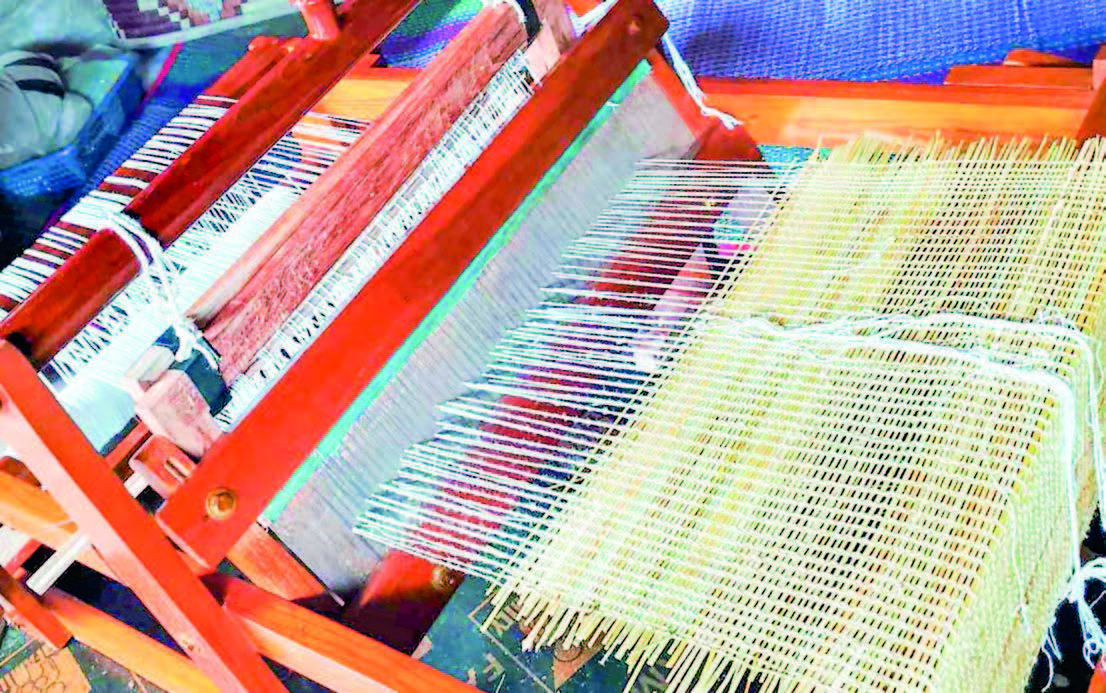
The loom is a small, tabletop device that can weave textiles from banana fibre, water hyacinth, bamboo, greater club-rush, and cotton.
“I saw consumer products made from greater club-rush at a trade fair in Thailand, and I decided to try making them in Myanmar, as the raw material is abundant. Although large looms exist, only two types of looms can be placed on a table for weaving, and we continue to produce these small looms. We are collaborating with a professional from the Weaving School, and it is fair to say that this is the first small loom invented in Myanmar. While other weavers have expressed interest, the looms are not for sale, as there is an ongoing need for small looms to produce consumer goods. We have also replaced iron with cotton rope for the weaving teeth and are striving to make our production comparable with that of ASEAN countries,” said U Myint Thein, founder of Green Banana Myanmar.
The small loom is designed for tabletop use and is easy to operate. It measures 3 by 2 feet in length, 2 by 1.5 feet in width, and stands two feet high. Made of wood, it comes in two types, and there are plans to produce cost-effective bamboo versions as well. The project aims to generate employment opportunities for women by developing and manufacturing commercial products from naturally growing plants and waste materials.
The small loom that was developed will be showcased at both domestic and international exhibitions to demonstrate the production of consumer goods. These demonstrations will highlight weaving techniques and innovation, while also showing how using waste materials in production reflects global cooperation in environmental conservation. — Thitsa (MNA)/TH